Veterans Day is a full-staff day. Fly the U.S. flag at full staff from sunrise to sunset unless a presidential or gubernatorial proclamation specifically orders half-staff for that date. The legal basis sits in U.S. Code Title 4, reinforced by VA guidance and The American Legion’s Flag Code explainer. Don’t confuse this with Memorial Day, which calls for half-staff until noon. Veterans Day honors the living; that distinction alone dictates the pole position.
TL;DR:
- Flags must be flown at full staff from sunrise to sunset on Veterans Day, unless a specific proclamation orders half-staff, which is rare for this holiday.
- The flag should be properly illuminated if displayed at night, and extreme weather conditions require bringing the flag down to prevent damage.
- The union always sits at the top left from the observer’s perspective, and the US flag must fly above other flags on a shared staff.
- Only the president or governors can issue half-staff orders, typically for deaths of officials or tragedies, with strict procedures to follow when lowering and raising the flag.
- Proper flag retirement and maintenance involve replacing damaged flags and following respectful disposal methods, such as burning, when the fabric no longer reads as red, white, and blue.
Table of Contents
- What Are the Veterans Day Flag Rules for Display Hours?
- Why Is the Flag Full-Staff on Veterans Day, Not Half-Staff?
- When Does the Flag Get Lowered to Half-Staff?
- How Do You Properly Lower a Flag to Half-Staff?
- What if You Can’t Follow Standard Flag Protocol?
- When Should You Retire an American Flag?
- About This Guidance
- Why Correct Flag Display Honors Veterans Best
- Get Your Flag Display Ready for Veterans Day
- Sources
- FAQ
What Are the Veterans Day Flag Rules for Display Hours?
The custom that governs most American flag display, civilian or official, is the sunrise-to-sunset window. Raise it briskly at dawn, lower it slowly and with dignity as the sun sets. That single rule causes more Veterans Day confusion than anything else, because families assume “all day” means dusk to dawn as well.
It doesn’t, unless you’ve solved for it. U.S. Code Title 4 permits nighttime display when the flag is “properly illuminated during the hours of darkness.” A porch light angled at the pole works. So does a dedicated flagpole light kit. Without illumination, bring it in when the sun goes down and put it back up in the morning.
Weather matters just as much as timing. A cotton or standard nylon flag shouldn’t be left out in driving rain, high wind, or snow unless it’s built and rated as an all-weather flag with reinforced stitching and heavier fabric. If a storm rolls through on November 11, take it down rather than risk fraying the fly end or snapping a cheap grommet.
Placement rules stay consistent whether you’re flying one flag alone or several:
- The union (the blue field with stars) always sits at the top left from the observer’s perspective, whether displayed vertically, horizontally, or in a window.
- On a single staff, the U.S. flag flies above any other flag, never below or beside it at equal height.
- When hung flat against a wall or in a window, the union goes to the flag’s own right, which reads as the viewer’s left when facing outward, and to the upper left when facing inward.
Getting the union position wrong is one of the most common mistakes among well-meaning households, right up there with leaving a flag up overnight unlit. Ultimate Flags breaks down the full mechanics of how to properly display and respect the American flag if you want the complete reference before Veterans Day arrives.
Why Is the Flag Full-Staff on Veterans Day, Not Half-Staff?
Veterans Day and Memorial Day get lumped together constantly, and the mix-up runs in one direction almost every time: people lower the flag on November 11 out of respect, when the law and the occasion call for the opposite.
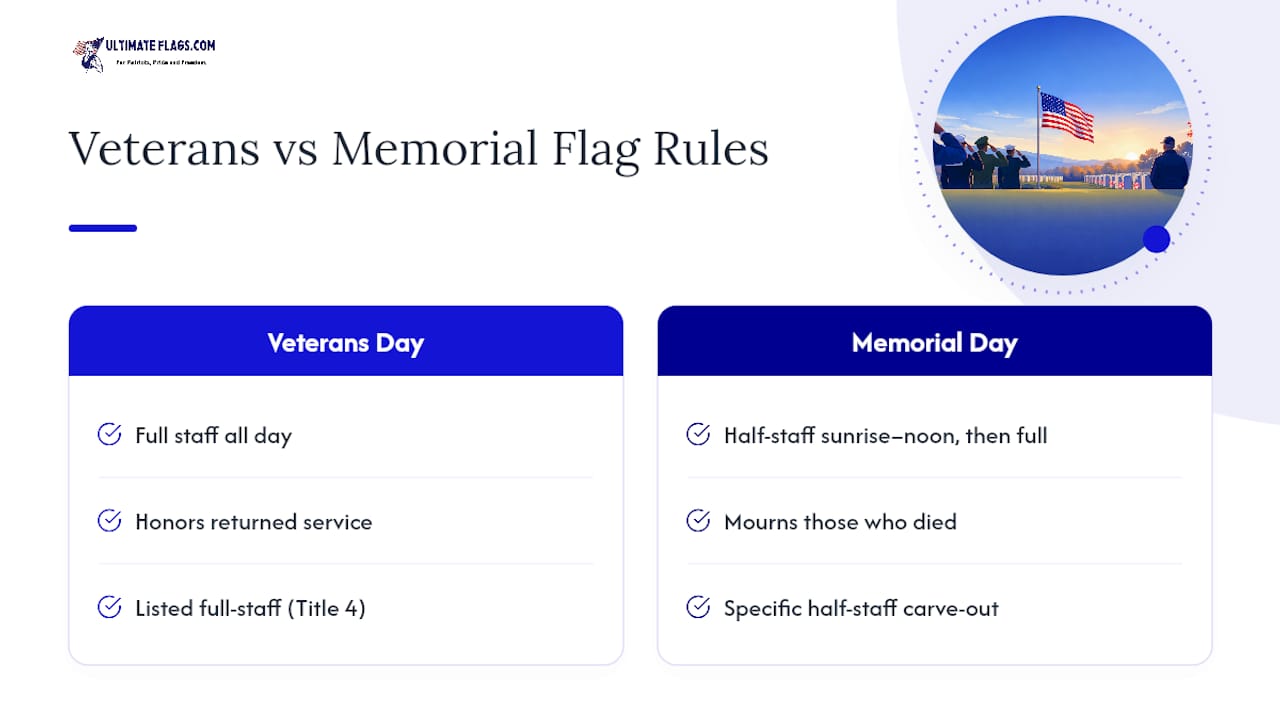
U.S. Code Title 4 lists Veterans Day among the days the flag should be displayed at full staff. Memorial Day gets its own specific carve-out: half-staff from sunrise until noon, then raised to the peak for the remainder of the day. That’s not an oversight in the statute. It’s the entire point.
Veterans Day honors every man and woman who served and came home. Memorial Day mourns those who did not. A flag at full staff on November 11 isn’t a lesser gesture, it’s the correct one, because the day celebrates survival and service, not loss.
The Flag Code functions as federal guidance rather than a criminal statute for private citizens, but it remains the authoritative source for official government buildings, military installations, and any organization that wants to get the etiquette right. States and the President retain the power to override the default with a specific proclamation, and when that happens, the proclamation wins. Absent one, full staff is the standing instruction, and The American Legion’s Flag Code summary confirms the same reading for civilians trying to get it right at home. If you want the exact procedural difference laid out for the other holiday, Ultimate Flags covers the Memorial Day half-staff-until-noon sequence in detail.
When Does the Flag Get Lowered to Half-Staff?
Half-staff isn’t a personal judgment call. It’s an authority-driven order, and only certain people can issue it.
- The President of the United States can order half-staff nationwide, typically following the death of a current or former federal official, a member of the Armed Forces killed in action, or a national tragedy.
- State governors can order half-staff within their own states, often for the death of a state official, a first responder, or a local tragedy that a governor determines warrants recognition.
- Statute-designated occasions trigger half-staff automatically every year without a new proclamation, including Memorial Day (sunrise to noon), Peace Officers Memorial Day on May 15, and Pearl Harbor Remembrance Day on December 7.
A governor’s proclamation applies within that state’s borders and doesn’t extend federal buildings elsewhere, which is why you’ll sometimes see flags at half-staff in one state and full staff in the next during the same week. Federal facilities follow presidential proclamations regardless of location. If your city hall or local VFW post has the flag lowered on a date that seems unusual, check your state’s official proclamations before assuming an error. The 4 U.S. Code § 7 provisions leave room for exactly this kind of layered authority, federal guidance sitting alongside state discretion.
How Do You Properly Lower a Flag to Half-Staff?
The sequence matters more than most people realize, and skipping the first step is the most common procedural error.
- Hoist the flag briskly to the peak first. Never raise it directly to the half-staff position. The flag has to touch the top of the pole, even briefly, before being lowered.
- Lower it slowly to the half-staff position, roughly the midpoint of the pole, and secure the halyard.
- At the end of the observance or at sunset, raise the flag back to the peak briefly before lowering it for the day. Skipping this step is the single most common half-staff mistake civilians make.
- When flying multiple flags on one halyard system, lower the U.S. flag to half-staff while any state, POW/MIA, or organizational flags below it adjust proportionally, maintaining the U.S. flag’s superior position throughout.
The VA’s own half-staff guidance PDF confirms this exact peak-lower-raise-lower sequence, and it applies whether you’re a groundskeeper at a federal building or a homeowner with a 20-foot residential pole.
Pro Tip: If you manage a flag for a school, VFW post, or small business and don’t handle the halyard often, do one dry run before the actual observance. Practicing the peak-to-half sequence once, with no audience, catches sticky pulleys and tangled rope before a live event does.
When genuine doubt exists about whether a specific date calls for half-staff, check your state government’s website or the federal register rather than guessing. Proclamations get issued with little advance notice sometimes, and following the actual order beats improvising.
What if You Can’t Follow Standard Flag Protocol?
Not every household has a 20-foot pole and a clear view of the horizon, and that’s fine. The Flag Code accounts for real-world constraints, and there are dignified workarounds for nearly every obstacle.
- No flagpole: Display the flag flat against a window or wall with the union in the upper left corner as seen by someone outside looking in. A wall-mounted bracket staff works well for porches and doorways too.
- Bad weather: Never leave a standard cloth flag out in driving rain, sleet, or high wind. Bring it inside and fly it the next clear day rather than risk shredding the fabric or bending a cheap pole.
- Damaged flag: A small tear along a seam can sometimes be repaired by a tailor or flag specialist, but a flag with holes, heavy fraying, or faded colors that no longer read as red, white, and blue has reached the end of its service and should be retired, not repaired past the point of dignity.
- No union-side clarity indoors: When in doubt about orientation on a wall display, remember the union sits to the flag’s own right, which lands at the viewer’s left when the flag faces outward toward a street or sidewalk.
None of these workarounds are lesser gestures. A flag displayed correctly in a window honors Veterans Day exactly as much as one flying from a commercial pole outside city hall.
When Should You Retire an American Flag?
A flag earns retirement the same way a uniform does: through honest wear, not neglect. Watch for these signs that it’s time.
- Frayed edges or a ragged fly end that no longer holds a clean rectangular shape.
- Holes or tears anywhere in the field or stripes, even small ones that will only spread with continued use.
- Faded colors where the blue has gone gray or the red has washed to pink, since that fading signals the fabric itself is breaking down.
- Bent or rusted grommets that no longer hold securely to a halyard or pole clip, risking loss of the flag in wind.
The VA’s flag display guidelines recommend dignified burning as the preferred retirement method, typically performed by veterans’ organizations, Scout troops, or American Legion posts that hold formal retirement ceremonies. Many communities collect worn flags at fire stations, VFW halls, or Legion posts specifically for this purpose, so you don’t need to perform the ceremony yourself. Ultimate Flags outlines the full range of retirement methods, including when burning, burial, or approved recycling programs apply.
Basic maintenance extends the life of any flag well before retirement becomes necessary: gentle machine washing on cold, air drying flat, and periodic inspection of grommets and header stitching catch small problems before they become reasons to retire a flag early.
About This Guidance
This guide draws its authority from U.S. Code Title 4, VA display and half-staff guidance, and The American Legion’s Flag Code summary, the three sources that govern nearly every civilian and official flag question in the United States. Ultimate Flags has operated as one of the country’s longest-running online flag retailers, and its practical guides exist to translate statutory language into steps a homeowner, veteran, or small organization can actually follow on November 11. The article is written by John Hough for Ultimate Flags.
For readers who want a deeper dive on any single piece of this etiquette, Ultimate Flags maintains dedicated resources on Veterans Day display requirements, flagpole types and footing, and full display and respect guidelines for anyone setting up a pole for the first time this season.
Why Correct Flag Display Honors Veterans Best
A flag flown correctly says something a lowered flag, flown by mistake, cannot. Veterans Day exists to thank the men and women who wore the uniform and came home, and full staff is the visual language of that gratitude, not an oversight waiting to be corrected. Good intentions don’t excuse getting the gesture backward.
I’d rather see a homeowner check the U.S. Code once than trust a half-remembered rule from a neighbor’s yard. The etiquette isn’t complicated once you know it, and getting it right costs nothing but a few minutes of attention. If your flag itself has seen too many seasons to represent that gratitude with dignity, that’s worth fixing before November 11 arrives.
— John Hough
Get Your Flag Display Ready for Veterans Day
An experienced online flag retailer offers a catalog built for exactly the situations this guide covers. Need a full-size replacement before the fabric on your current flag gives out, or an all-weather option that can actually handle a November storm without coming down early? Ultimate Flags carries USA flags, military and service flags, and flagpole hardware in the sizes and durability grades that match real display conditions, not just decorative ones.

If your pole itself needs attention rather than the flag, from finials to footing to rope replacement, Hardware resources cover the practical side of keeping a display dignified year-round. Browse the flag and flagpole collection now and have everything in place well before sunrise on November 11.
Sources
The etiquette rules in this article come directly from the following authoritative sources:
- 4 U.S. Code § 6 – Time and occasions for display
- Guidelines for display of the flag (VA)
- U.S. Flag Code: Display, Respect & Proper Use | The American Legion
FAQ
Is it appropriate to fly the flag on Veterans Day?
Yes. Veterans Day is one of the specific days U.S. Code Title 4 lists for flag display, and flying it at full staff from sunrise to sunset is the correct, encouraged practice for homes, businesses, and government buildings alike.
Do flags need to be lowered for Veterans Day?
No, flags stay at full staff all day on Veterans Day unless a specific presidential or gubernatorial proclamation orders half-staff for that date. That’s the opposite of Memorial Day, which calls for half-staff until noon under the same statute.
Is it proper to salute the flag if you’re not a veteran?
Civilians aren’t required by law to render the military salute. The accepted civilian response during hoisting, lowering, or a passing flag is to stand at attention facing the flag with the right hand over the heart, as described in 4 U.S. Code § 9.
What is the only flag allowed to fly above the American flag?
On U.S. soil, no other flag is flown higher than or above the American flag on the same staff. In specific United Nations contexts covered separately by the Flag Code, the UN flag may occupy a position at the same height on an adjoining staff, but this exception doesn’t apply to typical civilian or municipal displays.
Does Ultimate Flags sell flags suited for year-round outdoor Veterans Day display?
Ultimate Flags carries USA flags, military and service flags, and flagpole hardware built for outdoor conditions, including options suited to extended or all-weather display. Current pricing and sizing details are available on the flag collections page.