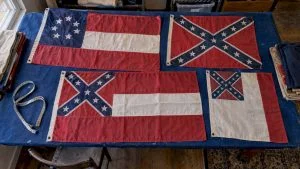
The Southern Cross, for shopping purposes, is the Confederate battle flag design: a blue diagonal saltire edged in white on a red field, usually set with thirteen stars. This guide walks you through identifying genuine patterns, choosing materials and sizes, and checking display rules before you buy. We draw on museum records and historical scholarship to help you shop with confidence and respect for what this banner represents.
TL;DR:
- The Confederate battle flag’s stars typically number thirteen, but variations with fewer stars exist depending on the unit and historical period.
- The flag’s size and proportions vary by use, with outdoor flags needing durable polyester or nylon for weather resistance, and cotton suited for indoor displays.
- Federal and state rules restrict display on public land, with exceptions limited to museums, cemeteries, or historical contexts, requiring prior permission.
- The term “Southern Cross” also refers to a star constellation unrelated to the Confederate flag, which can cause confusion in searches or discussions.
- The flag was never the official national banner but served solely as a military insignia, with its design created to improve battlefield visibility.
Table of Contents
- 1. How to Identify the Southern Cross Pattern and Its Historic Variants
- 2. Buying Guide: Materials, Sizes, Finishing, and Recommended Uses
- 3. Display, Venue, and Legal Considerations Before You Fly One
- 4. Cultural Significance and Symbolism in Different Countries
- 5. Southern Cross Constellation Versus the Flag’s Design
- 6. The Southern Cross in Contemporary Media and Popular Culture
- 7. Common Misconceptions and Controversies Surrounding the Flag
- Publisher Perspective: Supporting Informed, Responsible Shoppers
- Find the Right Southern Cross Flag for Your Collection
- FAQ
- Sources
1. How to Identify the Southern Cross Pattern and Its Historic Variants
Before you add a flag to your cart, look closely at what the image actually shows. The National Museum of American History describes the Confederate battle flag, the Southern Cross, as a dark blue diagonal cross set against a red field, trimmed in white, with stars arranged in a count that identified specific units during the war. In the Smithsonian’s own catalog example, three stars sit on each arm of the cross and one rests at the center, a pattern that has become the version most reproductions follow today.
That said, wartime flags were never perfectly uniform. According to Encyclopedia Virginia, the battle flag was developed in 1861 specifically to solve a battlefield problem: the Confederacy’s first national flag, the Stars and Bars, looked enough like the Stars and Stripes to cause confusion through smoke and distance. The battle flag that emerged, and that we now call the Southern Cross, was never the Confederacy’s official national flag at all. It flew as a military banner, and its size, star count, and edging shifted depending on the unit, the branch of service, and the year it was made.
Before you buy, run through a short checklist so you order what you actually want:
- Confirm the saltire is blue on a red field with white edging, not a variant with different colors or a different cross shape.
- Count the stars in the product photo; thirteen is standard, but some historical reproductions use fewer to match a specific unit.
- Check whether the listing specifies “battle flag,” “Second Confederate Navy Jack,” or another historical name, since sellers sometimes blur these terms.
- Look for whether the flag is square (a common infantry proportion) or rectangular, since this changes how it displays.
2. Buying Guide: Materials, Sizes, Finishing, and Recommended Uses
Choosing the right flag starts with asking where it will live. A flag meant to fly outdoors in wind and rain has different requirements than one destined for a den wall or a reenactment camp.
- Pick your material based on exposure. Polyester and nylon resist fraying and fading in sun and wind, making them the practical choice for a flagpole that flies year round. Cotton gives a muted, textured look closer to period originals, but it wears out fast outdoors and suits indoor or display-only settings better.
- Match the size to the purpose. Small hand flags and miniature grave markers suit memorial and cemetery use. Mid-size three-by-five options fit standard residential poles, while larger banner-style flags work for wall displays or reenactment camp settings where a bigger visual statement makes sense.
- Check the finishing details. Grommets and sturdy headers hold up to repeated raising and lowering on a pole. Sewn edges and double-stitched hems resist fraying in wind far longer than a flag with simple cut edges.
- Think about who the flag is really for. Collectors and reenactors usually want a flag that mirrors a documented historical pattern, star count, and proportion. Shoppers looking for a decorative piece for a porch or a man cave have more flexibility to choose by color and size alone.
Care matters as much as the initial purchase. Polyester flags rinse clean with water and air dry quickly, while cotton reproductions need gentler handling, often a hand wash and a flat dry, to avoid shrinking or distorting the weave. For both materials, storing a flag folded and dry, away from direct sunlight, keeps colors from fading between uses. Our own comparison of cotton and polyester options breaks down the tradeoffs further if you want to go deeper before you decide.
Pro Tip: If you are unsure whether to size up or down, a flag slightly smaller than your pole’s maximum recommended size will hold up better in strong wind than one cut to the limit.
3. Display, Venue, and Legal Considerations Before You Fly One
Buying the flag is the easy part. Where and how you display it carries real legal weight, and the rules are not the same everywhere.
At the federal level, the Congressional Research Service summarizes that most federal property generally restricts flying Confederate flags, though narrow, contextual exceptions exist. National Park Service sites and Veterans Affairs cemeteries sometimes permit limited historical displays, such as grave decorations tied to a specific observance or flags used within museum interpretation, but these exceptions are conditional and typically require a sponsoring organization or written permission in advance.
State and local rules add another layer, and they vary widely. Florida offers a useful illustration: its statute on Confederate flag use restricts copying or using the design for commercial advertising within the state, while still allowing decorative and patriotic exceptions, and it separately prohibits the mutilation or public disrespect of Confederate flag replicas.
One in a handful of federal policy carve-outs covers cemetery and museum contexts specifically, according to the Congressional Research Service, underscoring how narrow these exceptions really are compared to general public display.
Before you commit to flying a flag anywhere beyond private property, work through this short list:
- Check the specific venue’s written policy, since federal, state, and private property rules all differ.
- Ask property managers or HOA boards directly rather than assuming a flag is welcome.
- Avoid flying one on public or federal land without documented permission.
- Secure written approval in advance for any display tied to an interpretive or commemorative event.
4. Cultural Significance and Symbolism in Different Countries
It is worth pausing on a point of confusion shoppers sometimes raise: the name “Southern Cross” also belongs to a star pattern, the constellation Crux, which carries entirely separate meaning in countries like Australia and New Zealand. There, the Southern Cross constellation appears on national and state flags as a navigational and cultural symbol tied to the Southern Hemisphere sky, unrelated to the American Civil War.

That is a different symbol with a different history, and this guide does not cover it. The flag we are discussing here, the one sold under names like “Southern Cross flag” or “Confederate battle flag,” belongs to a distinct American historical and cultural context rooted in the Civil War and its aftermath. If you encounter the term used in an astronomical or Pacific-nation context while researching your purchase, you have crossed into unrelated territory, and it is worth double-checking any listing that seems to blend the two to avoid confusion about what you are actually buying.
For our purposes as a flag retailer, the name “Southern Cross” refers consistently to the Confederate battle flag design, and every identification tip in this guide applies to that meaning alone.
5. Southern Cross Constellation Versus the Flag’s Design
Because the name overlaps with a star formation, it helps to separate the two clearly. The constellation Crux, often called the Southern Cross in casual speech, is a cluster of stars visible primarily from the Southern Hemisphere, used historically for navigation. It has no design relationship to the Confederate battle flag beyond sharing a name rooted in cross-shaped imagery.
The Confederate battle flag’s saltire, meanwhile, was a deliberate military design choice. As Encyclopedia Virginia notes, its diagonal blue cross on red was built for battlefield visibility, not for any symbolic reference to a star pattern. The stars placed on the saltire’s arms represented Confederate states, not literal constellations.
Shoppers occasionally see the two conflated in casual conversation or in search results, since both share the phrase “Southern Cross.” When you are browsing for a flag tied to American Civil War history, the saltire pattern described earlier in this guide, not any astronomical chart, is what you want to confirm in the product photos. Confusing the two risks landing on an entirely unrelated product, whether that is a novelty astronomy print or a flag from a different country altogether.
6. The Southern Cross in Contemporary Media and Popular Culture
The Confederate battle flag has appeared across decades of American film, television, and music, often as shorthand for Southern identity, rebellion, or regional pride, depending on the storyteller’s intent. Its visual simplicity, that bold blue saltire on red, makes it instantly recognizable even to viewers unfamiliar with Civil War history.
That recognizability is part of why the flag remains controversial in media depictions. National Geographic traces how portrayals shifted over the twentieth century, with the flag increasingly read as a political statement rather than a neutral regional marker. Scholarship summarized by Harvard University Press on John Coski’s research points to the mid-twentieth century, particularly the Civil Rights era, as the period when the flag’s modern political associations intensified well beyond its original battlefield context.
For shoppers, this cultural weight means context matters. A flag purchased for a Civil War reenactment carries a different intended message than one flown from a truck or displayed at a public rally, even though the physical object is identical. We encourage every buyer to think through how a chosen display setting will read to the people who see it, since the same banner can carry very different meanings depending on where and how it appears.
7. Common Misconceptions and Controversies Surrounding the Flag
One persistent misconception is that the Southern Cross was the Confederacy’s official national flag. It was not. As Encyclopedia Virginia documents, it served as a military battle flag, distinct from the Stars and Bars and the later national flags the Confederate government adopted.
Another common assumption is that the flag has always carried a single, settled meaning. Scholarship summarized by Harvard University Press on Coski’s work makes clear this is not the case: the flag’s meaning has shifted across generations, and its association with white supremacist movements grew substantially during the twentieth century, layered on top of earlier Civil War and “Lost Cause” framing. National Geographic covers this same trajectory in detail, noting that some Americans view the flag primarily as a heritage symbol while others see it as inseparable from slavery and racial oppression.
A third misconception involves legality. Owning or displaying the flag on private property is broadly protected, but as the Florida statute and federal policy summaries above show, commercial use, public land display, and treatment of the physical object can all carry specific legal restrictions depending on where you are. We think the most responsible approach for shoppers is to recognize this complexity honestly rather than assume one interpretation applies universally, and to make display decisions with that complexity in mind.

Publisher Perspective: Supporting Informed, Responsible Shoppers
We built this guide because so many shoppers arrive searching for a Southern Cross flag without a clear sense of what they are actually looking at or where they can display it. We have spent years cataloging historical flags, from Revolutionary War banners to Civil War battle flags, and writing about the people and events behind them.
A few resources we point readers toward when they want to go deeper:
- Our historical article on the men who carried the battle flag for the human story behind the symbol.
- Our cotton versus polyester comparison for material decisions.
- Our flagpole guide for anyone planning to fly a flag outdoors.
| Resource type | What it covers |
|---|---|
| Historical article | Stories of the color guard and battle flag origins |
| Material comparison | Cotton versus polyester tradeoffs for display |
| Flagpole guide | Pole types and footing rules for outdoor display |
We encourage every shopper to verify venue rules before flying a flag publicly, and to treat the educational pages above as a starting point for matching the right product to the right context.
— John Hough
Find the Right Southern Cross Flag for Your Collection
We carry an extensive catalog of historical and regional flags, and our flag collections page is the fastest way to browse Confederate-themed options alongside military, state, and historic war flags.

Once you have chosen a flag, you can explore options for sizing questions or custom requests that fall outside standard dimensions, since not every display setting fits a stock size. If you are decorating a space that calls for complementary vintage pieces, partners like ArtFuzz’s vintage Southern Railway sign offer decor that pairs well with historical flag displays.
A few starting points:
- Browse Confederate and Southern heritage reproductions on the flag collections page.
- Contact customer service for custom sizing or finishing requests.
- Check the flagpole guide if you need hardware to match your new flag.
Ready to find the right piece for your collection? Visit our flag collections to get started.
FAQ
What does the Southern Cross flag actually look like?
The Southern Cross is a blue diagonal saltire edged in white on a red field, typically set with thirteen stars according to the Smithsonian’s catalog description. Star counts and proportions varied slightly by military unit during the Civil War.
Was the Southern Cross the official Confederate national flag?
No, it was not. According to Encyclopedia Virginia, it served as a battle flag for Confederate military units and was developed in 1861 to avoid battlefield confusion with the United States flag.
Can I legally fly a Southern Cross flag on public property?
It depends heavily on the location. The Congressional Research Service notes that federal property generally restricts display with narrow, conditional exceptions, and state laws like Florida’s statute add further restrictions on commercial use and treatment of the flag.
What material holds up best for an outdoor Southern Cross flag?
Polyester and nylon resist fading and fraying far better than cotton when flown outdoors regularly. Cotton suits indoor or collector display where period authenticity matters more than weather resistance.
Is the Southern Cross flag the same as the Southern Cross constellation on Australian flags?
No, these are unrelated symbols that happen to share a name. The Confederate battle flag’s saltire design has no connection to the Crux constellation that appears on flags in Australia and New Zealand.
Sources
- Confederate battle flag – National Museum of American History
- Confederate battle flag – Encyclopedia Virginia
- How the Confederate battle flag became a symbol of racism – National Geographic
- Confederate symbols: relation to federal lands and programs – Congressional Research Service
- The Confederate Battle Flag — Harvard University Press