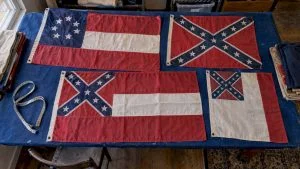
Mississippi has had three official state flags: the 1861 “Magnolia” flag, the 1894 flag (which carried the Confederate battle emblem), and the 2020 to 2021 “New Magnolia” flag approved by referendum and enacted into law in January 2021. The 1894 banner was retired that same year after a legislative commission was tasked with crafting a replacement, one that excludes Confederate imagery entirely. The flag flying over the state today bears a white magnolia, twenty stars, a lone gold star honoring the region’s original inhabitants, and the words “In God We Trust.”
TL;DR:
- The 1894 Mississippi flag, which included the Confederate battle emblem, was legally recognized despite a 1906 omission that made it technically unofficial until court rulings around 2000.
- The 1906 legal gap prompted a 2001 commission and a referendum that kept the old flag in place despite questions about its legality.
- Growing national protests and economic concerns from 2015 to 2020 accelerated the removal of Confederate symbols, leading to the 2020 legislative decision to retire the 1894 flag.
- The new “New Magnolia” flag was selected through a public process, approved by voters in November 2020, and features a magnolia, twenty white stars, a gold star, and the words “In God We Trust.”
- The current flag’s symbolism emphasizes vigilance, justice, heritage, and respect for indigenous peoples, replacing divisive Confederate imagery with unifying symbols.
Table of Contents
- Flags That Flew Before Statehood
- The Magnolia Flag of 1861 and Its Short Life
- Why the 1894 Flag Carried the Confederate Emblem
- The 1906 Omission That Left the Flag in Limbo
- The 2001 Commission and a Referendum That Preserved the Old Flag
- Renewed Pressure From 2015 to 2020
- How Mississippi Chose Its New Flag
- What the New Magnolia Flag Represents
- A Publisher’s Note on Preserving This History
- Where to Read the Original Records
- Sources
- FAQ
Flags That Flew Before Statehood
Long before Mississippi joined the Union, its soil answered to foreign crowns and rival claims, each leaving a symbolic mark that would echo, faintly, in the state’s later banners. The Gulf coast bent under Spanish rule for generations, its skies marked by the Bars of Aragon. British colonial power raised the Red Ensign over disputed territory, while French explorers staked their own claims inland.
- Spain governed portions of the coast under the Bars of Aragon before ceding control.
- Britain flew the Red Ensign during its colonial administration of the region.
- France asserted early territorial claims across the Mississippi valley.
- The short-lived Republic of West Florida flew the Bonnie Blue flag, a single white star on a blue field, a motif that would resurface with fierce symbolic weight during secession.
That lone-star imagery, along with the state’s beloved magnolia blossom, had already rooted itself in Mississippi’s visual imagination by the time secession forced the question of an official banner in 1861. The evolution of American flags across this era shows how borrowed motifs became distinctly regional symbols.
The Magnolia Flag of 1861 and Its Short Life
When Mississippi seceded in January 1861, a legislative committee moved swiftly to give the new republic a banner worthy of the moment. The result, adopted that same year, became known as the Magnolia Flag: a white field bearing a magnolia tree at its center, a blue canton holding a single white star in the corner, and a red bar along the fly end. It was a flag meant to declare sovereignty in unmistakable terms, drawing on the Bonnie Blue’s lone star while planting the state’s own botanical emblem at its heart.
In practice, the Magnolia Flag saw limited use. Confederate national flags and regimental battle standards dominated the battlefield and the public eye, leaving Mississippi’s own banner as more a ceremonial statement than a widely flown emblem. Its legal life proved just as brief. When Mississippi’s constitutional convention met in 1865 to reckon with defeat and reconstruction, the delegates repealed the 1861 flag law, and the Magnolia Flag slipped out of official existence almost as quickly as it had entered it, a footnote awaiting rediscovery generations later.
Why the 1894 Flag Carried the Confederate Emblem
Nearly three decades passed before Mississippi settled on a new official banner, and when it did, the choice carried unmistakable political weight. The legislature’s 1894 statute described a flag of three horizontal bars, blue, white, and red, with a canton in the upper left bearing the Confederate battle emblem’s square blue cross and thirteen stars. Governor John M. Stone presided over a state still negotiating its identity after Reconstruction, and the design reflected that negotiation directly.
Historical analysis ties the 1894 adoption to the currents of its era: veterans’ organizations pressing to enshrine their cause, and a broader political effort to consolidate a Confederate-centered regional memory into the state’s official symbols, as Mississippi History Now documents. The flag was never a neutral choice of colors and geometry. It was a deliberate act of memory politics, stitched into law at a moment when the state’s white political establishment sought to cement a particular narrative of the past.
The 1894 flag’s adoption reflected the post-Reconstruction politics of veterans’ memory and regional identity consolidation rather than a simple aesthetic decision.
That origin would haunt the flag for the rest of its 126-year run, fueling controversy that intensified with each passing decade even as the banner became, for many, simply “the Mississippi flag” through sheer familiarity.
The 1906 Omission That Left the Flag in Limbo
In 1906, the state undertook a wholesale revision of its legal code, and in the process of consolidating statutes, lawmakers omitted the 1894 flag law entirely. For nearly a century, Mississippi flew a banner that custom and habit sustained, but that no living statute actually authorized, a quiet legal vacancy hiding in plain sight atop every courthouse and schoolhouse in the state.

The gap went largely unnoticed until the 1990s, when legal challenges, including a suit brought with NAACP involvement, forced the courts to confront the question directly. Civic debate sharpened as Mississippians began asking not just whether the flag should change, but whether it legally existed at all. The Mississippi Supreme Court ultimately found, around 2000, that the state technically lacked an official flag due to the 1906 omission, a finding that landed with the force of revelation even though the underlying facts had sat dormant in the code for generations. That ruling did not erase the 1894 banner from public buildings, but it cracked open the door for the commissions and reform efforts that followed.
The 2001 Commission and a Referendum That Preserved the Old Flag
The Supreme Court’s finding prompted state leaders to convene an advisory commission in 2001, charged with proposing a formal successor. The commission held public hearings, drew input from schools and civic organizations, and ultimately proposed a new design replacing the Confederate canton with a circle of stars, paired with legislative language protecting the 1894 flag’s continued display as a historical artifact regardless of the outcome.

Voters went to the polls that April, and the result surprised few who had watched the debate unfold along familiar lines: the electorate chose to retain the 1894 flag, with voting patterns splitting sharply along racial and political lines that mirrored the state’s broader divisions. The old banner, legally shaky or not, would fly for nearly two more decades.
Renewed Pressure From 2015 to 2020
The 2015 shooting at Emanuel African Methodist Episcopal Church in Charleston reshaped the national conversation around Confederate symbols almost overnight, and Mississippi felt the aftershocks directly. Universities across the state began lowering the 1894 flag from their campuses, and several municipal governments followed with their own removals, choosing not to wait for Jackson to act.

Business and civic leaders added a pragmatic argument to the moral one, warning that the flag’s Confederate emblem carried real reputational and economic costs for a state courting investment and talent. That pressure built steadily through the following years until the summer of 2020, when a wave of national protest gave the legislature the momentum it needed. In June 2020, lawmakers passed House Bill 1796, retiring the 1894 flag outright and establishing a commission to design its replacement, a decisive break after decades of stalemate.
How Mississippi Chose Its New Flag
The Commission to Redesign the Mississippi State Flag moved with unusual speed once House Bill 1796 became law. Its mandate was clear from the outset: no Confederate emblem would appear on the new design, and the words “In God We Trust” were required by statute. Within that framework, the commission opened the process to the public, soliciting design submissions and gathering testimony at meetings held across the state, as MDAH’s commission records detail.
- The commission collected public submissions and narrowed the field across multiple review rounds.
- Design consultant Clay Moss briefed the commission on flag design principles, favoring simplicity and clear symbolism.
- Two finalists emerged for public consideration, including a design known as “Great River” alongside the eventual winner.
- The commission selected the “New Magnolia” design, branded with the phrase “In God We Trust,” and placed it on the November ballot.
Voters approved the New Magnolia design by a wide margin in the November 3, 2020 referendum, clearing the path for legislative action. Mississippi credits the design to Rocky Vaughan, with contributions acknowledged from Sue Anna Joe, Kara Giles, Dominique Pugh, and Micah Whitson, a genuinely collaborative act of civic artistry rather than the work of a single hand. The legislature ratified the choice through House Bill No. 1, and the governor signed the New Magnolia flag into law in January 2021, closing a chapter that had opened with the Supreme Court’s finding two decades earlier.
What the New Magnolia Flag Represents
The statute describing Mississippi’s current flag is precise about its imagery: a white magnolia blossom at the center, encircled by twenty white stars representing Mississippi’s status as the twentieth state, and a single gold star honoring the indigenous peoples who called the land home before statehood, as Britannica’s summary records.
- The blue field is commonly associated with vigilance, justice, and perseverance.
- Red stands for hardiness and valor, echoing the color’s traditional military meaning.
- Gold represents the state’s cultural heritage, tying the emblem to the land’s deeper history.
- The words “In God We Trust” appear beneath the magnolia, a statutory requirement rather than a decorative flourish.
Official artwork for the flag is published through the state’s own channels, and the design remains free of any proprietary restriction on civic or educational use.
A Publisher’s Note on Preserving This History
Flags carry the weight of the moments that shaped them, and Mississippi’s three banners tell a story no single image could hold alone: colonial ambition, secession’s defiance, a century of contested memory, and finally, a hard-won consensus forged in public. We appreciate the long history of online flag retailers and treat the history of flags with the seriousness it deserves, whether a collector is drawn to the new state banner or to the historical flags that came before it. Responsible collecting means understanding what a flag meant in its own time, not just what it looks like on a pole. Readers curious about historical flags and their designs will find that context matters as much as the fabric itself.
— John Hough
Where to Read the Original Records
- MDAH’s commission announcement covers the New Magnolia selection and design credits directly from the state archive.
- The MDAH commission page holds meeting records and the full redesign timeline.
- Mississippi History Now offers scholarly context on the 1894 flag’s political origins.
- Britannica documents the current flag’s statutory symbolism in full.
Sources
- Flag of Mississippi | Britannica
- State Flag Commission Picks New Magnolia Flag for November Ballot | Mississippi Department of Archives & History
- Commission to Redesign the Mississippi State Flag | Mississippi Department of Archives and History
- The History of Mississippi’s State Flag — Mississippi History Now
FAQ
Why did Mississippi change its state flag?
Mississippi retired its 1894 flag in 2020 because its canton carried the Confederate battle emblem, a symbol tied to renewed national scrutiny following the 2015 Charleston church shooting and years of campus and municipal removals. The legislature passed House Bill 1796 that June, retiring the flag and creating a commission to design a replacement without Confederate imagery.
Why are there 21 stars on the Mississippi flag?
The current flag actually carries twenty white stars plus one gold star, not twenty-one as separate elements of the same kind. The twenty white stars represent Mississippi’s admission as the twentieth state, while the single gold star specifically honors the region’s indigenous peoples.
What U.S. state has the oldest continuously used flag?
Flag histories vary by state, and “oldest” often depends on whether the measure is continuous design or original adoption date. Mississippi’s own record shows three distinct official flags across its history, the Magnolia flag of 1861, the 1894 flag, and the New Magnolia flag adopted in 2021, making it a poor candidate for that title.
What state flag resembled a Confederate flag before being changed?
Mississippi’s flag from 1894 until 2020 incorporated the Confederate battle emblem directly into its canton, making it the most prominent example of a state flag built around that specific imagery. The state replaced it with the New Magnolia design after a November 2020 referendum and legislative enactment in January 2021.