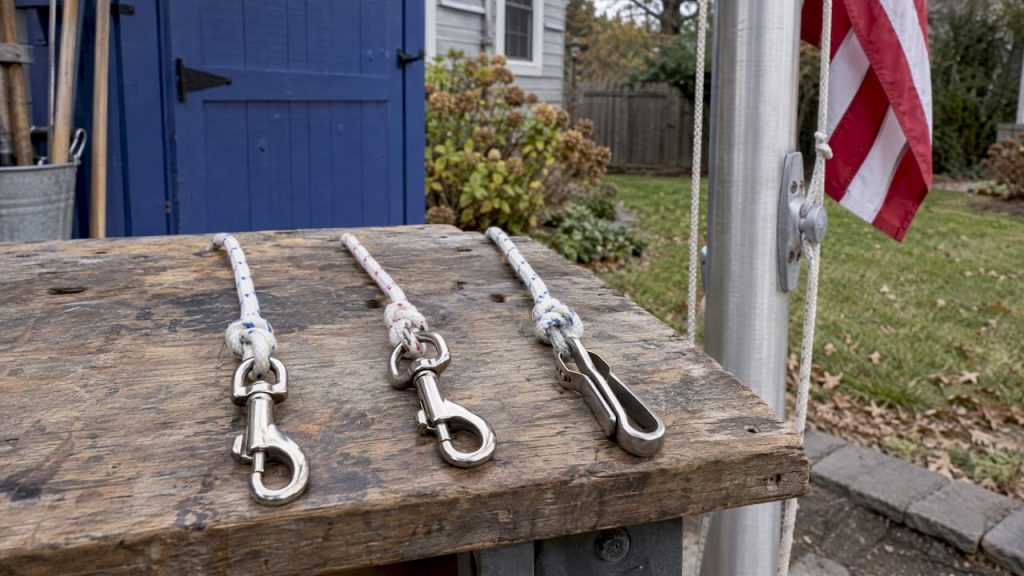
A flag is only as secure as the small piece of hardware that joins it to the halyard, the rope that runs up the pole. The main types are snap hooks (including swivel snaps), sister clips, and clamp-style fasteners for poles without a rope. Each comes in nylon, brass or stainless steel, and the right pick depends on your flag’s size, your pole and the weather it will face. Below, we walk through each type, what it is made of and how to match it to your display. Our hardware and flagpole collection carries the hardware that goes with the flags we sell.
TL;DR
- Snap hooks are the everyday choice: a spring-loaded gate clips onto the flag’s grommet (the metal-ringed hole in the heading) and onto the halyard.
- Swivel snaps add a rotating eye so the flag can turn with the wind without twisting the rope around itself.
- Sister clips (Inglefield clips) have no moving parts, a design with a long naval history.
- Material follows place: nylon for quiet, light residential use, brass for a classic look, stainless steel for coastal air and heavy wind.
- Match the hook to the grommet and flag size, then check it each season for wear.
Table of Contents
- What flag clips do, and what they are called
- The main flag clip types
- Comparing the types at a glance
- Choosing the material
- Matching the hook to your flag and pole
- Which hook for which display
- Routine care for flag hardware
- Promo: flags worth flying properly
- Perspective: the hook is part of the tribute
- FAQ
- Sources
What flag clips do, and what they are called
The words are used loosely. Flag clips, flag snaps, snap hooks, swivel snaps and halyard clips all describe hardware that connects a flag to a rope. When people ask what the hooks on a flagpole are called, they usually mean this: the snap hooks tied or sewn on the halyard, or attached to the flag itself.
A traditional external-halyard pole works like this. The rope loops through a pulley at the top of the pole. You attach the top corner of the flag to the upper part of the rope and the bottom corner to the lower part, then haul it up hand over hand. Both attachment points carry load every time the wind gusts, so the hardware is not a place to economize carelessly.
If you are still deciding on the pole itself, our guide to flagpole types and footing rules explains which setups use a halyard and which do not.
The main flag clip types
Standard snap hooks
The snap hook is the workhorse. A spring-loaded gate opens when you press it, closes when you let go, and keeps the flag from slipping free. One hook usually goes on each grommet. Because the gate closes on its own, it is quick to use on a pole you raise and lower daily, such as a ceremonial display at a post, a school or a home.
Swivel snap hooks
A swivel snap is a snap hook with a rotating joint between the gate and the eye that ties to the rope. In steady wind, a flag often turns around the halyard. Without a swivel, that turning can wind the rope tight around the pole or around itself, and the flag stays wrapped. The swivel lets the flag and hook rotate freely instead.
This is why swivel snap hooks are one of the most searched flag hardware terms. For a flag that stays up for long stretches in changing breezes, a swivel is the sensible default.
Sister clips (Inglefield clips)
The sister clip, also called the Inglefield clip or Brummel hook, is a different idea. According to Wikipedia’s entry on the Inglefield clip, it resembles a chain link with a chamfered split and has no moving parts, though some versions add a swivel piece. It comes in standard and swivel types and is commonly made of brass, bronze, stainless steel or plastic. The same source traces it to Lieutenant Edward Fitzmaurice Inglefield, who developed it for signal flags aboard HMS Melita in the early 1890s, and says it was standard issue to the British Royal Navy by 1895.
That history gives it a place in the world of nautical and ceremonial flags. For anyone flying naval ensigns or signal flags, or collecting them, the sister clip is the traditional look.
Pole fasteners and clamp-style clips
Not every flag rides a rope. Spinning poles and bracket-mounted poles often use small fasteners that wrap around the pole and clip to the flag’s heading, so the flag cannot slide down. Many are sold in pairs and sized to the pole diameter, commonly in fractions of an inch. If your flag hangs from a house bracket rather than a halyard, this is the hardware to look at. Our guide to which American flag attachment fits your pole helps you sort out which pole style you have.
Spring clips and carabiners
Small spring clips and carabiners show up on banners, boat flags and temporary displays. They are fine for light flags indoors or on short poles. For a full-size flag on a tall outdoor pole, stay with hooks made for the job, since a halyard setup needs a gate that closes reliably under constant motion.
Comparing the types at a glance
| Type | Moving parts | Best for | Watch for |
|---|---|---|---|
| Standard snap hook | Spring gate | Daily raise and lower, most home poles | Rope can twist in turning wind |
| Swivel snap hook | Spring gate plus rotating eye | Flags that stay up in changing breezes | Needs a good fit to the grommet |
| Sister clip | None (swivel versions add one) | Nautical, ceremonial and traditional looks | Fit to the rope and heading |
| Pole fastener | Clamp or clip | Spinning poles, bracket poles | Match pole diameter |
| Spring clip or carabiner | Gate | Banners, boat flags, short or indoor displays | Not the first choice for tall outdoor halyards |
Choosing the material
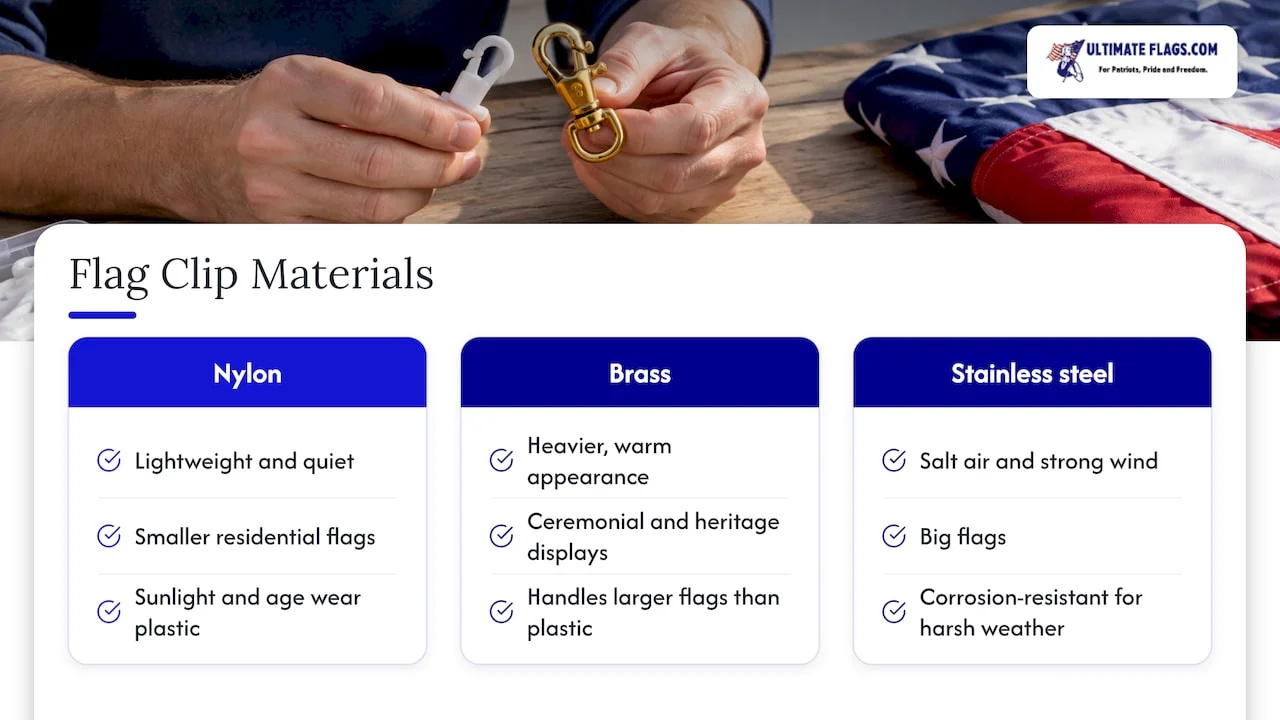
The three common materials behave differently outdoors.
Nylon. Lightweight and quiet. It will not clank against an aluminum pole in the night, which neighbors appreciate. It suits smaller flags on residential poles. Sunlight and age eventually wear plastic, so replace it on a schedule rather than waiting for a failure.
Brass. Heavier, with a warm, traditional appearance that suits ceremonial and heritage displays. It handles larger flags better than plastic and ages with character.
Stainless steel. The choice for hard conditions: salt air, strong wind, big flags. If your home sits near the water, read our piece on outdoor American flags for exposed coastal homes and pair the flag with stainless hardware. Some flag hardware is also nickel-plated cast metal, an economical middle option.
A simple rule: the harsher the weather and the heavier the flag, the more you want metal, and the more you want it corrosion-resistant.
Matching the hook to your flag and pole
Four checks get most displays right.
- Flag size and weight. A 3 x 5 foot flag and a 5 x 8 foot flag do not pull the same. Larger flags call for larger, sturdier hooks. Hooks are sold in several lengths, so size up as the flag and pole grow.
- Grommet opening. The gate must pass through the grommet without forcing it, and the hook body should not be so large that it jams. Both hooks should sit on the grommets evenly.
- Halyard thickness. The rope has to tie, or be spliced, to the hook’s eye. A rope too thick for the eye will not knot cleanly, and a rope too thin can slip. If your rope is frayed or stiff, it is worth replacing it at the same time. Our guide to flagpole rope replacement covers the pulley checks and the limits of a homeowner job.
- Pole style. A pole with an external halyard takes snap hooks. A spinning or bracket pole takes fasteners that clamp to the pole.
Once the flag is clipped on, tie off the halyard on a cleat. Where you mount the cleat affects how easily you can secure it.
Which hook for which display
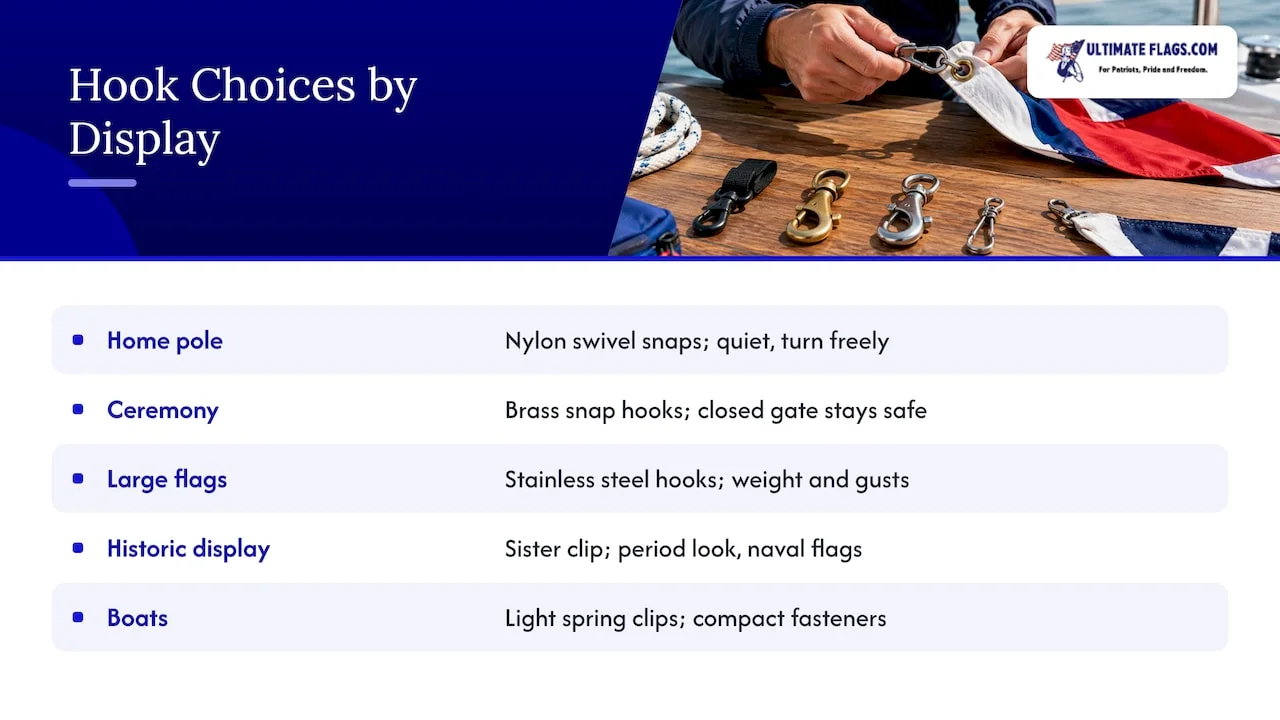
A home pole in a quiet neighborhood. Nylon swivel snaps keep noise down and turn freely. Raise the flag each morning and inspect the hooks when you do.
A ceremonial or memorial display. Brass snap hooks match the dignity of the occasion, and the closed gate means the flag stays safe through the ceremony. For indoor stands, see our notes on American flags for indoor ceremony displays.
A veteran post or business with a large flag. Stainless steel hooks stand up to the weight and the gusts of a big flag flying for long stretches.
A historic reenactment or collector’s display. A sister clip carries the look of the period you are honoring, particularly for naval flags. Collectors who fly their pieces should treat the hardware as part of the presentation.
Boats and small poles. Light spring clips and compact fasteners suit boat flags. Our boat flag pole that fits fishing rod holders is an example of a small setup where the hardware stays light.
Routine care for flag hardware
Hardware is the part of a flag display that fails first, and it usually fails quietly. A few minutes each season prevents a lost flag.
- Squeeze each gate and confirm it snaps shut cleanly.
- Look for bent springs, cracked plastic, corrosion and worn spots at the eye.
- Check the knot where the rope meets the hook, and retie if the rope has frayed.
- Rinse salt or grit from metal hooks and wipe them dry.
- Replace any hook that shows damage. A new hook costs very little next to a flag lost in a storm.
One more tip: take the flag down in severe weather. No hook, however strong, makes a flag storm-proof, and your flag deserves better than a beating.
Promo: flags worth flying properly
A flag carries a story, whether it is the Stars and Stripes, a Revolutionary War banner, a Civil War regimental colour or a Gadsden rattlesnake. Ultimate Flags is America’s oldest online flag store, and we offer USA, state, military, historic and political flags together with flagpoles and hardware. Browse the full flag collections to find the flag, then pair it with the right hardware.

For the pole and the hooks, start in our hardware and flagpole collection.
Perspective: the hook is part of the tribute
We have spent years around flags that carry real weight: the colors a veteran family folds, the banner a reenactment unit raises at dawn, the state flag outside a town hall. In all of them, we see the same thing. The cloth gets the attention, and the hardware does the quiet work of keeping that cloth where it belongs.
Flying a flag is an act of respect. A flag that drops to the ground because a cheap clip let go does not honor anyone. That is why we treat poles, halyards and hooks as part of the display, and why we offer hardware alongside our flags rather than leaving it as an afterthought.
Our advice is simple. Choose the hook for the flag you are flying and the weather it will meet, check it when the seasons turn, and replace it without sentiment. The banner that rallied troops at Gettysburg or Yorktown was carried by people who trusted their gear. Give your flag the same.
John Hough
FAQ
What are the hooks on a flagpole called?
Most people mean snap hooks, also called flag clips, swivel snaps or halyard clips. They attach the flag’s grommets to the rope. A swivel snap has a rotating eye, while a sister clip, also known as an Inglefield clip, is a chain-link style clip with no spring gate.
Are swivel snap hooks better than regular snap hooks?
For a flag that flies for long periods, swivels are the practical choice because they let the flag turn without winding the halyard. Standard hooks work well when you raise and lower the flag daily and the wind is light. Both close with a spring gate and clip to the grommet in the same way.
Which material should I choose for flag snap hooks?
Nylon is quiet and light and suits smaller residential flags. Brass is traditional and suits ceremonial displays. Stainless steel is the answer for salt air, strong wind and large flags. Match the material to your location first, then to the size of the flag.
How many snap hooks does a flag need?
A standard flag on a halyard pole uses one hook per attachment point, normally two grommets, so two hooks. Larger flags may have additional grommets or rings. Use one hook for each point the flag was made to be flown from.
How often should I replace flag clips?
Inspect them whenever the seasons change and any time the flag has been through a storm. Replace a hook the moment you see a weak spring, a gate that sticks, cracks or corrosion. Plastic hooks in strong sun generally need replacing sooner than metal ones.