
Most Americans know George Armstrong Custer for the way he died, surrounded at the Little Bighorn in 1876. Far fewer know that he first made his name in the Civil War, where he fought from the first major battle at Bull Run to the very last morning at Appomattox. Along the way he went from the worst-behaved cadet at West Point to the youngest general in the Union army and one of its most famous cavalry commanders.
Here is the story of Custer’s Civil War, from his rocky start to the day he carried home the table on which the surrender terms were written.

West Point’s Most Famous “Goat”
Custer was born on December 5, 1839, in New Rumley, Ohio, and entered the U.S. Military Academy at West Point in 1857. He was popular with his classmates and loved a prank, but he was not a model cadet.
West Point gave demerits for every kind of offense. A cadet who piled up too many in a six-month period could be dismissed. Custer seemed to live on the edge of that limit. He collected more demerits than anyone else in his class over four years. His offenses included snowball fights, a messy room, chronic lateness, shouting at a corporal and wearing his hair out of regulation. In his final six months he earned 97 demerits, and at one point he came within a couple of marks of expulsion.
He graduated in June 1861 at the very bottom of his class, a position cadets called “the goat.” Then, while serving as officer of the guard just after graduation, he let two cadets keep fighting instead of breaking it up. He was court-martialed for neglect of duty. He was found guilty, but with the Union army desperate for trained officers after so many Southerners had resigned to join the Confederacy, he got off with a reprimand.
From Bull Run to General McClellan’s Staff
Custer left for Washington in July 1861 and arrived just in time for the First Battle of Bull Run on July 21. He carried messages and helped cover the Union retreat. In 1862 he served on the staff of General George B. McClellan during the Peninsula Campaign, where his daring scouting earned him notice.
One well-known photograph from that period shows Captain Custer seated beside a captured Confederate officer, Lieutenant James B. Washington, an aide to General Joseph E. Johnston, taken in May 1862. The two had known each other before the war, and the picture became a striking reminder that many officers on opposite sides had been friends and classmates.
1863: The Boy General
Custer’s big break came in June 1863. As Robert E. Lee’s Confederate army marched north toward Pennsylvania, the Union and Confederate cavalry clashed again and again in Virginia, at Brandy Station on June 9 and Aldie on June 17. Custer, then a young captain serving on cavalry commander Alfred Pleasonton’s staff, became known for riding at the front of charges in his broad-brimmed hat with saber drawn, rallying men under fire.
On June 29, 1863, Pleasonton jumped Custer from captain to brigadier general of volunteers. He was 23 years old, the youngest general in the Union army at the time. He was given command of the Michigan Cavalry Brigade, soon known as the “Wolverines.” Custer designed his own flashy uniform of black velvet trimmed with gold lace and a red necktie that his men began to copy.
Just four days later he proved himself. On July 3, 1863, while Pickett’s Charge struck the Union center at Gettysburg, J.E.B. Stuart’s Confederate cavalry tried to swing around behind the Union army at what is now called East Cavalry Field. Custer personally led the 7th and 1st Michigan Cavalry in charges to stop them, reportedly shouting, “Come on, you Wolverines!” Stuart was turned back.
Yellow Tavern, the Shenandoah and the Road to Appomattox
Custer fought in nearly every major cavalry action in the East after Gettysburg. At Yellow Tavern near Richmond on May 11, 1864, his brigade was in the thick of the fight in which J.E.B. Stuart was mortally wounded. A trooper of the 5th Michigan Cavalry is generally credited with the fatal shot.
Under General Philip Sheridan in the Shenandoah Valley that fall, Custer was promoted to command a division and played a key role at Third Winchester, Tom’s Brook and Cedar Creek. In March 1865 his division smashed the last of Jubal Early’s small army at Waynesboro, Virginia.
In the final campaign of April 1865, Custer’s horsemen helped cut off Lee’s retreating army. On April 8 they captured Confederate supply trains at Appomattox Station, blocking Lee’s escape route. The next morning, April 9, a Confederate rider carrying a white flag of truce approached Custer’s lines, one of the steps that led to the meeting between Lee and Ulysses S. Grant at the McLean house that afternoon.
The Surrender Table
After Grant and Lee signed the surrender, Union officers bought or carried off souvenirs from the McLean parlor. General Sheridan purchased the small table on which Grant had written out the terms and gave it to Custer’s wife, Elizabeth “Libbie” Custer, as a gift in honor of her husband’s service. It is one of the most famous relics of the end of the war.
Custer finished the Civil War as a major general of volunteers at just 25. After the war he reverted to a lower regular army rank and became lieutenant colonel of the new 7th U.S. Cavalry. He was killed with more than 200 of his men at the Battle of the Little Bighorn in Montana Territory on June 25, 1876.
Sometimes It Takes a Rebel
Custer’s story is full of contradictions. He was a reckless cadet who became a brilliant combat leader, and a showman whose courage was never in doubt. His troopers followed him because he rode in front. Whatever historians think of his later career on the Plains, his Civil War record helped save the Union cavalry at Gettysburg and helped bring the war to an end at Appomattox. For more stories of American flags and the men who fought under them, read Don’t Give Up the Ship: The Story Behind Perry’s Famous Battle Flag.
Frequently Asked Questions
Did Custer fight in the Civil War?
Yes. Custer fought for the Union from the First Battle of Bull Run in July 1861 to Appomattox in April 1865, rising from second lieutenant to major general of volunteers.
Was Custer last in his class at West Point?
Yes. Custer graduated in 1861 at the bottom of his class and collected more demerits than any of his classmates.
How old was Custer when he became a general?
Custer was 23 when he was promoted to brigadier general on June 29, 1863, making him the youngest general in the Union army at the time.
What did Custer do at Gettysburg?
On July 3, 1863, Custer led the Michigan Cavalry Brigade at East Cavalry Field, where his charges helped stop J.E.B. Stuart’s Confederate cavalry from reaching the rear of the Union army.
Who got the table from Lee’s surrender?
General Philip Sheridan bought the table Grant used to write the surrender terms and gave it to Elizabeth Custer, George Custer’s wife.
Who were Custer’s Wolverines?
The Wolverines were the Michigan Cavalry Brigade, made up of the 1st, 5th, 6th and 7th Michigan Cavalry regiments, which Custer commanded from 1863.
Fly a Flag from Custer’s War
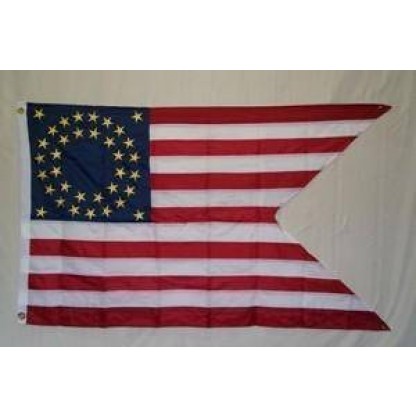
Honor the Union cavalry with our Custer Battle Flag or the Union Cavalry Guidon Flag, or fly the 35 Star Civil War USA Flag that flew over the Union by the end of the war.
Thanks for reading! We hope you enjoyed our post. Please share with all your fellow patriots. Brought to you by: Ultimate Flags