Posted on

Blueskin and Old Nelson

Thomas Jefferson once referred to George Washington as:

“the best horseman of his age, and the most graceful figure that could be seen on horseback.”

Washington’s friend, the Marquis de Chastellux, a French national, also observed that Washington:

“is a very excellent and bold horseman, leaping the highest fences, and going extremely quick, without standing upon his stirrups, bearing on the bridle, or letting his horse run wild.”

Jefferson knew a good horseman when he saw one, and this was the age when being an accomplished horseman was taken as a mark of a true gentleman.

A good horseman needs a good horse, and Washington had many magnificent ones to ride. During the American Revolutionary War, the two horses prominently connected to him were Blueskin, and “Old Nelson.”

Blueskin was a dashing stallion “of a dark iron-gray color, approaching to blue.”He was a spirited animal, known for his endurance during a long chase.  Blueskin was a gift to Washington from Colonel Benjamin Tasker Dulany of Maryland.

“Old Nelson” was a chestnut with a white blaze and white feet. He was described as a “splendid charger,” standing sixteen hands high.  He was a gift from Thomas Nelson, Jr., a signer of the Declaration of Independence and later governor of Virginia.

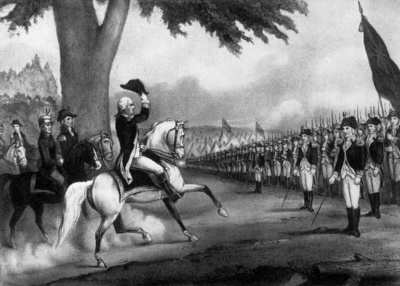
Old Nelson proved to be Washington’s favorite horse to ride into war because he was less skittish during cannon fire and the startling sounds of battle. Blueskin was his favorite hunting horse. Due to his near white hair coat, he was the horse most often portrayed in artwork showing Washington on horseback.
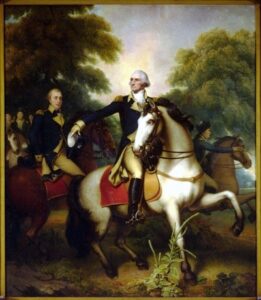
Washington on Blueskin

Washington chose to ride Nelson on the day the British army under the direction of Lord Cornwallis surrendered at Yorktown, Virginia in 1781

Both horses served Washington well during the 8 1/2 years of the American Revolutionary War. Nelson and Blueskin survived intact and were retired to Washington’s stables in Mount Vernon to live a life of ease and celebrity.Washington always displayed great respect and affection for his horses, and it was clear that the horses loved him, too. It was reported that Washington would walk around the grounds of the estate, and stop at Nelson’s paddock, “when the old war-horse would run, neighing, to the fence, proud to be caressed by the great master’s hands.”

Blueskin lived at Mount Vernon until Washington returned him to to Mrs. Dulany in November 1785, with along with a letter of gratitude. “Old Nelson” died at the estate in 1790 at about the age of 27, quite old for a horse in that era.

Great men carry the honor and privilege of having great horses.


Thanks for reading! We hope you enjoyed our post. Please share with all your fellow patriots. Brought to you by: Ultimate Flags
Posted on

Wheat’s Tigers: Rebels in Arms

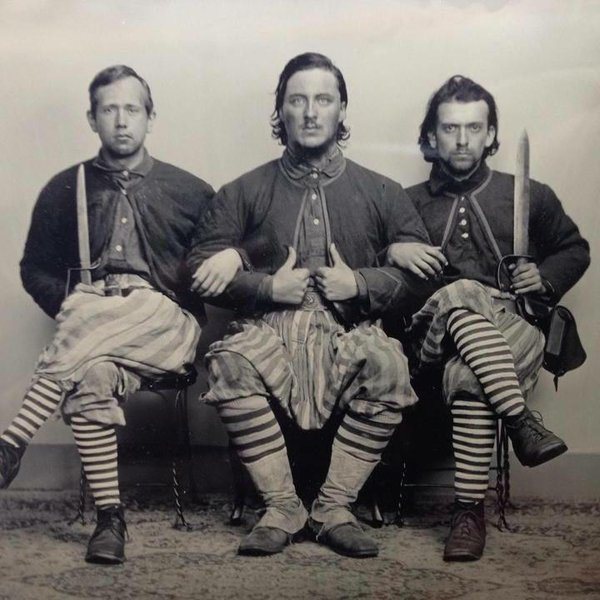
“Wheat’s Tigers” was the nickname of a Louisiana Battalion formed from the rougher sections of New Orleans, men described as “thieves, and outcasts…and bad characters generally.”

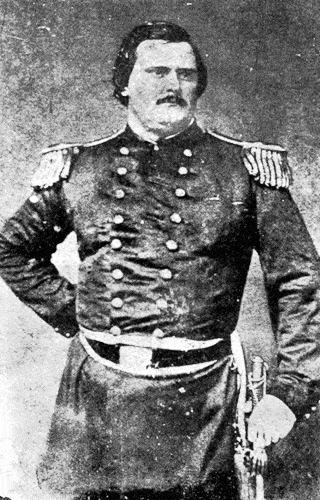
Of all the units that took the field at the First Battle of Manassas in July 1861, none exceeded the flair and intensity of the 1st Louisiana Special Battalion.  Raised from the dregs of New Orleans, they were primarily Irish immigrant dockworkers, tough and gutsy as their combative commander, Major Roberdeau Wheat.

Although the Tigers were known for their drinking, card playing, fighting and general mischief, they proved themselves fearless and effective at the Battle of First Manassas.

The Tigers dressed in colorful uniforms like the North African “Zouaves” then in the service of the French Army, and became known as one of the South’s best and most fearsome units.

Known as Bull Run to the Federals, Manassas was the first major battle of the war.  Even before the main fight began, the Louisiana Tigers made a charge. Lieutenant Adrian of Company B fell with a leg wound. As he lay on the ground bleeding, he shouted:“Tigers, go in once more, go in my sons, I’ll be great gloriously God damned if the sons of bitches can ever whip the Tigers!”One of the Rebels later said, “Our blood was on fire. Life was valueless.”

One of the Yankees later said the charge “seemed to me to be the most terrible moment of this terrific contest.”By dusk of that day, the Union army was driven from the field and retreated all the way back to Washington. General Beauregard reported that the Tigers displayed “dauntless courage and imperturbable coolness,” and that these men could stand tall and say, “We were of that band who fought the first hour of the battle of Manassas.”

Major Roberdeau Wheat, leader of the Tigers

Thanks for reading. Please share our posts with your friends and family so they too can learn more about Southern Heritage and History.

Brought to you by: Ultimate Flags

Posted on

Confederate Cherokee Bravery

During the Civil War, the Cherokee Nation had 3,000 men serving as Confederate soldiers.

The Cherokee, by nature a peaceful people, were exceptionally skilled at protecting themselves.  They were naturals at close-quarters fighting, and adept at the irregular tactics of guerrilla warfare.

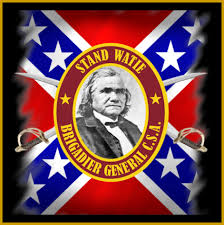
A leader of the Cherokee, Stand Watie, was eager to join the Confederate cause. In June 1861, he began recruiting for an army to assist the Southern cause. He was elected Chief of the newly declared Southern Cherokee Nation

Stand Watie’s birth name was Tak-er-taw-ker, meaning “Stands Firm.”  He combined parts of his Cherokee name and his father’s name, Oo-wat-ie, to call himself Stand Watie in English..

In March of 1862 Stand Watie caught the attention of senior officers when he captured a Union artillery battery. He then led a skilled rear guard action to protect a retreating Confederate army to prevent a disastrous defeat.

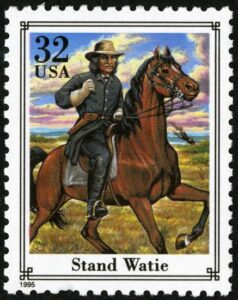
Watie’s courage, tactics and leadership led to his assignment to a command position. Watie rose to the rank of Brigadier General. One of the units under Watie’s command was the Cherokee Mounted Rifles.  His unit was active in cutting Union supply lines and disrupting the enemy’s operations in the Western Theater of the Civil War.

He kept on fighting until June 23rd, 1863, months after Appomattox, and longer than any other Confederate General.

The U.S. Postal Service commemorative stamp issued on June 29, 1995.

Thanks for reading. Please share our posts with your friends and family so they too can learn more about Southern Heritage and History.

Brought to you by: Ultimate Flags

Posted on

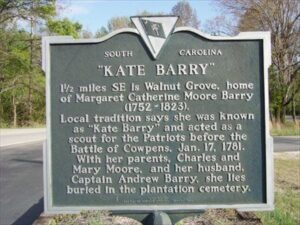
“Heroine of the Battle of Cowpens” – Catherine Moore Barry

At the time American society did not easily permit women to take part in the Revolutionary War. But there were many women who definitely had a significant role in the formation of this country. One of them was Catherine (Kate) Moore Barry.

Kate was a true American heroine.When her husband, Andrew, became a captain and commanding officer in the war, she proudly helped him acting as a spy and messenger and even fought in some battles with him.  She is best known for her role in warning the American militia the British were about to invade, just before the decisive Continental Army victory at the Battle of Cowpens, January 17, 1781.

Acting as a scout for the American forces, Kate became known as the “Heroine of the Battle of Cowpens.”  She was an excellent horsewoman and knew every trail and shortcut around her South Carolina plantation.  Although there is no historical proof, it is said that she tied her baby to her bedpost and, using her knowledge and skills, gallantly rode her horse through Indian trails to warn her neighbors that the British were coming.

Kate had single-handedly rounded up an impressive amount of local Patriots to help General Morgan. With her help, Morgan laid a trap for General Corwallis and his men. After the trap proved a success, Cornwallis retreated right into the hands of George Washington in Yorktown, Virginia.

Thanks to the bravery of women like Catherine Barry, the victory at the the Battle of Cowpens became the turning point in the American War for Independence that ultimately led to the American colonies winning their independence. .

Yes, “girl power” from the 1780’s. Even then not all women were stay at home Moms.

Catherine (Kate) Moore Barry Historical Marker in South Carolina


Thanks for reading! We hope you enjoyed our post. Please share with all your fellow patriots. Brought to you by: Ultimate Flags
Posted on

“The Most Daring Courage”

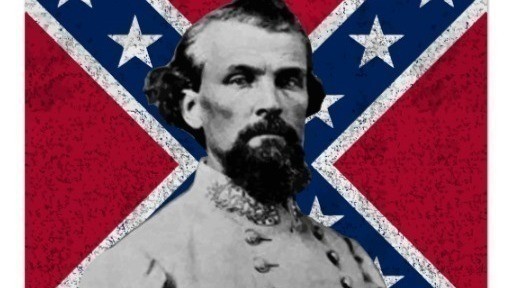
Nathan Bedford Forrest is one of ablest commanders on record, the only Civil War officer to go from Private at the beginning of the war to highest rank then used, Lieutenant General. Union General Sherman said Confederate Lt. General Forrest was “the most remarkable man our civil war produced on either side.” Sherman, regarded as a great strategist, wrote this about Forrest: “…he had a genius for strategy which was original, and to me incomprehensible. There was no theory or art of war by which I could calculate with any degree of certainty what Forrest was up to. He always seemed to know what I was going to do next.” Forrest was remarkably brave in battle. Private James Hamner described one of their early battles:   “The Col. (Forrest) was about 50 yards ahead of us fighting for his life. I believe there was at least fifty shots fired at him in five minutes. One shot took effect in his horse’s head, but did not kill him. He killed 9 of the enemy.” Of another early battle, General Clark wrote this of Forrest: “…he was conspicuous for the most daring courage; always in advance of his command. He was at one time engaged in a hand-to-hand conflict with 4 of the enemy, 3 of whom he killed, dismounting and making a prisoner of the fourth.” Forrest was noted for using a distinctive 12-star battle flag. He removed the middle star so his enemies knew exactly who they were fighting.

Thanks for reading. Please share our posts with your friends and family so they too can learn more about Southern Heritage and History.

Brought to you by: Ultimate Flags

Posted on

“The Fightinest Marine I Ever Knew”

The United States Highest award for “conspicuous gallantry and intrepidity at the risk of his life above and beyond the call of duty” is the Congressional Medal of Honor. In over 150 years only 19 men have won it twice.

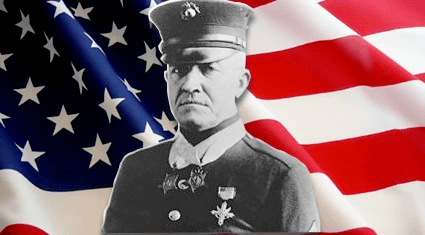
One of the most legendary two time recipients is Marine Corps Sergeant Major Dan Daly. Here is the remarkable story of how he earned his Medals of Honor.It was in China, 1900. Daly was part of the U.S. Embassy Guard in Peking when the Boxer Rebellion broke out. American diplomatic buildings were about to come under siege. Marine Private Dan Daly volunteered to man a barricade about 100 yards forward of the main line of Marines, a position known as the Tartar Wall. If the Chinese rebels thought one man would be a pushover, they were soon to learn better.Armed with a bolt-action rifle and bayonet, Daly spent the night beating back the attackers.  When more Marines arrived the next morning, they found Daly puffing on a cigarette, surrounded by bodies of the enemy. Marine Corps legend puts the number at around 200.  

Daly’s Medal of Honor citation simply states,

“Daly distinguished himself by meritorious conduct.”

Fourteen years later Gunnery Sergeant Daly would earn his second Medal of Honor serving in Haiti fighting against the Cacos.

While attempting to ford a river at night, his 38-man Marine unit was ambushed from three directions by hundreds of insurgents.  The Marines fought their way across the river, but lost their heavy machine gun in the river. Given the odds, that machine gun meant the difference between life and death. Daly went back into the river, searching for the gun while the enemy surrounded their position.  He returned with gun and ammunition strapped to his back. The Marines split into three teams and attacked.  As one man noted afterward,

“Had one squad failed, not one man of the party would have lived to tell the tale.” A later report stated that Daly “was the most conspicuous figure.” He was awarded his second Medal of Honor. But Daly was not finished being a hero yet. He is probably best remembered within the Marine Corps for bravery in World War I.  In June 1918 at the battle of Belleau Wood, the Marines were pinned down under heavy artillery barrage. The 44 year old Daly, led a counter-attack with a battle cry that has become Marines lore,

“Come on, you sons of Bitches, do you want to live forever?!”

Later in the battle, Daly single-handedly eliminated a machine gun nest armed with his 45 pistol and grenades. In the course of the battle he was wounded three times.

Daly was recommended for a third Medal of Honor, and was ultimately awarded the Distinguished Service Cross, the Navy Cross and France’s Médaille Militaire.

Major General Lejeune, Commandant of the Marine Corps, called him “the outstanding Marine of all time.”

Major General Butler the only other Marine to have earned two Medals of Honor,  called him “The fightinest Marine I ever knew,” and wrote that “it was an object lesson to have served with him.”

Offered promotion several times, Daly once remarked, “I would rather be an outstanding sergeant than just another officer”

U. S.  Marine Sergeant Major Dan Daly stands tall in the history of America.


Thanks for reading! We hope you enjoyed our post. Please share with all your fellow patriots. Brought to you by: Ultimate Flags
Posted on

Perryville – “It was Death to Retreat”

The Battle of Perryville in Kentucky one of the most important battles of the American Civil War, but most people, including many Civil War buffs, know little about it..

Sam Watkins was there and he wrote about it in his famous memoirs. Sam served in the First Tennessee, Company H, and fought in every major battle that this Confederate unit was engaged in – Shiloh, Corinth, Stones River, Chickamauga, Chattanooga, the Atlanta Campaign, Franklin, and Nashville.

There were over 55,000 Union and nearly 17,0006,800 Confederate troops in the area. These numbers make Perryville the largest battle to have been fought in the Bluegrass State.

He writes about his experience,

“I was in every battle, skirmish and march that was made by the First Tennessee Regiment during the war, and I do not remember of a harder contest and more evenly fought battle than that of Perryville.”The morning of the battle dawned, and the two sides “seemed to be eyeing each other.” Finally about noon, “they opened their war dogs upon us… and from one end of the line to the other seemed to be a solid sheet of blazing smoke and fire.”The Yankees and the Rebels were locked in “a mortal struggle” as the Rebels advanced.  Then Sam’s company encountered four cannons that fired into them:“We did not recoil, but our line was fairly hurled back by the leaden hail that was poured into our very faces… It was death to retreat now to either side.”These cannon were Napoleon guns, capable of firing 12-pound shots.The Rebels charged ahead and were soon in hand-to-hand fighting. Neither side wanted to yield.  Sam described it:“Such obstinate fighting I never had seen before or since….it seemed the earth itself was in a volcanic uproar.”

Confederate General Braxton Bragg also commented on the battle saying,

“for the time engaged it was the severest and most desperately contested engagement within my knowledge.”

Sam Watkins also wrote,

“I do not know which side whipped, but I know that I helped bring off those four Napoleon guns that night.”

Thanks for reading. Please share our posts with your friends and family so they too can learn more about Southern Heritage and History.

Brought to you by: Ultimate Flags

Posted on

Red Cloud – A True Hero

North Korean troops crossed the 38th Parallel in June 1950. President Harry S Truman ordered the 24th Infantry Division to head to Korea. Among the soldiers of the 24th was Mitchell Red Cloud, a Native American Ho-Chunk (Winnebago Tribe). A Marine veteran of WW II, he was one of Carlson’s Raiders at Guadalcanal, and took a bullet on Okinawa. Discharged after the war, he was back in uniform two years later to serve his country. His actions in Korea would earn him the Medal of Honor.One night Mitchell was at a forward observation post when he spotted the enemy charging from a brush-covered area, less than 100 feet away.  He opened fire with his Browning Automatic Rifle (BAR), and emptied magazine after magazine at point-blank range.

His citation read,

“His accurate and intense fire checked this assault and gained time for the company to consolidate its defense,”.Mitchell was hit twice. A medic applied dressings, and Mitchell resumed firing. He was hit again, but refused aid.“Corporal Red Cloud pulled himself to his feet, and wrapping his arm around a tree, continued his deadly fire again, until he was fatally wounded.”Because of Mitchell’s cover fire, the rest of his Company were able to withdraw to fortified positions. He gave his own life to save many.

And that is the definition of hero.


Thanks for reading! We hope you enjoyed our post. Please share with all your fellow patriots. Brought to you by: Ultimate Flags
Posted on

The Patriot Marksman

British Colonel George Hanger fought the American Continental Army in the Revolutionary War. He later said he had never seen better rifles than those made in America, nor men who could shoot better.

The British troops used the Brown Bess rifle, which could hit a man at 80 to 100 yards. It was unusual for a man to be even wounded by one if hit at 150 yards. But Hit a man at 200 yards?  

About that, Hanger wrote,

“you may just as well fire at the moon and have the same hopes of hitting your object.” As to British marksmanship, he thought little of it:

“excellent as they are to discipline the soldier and form him for parade and actual service in the line, the serjeant is just as capable of teaching him how to solve one of Sir Isaac Newton’s problems as to teach him to be a marksman.” But the Americans with their weapons and abilities, were a whole other story. Colonel Hanger wrote: “I have often asked what was the most they thought they could do with their rifle.  They have replied that they thought they were generally sure of splitting a man’s head at 200 yards, for so they termed their hitting the head.  I have also asked several whether they could hit a man at 400 yards.  They have replied certainly, or shoot very near him.” The Colonel experienced this Patriot marksmanship firsthand. He tells the a story of an American Patriot firing at him from 400 yards. The rifle ball missed him by a foot, but behind him a “horse staggered, fell down, and died.” Sorry about the poor horse, but good shot, indeed!


Thanks for reading! We hope you enjoyed our post. Please share with all your fellow patriots. Brought to you by: Ultimate Flags
Posted on

George Washington: Model of the Confederacy

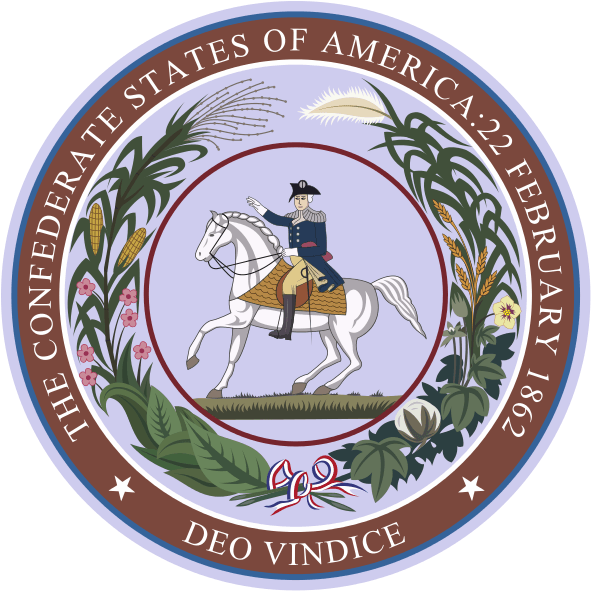
Soon after the formation of the Confederate States of America, the new government chose a national seal and motto: Deo Vindice: “God Will Vindicate”

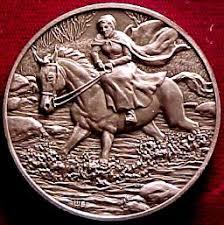
The seal features George Washington on horseback, pictured in his uniform of the Revolution securing American independence. Washington is surrounded with a wreath, made of some of the main agricultural products of the Confederacy: wheat, corn, tobacco, cotton, rice and sugarcane. In the top margin of the seal are the words “The Confederate States of America: 22 February 1862”. This date on the seal commemorates the establishment of the new Confederate government in Richmond, Virginia with the inauguration of President Jefferson Davis – and it is also Washington’s birthday.But why George Washington?  

It’s easy to see. Washington was chosen as the model for the Confederacy because of his importance in founding a new nation. He was man of great personal character, a military leader who secured independence, and a new nation’s political leader.

Both North and South would claim Washington as their patron of democracy. No public figure stood higher in the public esteem. He was beloved by Northerners and Southerners alike. By 1861 he had come to symbolize everything virtuous and heroic about the American Revolution.

Historian Joseph J. Ellis wrote,

‘If there was a Mount Olympus in the new American republic, all the lesser gods were gathered farther down the slope from Washington.”

Since the Southerners claimed Washington as their guiding spirit, a member of the Georgia delegation to the 1861 Confederate constitutional convention in Montgomery, Alabama, proposed to name the new Southern nation ‘‘Republic of Washington.”

Jefferson Davis. In his inaugural address said,

“On this the birthday of the man most identified with the establishment of American independence, and beneath the monument erected to commemorate his heroic virtues and those of his compatriots, we have assembled to usher into existence the permanent government of the Confederate States.”

The Confederacy, he continued, would

“perpetuate the principles of our Revolutionary fathers. The day, the memory, and the purpose seem fitly associated….We are in arms to renew such sacrifices as our fathers made to the holy cause of constitutional liberty.”

Although neither Jefferson Davis nor Confederate General Robert E. Lee ever claimed the title for themselves, they were often called “Second Washingtons.”

Had he lived to see it, many say that George Washington would not have supported the Confederacy because of his stated commitment to one nation, indivisible.

But that didn’t prevent Jefferson Davis, Robert E. Lee, Thomas J. ‘Stonewall’ Jackson, and other leading Southerners from declaring that Washington  was a citizen of his state first, and of the United States second.

Maybe he would have been a Confederate, too, or maybe not. Who knows? It’s fun to think about it.  In any case, George Washington was definitely a hero and model of the Confederacy.

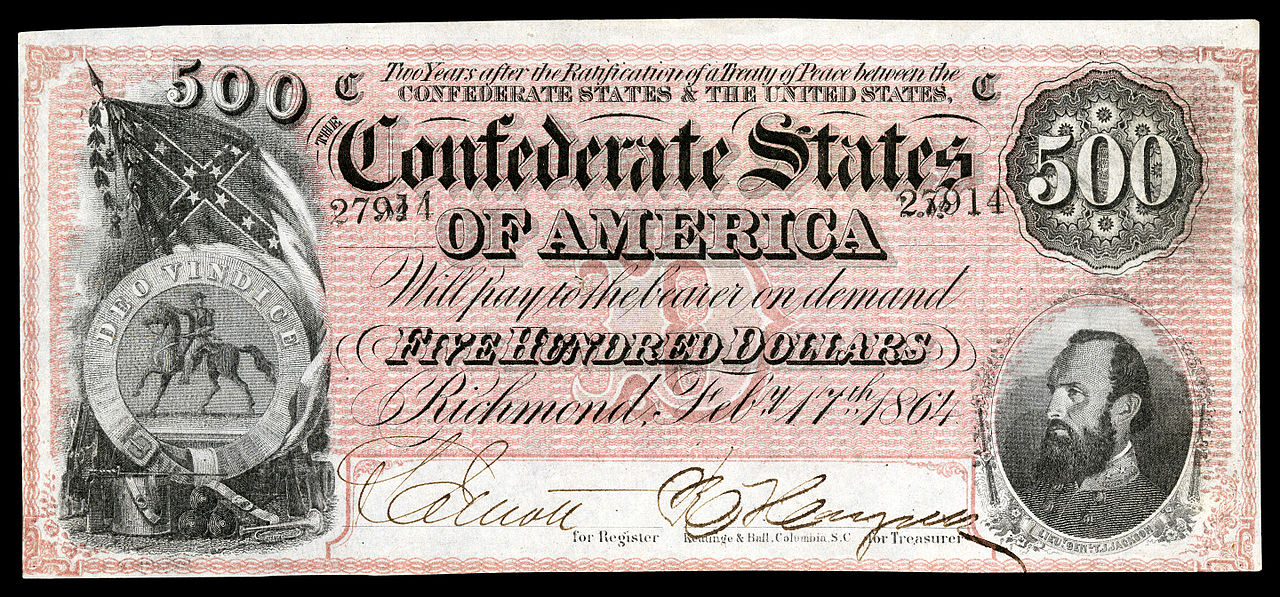
Confederate currency with Deo Vindice seal including George Washington

Thanks for reading. Please share our posts with your friends and family so they too can learn more about Southern Heritage and History.

Brought to you by: Ultimate Flags

Posted on

“Brothers, I am a Warrior.”

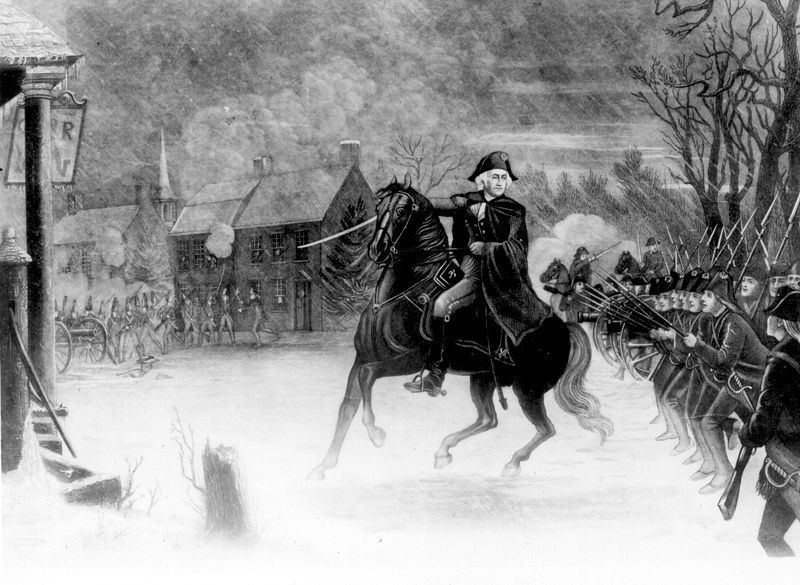
George Washington wrote these words during the American Revolutionary War. As a young man he had served with the British militia and saw that the British lacked understanding of Colonial warfare. Most of all they were unwilling to listen to good advice.  But this knowledge would serve him very well decades later.General Washington was a master of strategy. He knew his Colonial army was no match for a large and trained British army. So, he chose his battles carefully, and was willing to receive good advice.Washington required hard work and demanded discipline from his soldiers, and made sure he led by example. He stayed with his men at Valley Forge during the entire winter, the harshest one on record. 2,500 American soldiers died that year. During the seven years of war, he visited his home a total of only 10 days.

He later wrote about Valley Forge,

“To see the soldiers without clothes, without blankets, without shoes…without a hut to cover them…and submitting without a murmur… can scarcely be paralleled.”Washington was willing to lead his army from the front, and was famous for his courage in battle. The American soldiers knew Washington would not ask them to do something he himself would not do. They would go anywhere with him and do anything for him. So they bled for him and helped bring forth a brand new country..

It was no surprise that George Washington was unanimously elected as the first President of the new nation, the United States of America, and four years later was re elected.

One of Washington’s men who had accepted no pay wrote:

At the end of the war, Washington was a hero. Congress had given him powers that were equivalent to those of a dictator, and he could have taken full control of the new nation. Instead, Washington resigned, opening the way for us to enjoy the liberties we have today.

Washington’s character and leadership made him a true military and political hero and America’s role model.  


Thanks for reading! We hope you enjoyed our post. Please share with all your fellow patriots. Brought to you by: Ultimate Flags
Posted on

“I am a soldier and a good one.”

More Americans died in The Civil War than any other conflict. In fact, it took half of all Americans lost in all our wars.  Most of it was fought on Confederate territory.   It was a brutal conflict, yet many a man fought from beginning to end. Soldiers had little tolerance for the opinions of those not in the fray. One man wrote about them as

“men who have not spunk enough to leave their mammy…setting on their asses by warm fires and enjoying all the comforts of home, running down men who are enduring hardships all the time and risking their lives…” Soldiers fought with great courage. A chaplain wrote,

“Our battle-worn veterans go into danger when ordered, remain as a stern duty so long as directed, and leave as honor and duty allow.”

One captain explained,

“I am a soldier and a good one,” though he admitted he might complain and “growl” after a fight. But when “an order came to storm a battery, nary a squeal would I make.”   Men were pushed to the breaking point, but kept going. They knew they could trust the fellows next to them, men who had stood up to certain death before, and would do it again.

One Southern private explained, “We were defeated because bravery and human endurance were unequal to the undertaking.” Honoring those lost was particularly sacred in the South. Local women established memorial associations to create cemeteries. The departed that never returned were remembered in many ways, and still are to this day.

Thanks for reading. Please share our posts with your friends and family so they too can learn more about Southern Heritage and History.

Brought to you by: Ultimate Flags