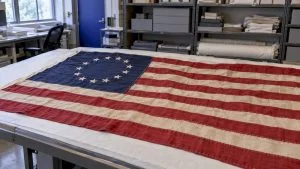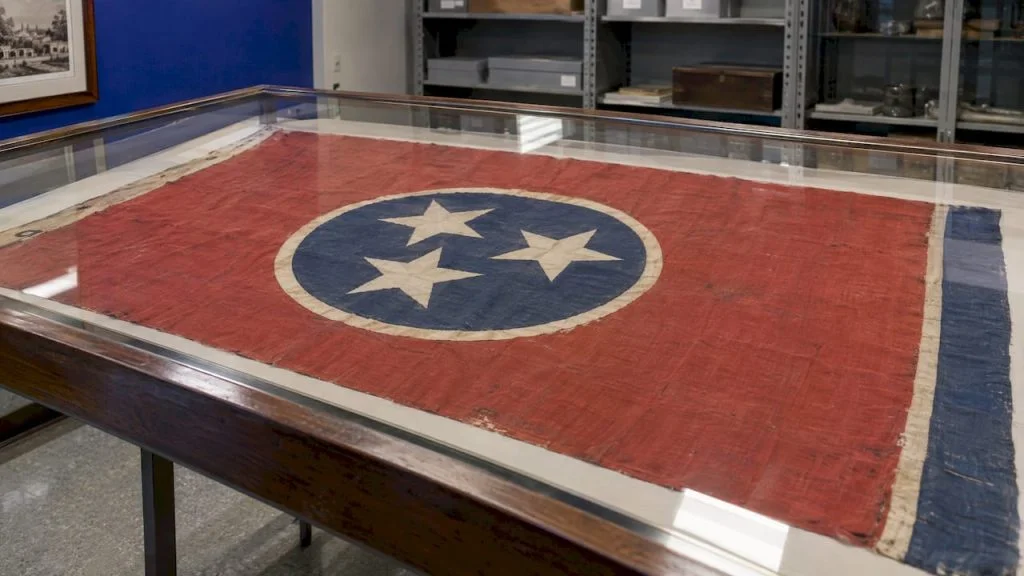
Tennessee’s flag is the work of one determined National Guard captain, LeRoy Reeves of Johnson City, and it became law on April 17, 1905. Its three white stars stand for East, Middle and West Tennessee, the state’s three Grand Divisions, bound together by an unbroken blue circle. It is a banner born of persistence, designed so that a state split by geography would have one symbol to rally beneath.
TL;DR
- Tennessee’s current flag was designed by Captain LeRoy Reeves and adopted by an act approved April 17, 1905.
- The three stars represent the Grand Divisions of East, Middle and West Tennessee, joined by the endless blue circle.
- It replaced a striped 1897 Centennial flag that rarely appeared in public.
- The blue bar and white edgings were practical choices, meant to keep the flag readable even when it hangs limp.
- State law fixes the proportions, but many commercial flags get the size of the blue circle wrong.
Table of Contents
- Before 1905: A State Without a Banner
- Captain LeRoy Reeves and His Long Campaign
- April 17, 1905: The Flag Becomes Law
- What the Three Stars Mean
- The Circle, the Crimson and the Blue Bar
- What the Law Actually Specifies
- After the Flag: Reeves and the Emblem’s Afterlife
- Flying Tennessee’s Flag Well
- Our Perspective
- Bring the Tennessee Flag Home
- FAQ
- Sources
Before 1905: A State Without a Banner
Every state flag begins as an argument about identity, and Tennessee’s began with a false start, then a second one that fizzled.
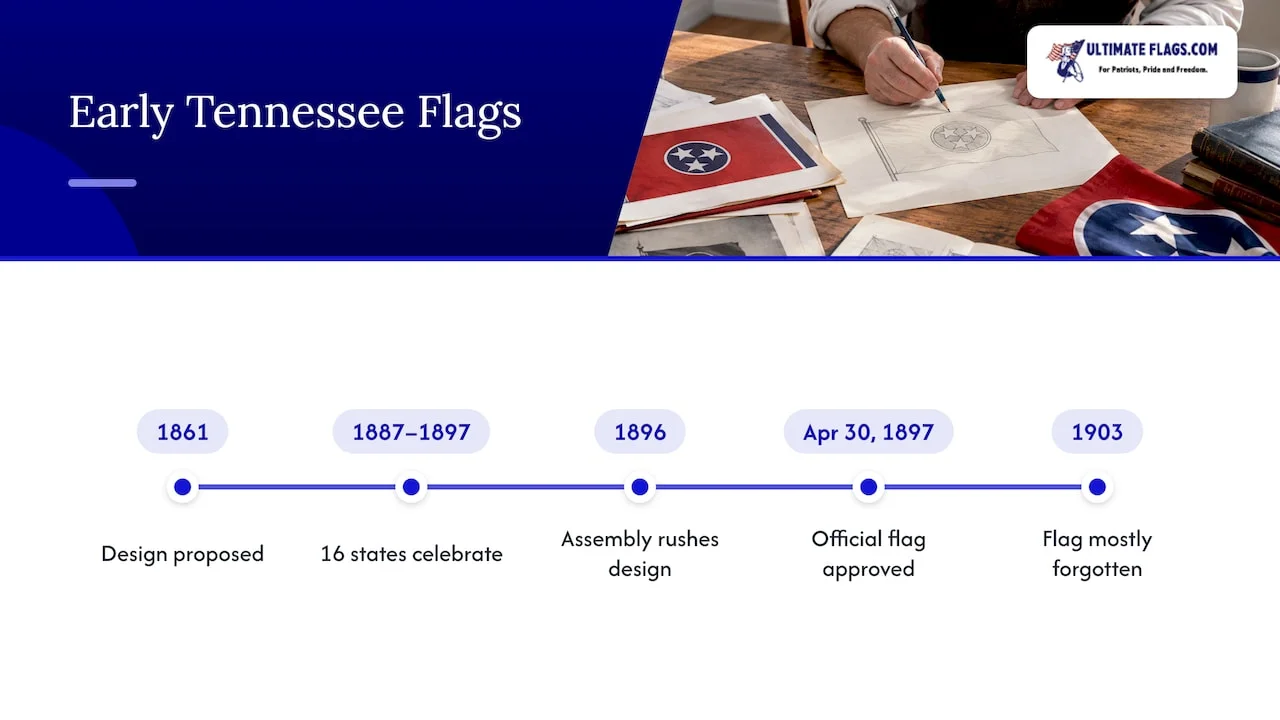
The earliest known proposal came in the charged spring of 1861. Senator Tazewell B. Newman introduced a design on April 25, 1861 during the secession debates: three horizontal red and white bars with a blue canton holding the state seal. It was sent to committee, never put to a vote and never adopted.
The first official flag arrived a generation later. Tennessee was one of 16 states holding centennial celebrations between 1887 and 1897, and in 1896 the General Assembly hurried to settle on a design before the Centennial Exhibition. The result, approved April 30, 1897, was a red, white and blue banner with three diagonal stripes meant to represent the geological lines of the state. “The Volunteer State” ran along the central stripe, and the number 16 on another honored Tennessee as the sixteenth state to join the Union, according to the Archives of Appalachia.
It was a flag with a good story and little pull. The same archive notes it was never enthusiastically embraced and appeared rarely, if at all, at public events beyond the Centennial. The Tennessee State Museum adds that by the time Reeves began campaigning in 1903, most Tennesseans had forgotten they had an official flag at all.
Captain LeRoy Reeves and His Long Campaign
The man who changed that was a teacher, lawyer and citizen-soldier. According to the Tennessee Encyclopedia, Reeves was born in Johnson City in June 1876, taught there from 1896 to 1898, was admitted to the bar in 1899, organized a National Guard company in June 1903 and was commissioned captain of the Third Regiment. The Tennessee State Museum’s junior curators add that he worked on several flag designs before choosing the one that would be adopted.
Why bother? The timing helps explain it. Volunteer regiments raised for the Spanish-American and Philippine-American wars had revived interest in state flags, and a soldier who marched under a banner naturally wanted his home state to have a proper one. Reeves was blunt about the 1897 flag. In 1903 he wrote that five years after the resolution, no one he knew had ever seen it fly, and that this showed something was wrong. A flag, he argued, should be recognizable at a distance and carry a symbol that speaks to the sentiment of the people beneath it.
Two Tries at the Legislature
The path was not smooth. The Tennessee Magazine reports that Reeves first took his proposal to Rep. Samuel Earnest Miller in 1902 and 1903, and that the 1903 bill died without ever coming to a vote. When Miller did not run in 1904, Reeves found a new House sponsor in Rep. W.W. Faw. On March 4, 1905, he wrote to Faw that Tennessee could afford the inexpensive distinction of a legalized State banner, a line as persuasive as it is thrifty.
The Tennessee State Museum notes that Reeves designed the flag alone, without collaborators, with the aim of uniting the state’s three Grand Divisions.
April 17, 1905: The Flag Becomes Law
The Chattanooga Press ran the headline “Triumphant Flag of Tennessee” on its front page on April 14, 1905, and the bill passed both houses three days later. The Secretary of State records the flag’s adoption by an act passed and approved April 17, 1905, Chapter 498 of the Public Acts of 1905. The House legislative manual notes the description entered the Code that same year (TCA 4-1-301) and has been altered only once since.
The first place the new tri-star flag flew was Reeves’s own hometown. After Gov. John Cox signed the bill, Reeves presided over a flag-raising at the National Guard armory in Johnson City. Getting the first flag made took some doing: on April 21, 1905, a Nashville printing company told him it was too rushed with color work to take the job.
Reeves did not let go after the signing. The State Museum reports he wrote to an Ohio flag manufacturer no fewer than 20 times to explain every nuance of the design and its colors, and as late as July 27, 1908, he was still pressing the adjutant general about how the flag should be used. The original 1905 flag survives: the Tennessee Historical Society holds it, presented by Reeves for preservation.
What the Three Stars Mean
This is the question behind most searches, and the answer comes from Reeves himself. In the explanation preserved by the Tennessee Secretary of State, the three pure white stars represent the state’s three Grand Divisions, bound together by the endless circle of the blue field as an indissoluble trinity.
A Grand Division is one of Tennessee’s three historic regions: East, Middle and West. They differ in landscape, in economy and in history, from the Appalachian ridges to the Nashville Basin to the Mississippi bottomlands.
Why No Star Outranks the Others
The law is deliberate about equality. The act requires three white five-pointed stars at equal intervals within the blue circle, with no two star centers aligned parallel to the flag’s sides or ends, and with the highest star nearest the upper confined corner (the corner next to the pole). No star sits on top, and none sits apart.
The State Museum reads this as a purposeful answer to the 1897 flag. That earlier design, with its segmented stripes, highlighted the divisions of the state. Reeves set one star for each region with no hierarchy and then encircled them, making three distinct regions one. He believed such a symbol would unite Tennesseans and distinguish their values and culture.
That is why the three stars have outlived their era. A single glance carries a whole political idea: different places, one people.
The Circle, the Crimson and the Blue Bar
The stars are the heart of the flag, but nothing else on it is accidental.
- The crimson field. The broad red principal field gives the flag its visibility at a distance, the very quality Reeves found missing in the 1897 design.
- The blue bar and white edgings. Reeves explained that the final blue bar relieves the sameness of the crimson and prevents too much red from showing when the flag hangs limp, while the white edgings contrast more strongly with the other colors, as the Secretary of State records. The Tennessee Historical Society likewise says the trim lets the flag show all three colors when hanging limp.
- The blue circle. It is the unbroken ring that holds the stars together.
A pleasing detail: those details are practical, almost sailor-like thinking. A flag spends most days hanging in still air, and Reeves designed for that reality rather than for a parade in a stiff breeze.
What the Law Actually Specifies
Chapter 498 is more exact than most people expect. According to the Secretary of State, the flag is oblong, one and two-thirds times as long as it is wide. The red field ends at the fly in a perpendicular blue bar, separated from the red by a white stripe one-fifth the width of the blue bar. The bar and stripe together equal one-eighth of the flag’s width. The blue circular field, not counting its white margin, has a diameter equal to half the flag’s width.
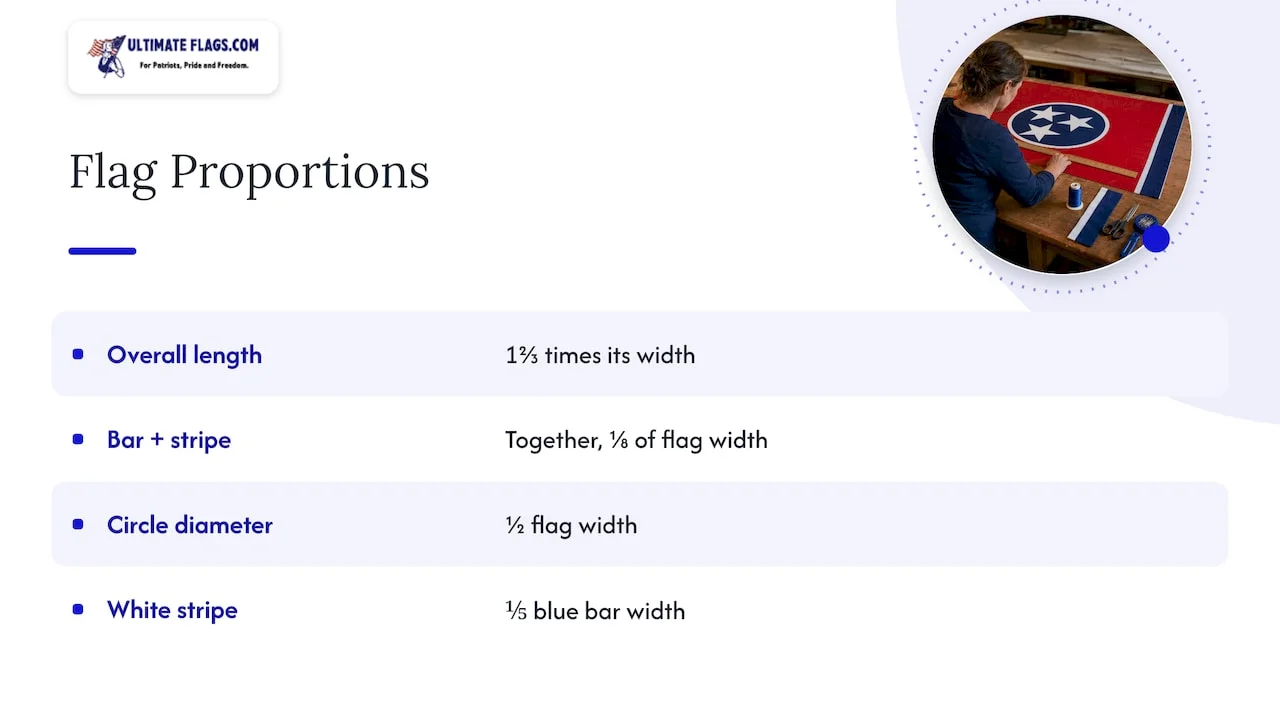
In plain terms, the circle should be generous but leave plenty of red around it. The Tennessee Department of Military Affairs points out that manufacturers often ignore that specification, with some flags showing the blue disc filling nearly the whole red field. If you are collecting or displaying a Tennessee flag, look at the proportion of circle to red. A faithful flag shows a clear band of crimson around the disc.
The exact shades of red and blue are not strictly defined by law, which is why you will see variation from one maker to another. The flag is also commonly flown the wrong way up, which is the most common display error. Check that the highest star points toward the upper corner by the pole.
After the Flag: Reeves and the Emblem’s Afterlife
Reeves went on to a long career. The Tennessee Encyclopedia notes he resigned his captaincy in 1906, became a major and judge advocate for the Tennessee National Guard, served during the Mexican border crisis, volunteered for the U.S. Army in January 1918, rose to colonel and retired in 1940. He died in 1960 and is buried in Johnson City’s Oak Hill Cemetery.
His design has moved well beyond the capitol. The central tri-star emblem has become an unofficial state logo, and it appears in the logos of First Horizon Bank and the Tennessee Titans. That is perhaps the highest compliment a design can earn: people who have never read Chapter 498 recognize it instantly.
Flying Tennessee’s Flag Well
If the history makes you want to fly it, a few choices matter. A 3 x 5 foot flag is the familiar standard for a home display, and our flagpole sizing guide shows what height suits a one-story or two-story house. For mounting, see flagpole types and footing rules and where to place the cleat in our flagpole cleat height guide.
For the wider story behind state banners, what state flag symbols really say and when states redesigned their flags make natural companions to this one. Collectors of Tennessee’s military past can also browse Army of Tennessee regiment flags and the 10th Tennessee Regiment flag.
Our Perspective
A state flag is a short history lesson that you can hang from a pole. Tennessee’s is one of the best, because its story is not about a battle or a king. It is about a captain who believed a divided state could see itself in three stars and a circle, and who kept writing letters until the banner was made correctly.
That is the spirit in which we approach flags. As America’s oldest online flag store, we think a flag belongs where people can see it, whether on a porch, in a classroom, at a reenactment or at a veterans’ hall. Telling the stories of history through flags is the heart of what we do, and Tennessee’s tri-star flag is a story worth flying.
When you choose one, look for a flag whose circle, bar and stripe honor the proportions Reeves set down in 1905. Choose the fabric and finish for where it will fly, and fly it high, with the highest star toward the upper corner by the pole.
John Hough
Bring the Tennessee Flag Home
We carry the State of Tennessee flag in several constructions, including cotton sewn, nylon embroidered 300D, standard and nylon printed, all in 3 x 5 ft. You can see the full range on our Tennessee flag page, and find poles and mounting hardware in our flagpoles and hardware collection.

Browse the rest of the catalog, from state and USA flags to historic war and military flags, in our flag collections.
FAQ
What does the Tennessee flag symbolize?
The flag symbolizes unity among Tennessee’s three Grand Divisions: East, Middle and West. The three white stars stand for them, and the blue circle binds them together. The red field, blue bar and white edgings were chosen for visibility and contrast, according to Reeves’s own explanation.
Who designed the Tennessee flag and when was it adopted?
Captain LeRoy Reeves of the Third Regiment, Tennessee Infantry, designed it. The legislature adopted it by an act approved April 17, 1905. It first flew at the National Guard armory in Johnson City.
What was Tennessee’s first state flag?
The first official flag was approved April 30, 1897. It had diagonal red, white and blue stripes, the words “The Volunteer State” and the number 16 for Tennessee’s place as the sixteenth state. It was used until 1905 but seldom seen in public.
How should the stars be arranged?
The law calls for three white five-pointed stars at equal intervals within the blue circle. No two star centers may line up parallel to the flag’s sides or ends, and the highest star sits nearest the upper corner next to the pole. Flying the flag upside down is the most common mistake.
Sources
- Tennessee State Symbols, Tennessee Secretary of State
- A Grand Design: Captain Le Roy Reeves and the Tennessee State Flag, Tennessee State Museum
- TN225: The Tennessee State Flag, Tennessee State Museum
- State Flag and State Seal, Tennessee House legislative manual
- Early Tennessee Flags, Archives of Appalachia
- Reeves, Lee Roy, Tennessee Encyclopedia
- Reeves State Flag, Tennessee Historical Society
- Tennessee Flag Exists Because of One Man’s Persistence, The Tennessee Magazine
- Tennessee State Flag, Tennessee Department of Military Affairs
- Flag of Tennessee, Wikipedia