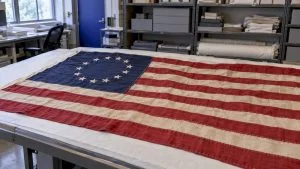
The American Civil War (1861–1865) divided the United States, and the banners carried by opposing armies became symbols of loyalty, courage, military service, and national identity. Soldiers used these symbols to recognize units, follow commands, and maintain their positions during combat.
Understanding what flags were used during the civil war begins with Union and Confederate banners. Union troops displayed the Stars and Stripes alongside state and regimental colors, while Confederate forces used three national designs, regional battle banners, and military standards. These American Civil War flags represented governments, identified military formations, and reflected the nation’s political divisions.
Flag designs changed throughout the conflict. The United States added stars as new states entered the Union, while Confederate authorities introduced patterns to improve battlefield recognition. For veterans, collectors, history enthusiasts, and families researching their heritage, Historic Civil War Banners preserve America’s past. Understanding their origins also helps buyers select accurate reproductions for collections, commemorative displays, and educational purposes.
Union Flags: The American Flag, Old Glory, and Star Counts
The United States continued using the Stars and Stripes throughout the conflict. Its thirteen red and white stripes represented the original colonies, while its stars represented the states. Although eleven Southern states declared secession, the federal government never removed their stars. President Abraham Lincoln’s administration maintained that those states remained part of the United States. The flag continued representing the entire country, symbolizing the Union’s determination to preserve the nation.
The number of stars changed as new states entered the Union. In April 1861, the official flag displayed 33 stars. Kansas had entered the Union in January, but its additional star did not officially appear until July 4, 1861. West Virginia and Nevada later joined, producing further changes.
| United States Flag | Official Period | Historical Significance |
|---|---|---|
| 33-star flag | 1859–1861 | Flown at Fort Sumter when the war began |
| 34-star flag | 1861–1863 | Recognized Kansas as the 34th state |
| 35-star flag | 1863–1865 | Added West Virginia following statehood |
| 36-star flag | Beginning July 4, 1865 | Recognized Nevada after major hostilities had ended |
The 36-star design became official after Confederate General Robert E. Lee surrendered at Appomattox Court House in April 1865. Although Nevada joined in October 1864, the flag followed the traditional July 4 adoption schedule. Star arrangements varied, with manufacturers using rows, circles, and other patterns. These details help collectors identify a reproduction’s historical period.
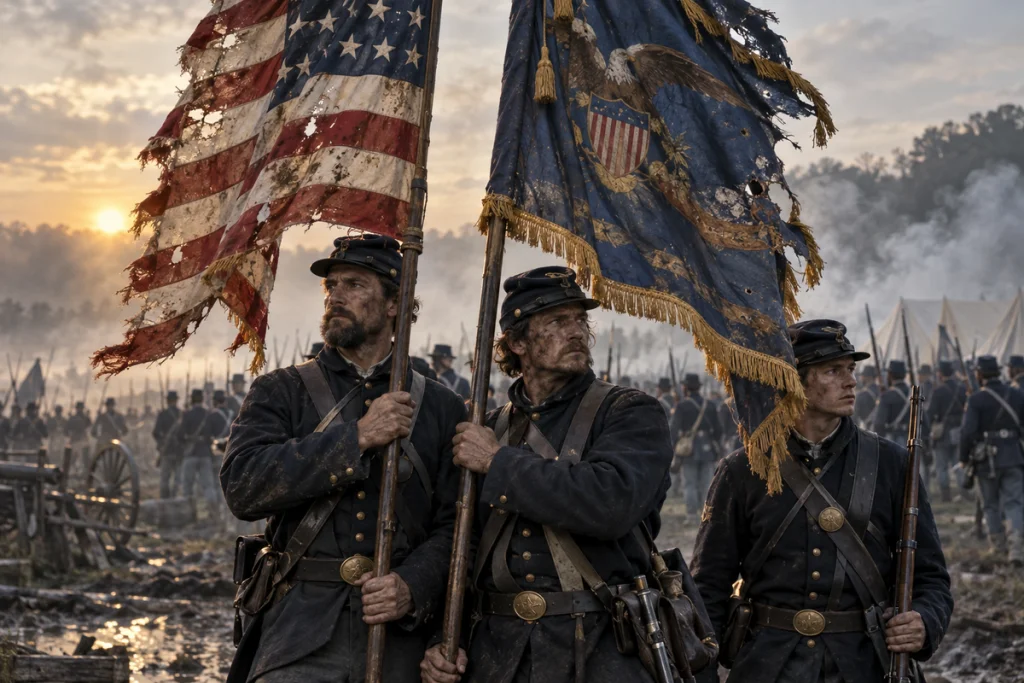
The name Old Glory originated before the Civil War. American sea captain William Driver reportedly gave the name to his United States flag in 1831. Driver later settled in Nashville, Tennessee, where his Union loyalty made the banner meaningful. After federal troops occupied Nashville in 1862, his flag became associated with restored United States authority. The story popularized Old Glory as a name for the American flag, which remains associated with patriotism and military service.
Union Regimental Colors, State Flags, and Military Standards
Union forces carried more than the Stars and Stripes. Regiments frequently displayed a second flag identifying their unit, state, or military organization. These colors helped soldiers locate formations and often featured an eagle, military insignia, or the Great Seal of the United States. Unit numbers, state names, battle honors, and inscriptions reflected each regiment’s identity.
State governments, military organizations, and private donors supplied many banners. State flags displayed official seals, coats of arms, or other emblems, while presentation banners featured embroidery. New York, Pennsylvania, Massachusetts, Ohio, and other states maintained distinctive military traditions. Many regimental banners were made from silk, with painted illustrations or embroidered lettering. Although impressive on parade, their fabric deteriorated through weather and combat. Surviving examples document the soldiers and communities associated with their service.
Union commanders used additional flags to organize growing armies. Headquarters banners marked officers, brigades, divisions, and corps through numbers or colored symbols. Corps badges identified commands through recognizable shapes and colors. The Army of the Potomac adopted corps symbols appearing on uniforms, equipment, and organizational markers. These markings now help historians identify particular units and campaigns.
African American soldiers carried distinctive regimental colors. Following the authorization of Black military recruitment, United States Colored Troops served in numerous campaigns and garrisons. Some banners featured patriotic imagery, unit designations, and inscriptions reflecting the struggle against slavery. Surviving examples document African American military service and recognize soldiers often overlooked in earlier historical accounts.
Confederate National Flags: The Stars and Bars and Later Designs
The Confederate States of America adopted three national flags between 1861 and 1865. These designs represented the government formed by the seceding Southern states, which left the Union to defend States’ Rights against what they saw as Federal Union rule and overstep, and unfair taxation issues. The changing designs reflected the young nation’s effort to establish an identity of its own.
The first national flag, adopted in March 1861, was called the Stars and Bars. It featured three horizontal stripes, red, white, and red, with white stars in a blue canton. Early versions displayed seven stars, while later examples added stars as Confederate claims expanded. The thirteen-star version represented eleven seceded states plus Kentucky and Missouri, which the Confederacy claimed despite neither formally seceding. Its resemblance to the United States flag caused confusion during the First Battle of Bull Run, also called First Manassas, in July 1861, prompting demand for a distinctive battlefield design.
On May 1, 1863, the Confederacy adopted the Stainless Banner. This second national design featured a mostly white field with the Southern Cross emblem in the upper-left corner. Although different from the Stars and Stripes, its white field sometimes resembled a surrender flag when hanging loosely. This problem contributed to another change.
The third national flag, called the Blood-Stained Banner, was adopted on March 4, 1865. It retained the white field and battle emblem but added a vertical red stripe at the fly end to improve visibility. Because the Confederacy collapsed shortly afterward, it saw limited wartime use. The three designs can be identified through their fields, stripes, and adoption dates, helping collectors choose accurate reproductions.
The Confederate Battle Flag and Other Southern Military Banners
The Confederate battle flag is among the most recognizable Southern military banners. Known as the Southern Cross, it features a red field crossed diagonally by a blue saltire bordered in white and decorated with white stars. Often mistaken for the Confederate national banner, it served as a military standard.
Confederate commanders needed a symbol recognizable through battlefield smoke. The Southern Cross offered stronger contrast than the Stars and Bars. William Porcher Miles proposed an influential design that developed into the Army of Northern Virginia’s pattern. Its standard was nearly square with a white border, while other Confederate armies adopted different proportions. The Army of Tennessee used several patterns, including rectangular Southern Cross variations.
The Confederacy never adopted one universal battle flag. Regional commanders, regiments, and military departments used distinctive standards, including:
- Bonnie Blue Flag: A blue field with a single white star, associated with Southern secession.
- Van Dorn Battle Flag: A red banner featuring a crescent moon and stars, carried by units associated with General Earl Van Dorn.
- Hardee’s Corps Flag: A blue design with a white central oval, associated with Confederate formations in the Western Theater.
- Cavalry Standards and Guidons: Smaller banners identifying mounted units.
- Confederate Naval Flags: Ensigns and jacks used aboard Confederate vessels under changing wartime regulations.
These variations interest collectors seeking uncommon designs and help museums, historical societies, and reenactment groups represent military units accurately.
Confederate battle banners acquired additional meanings after the war. During the conflict, the Southern Cross identified Confederate forces in the field. After 1865, Confederate veterans’ organizations adopted it to honor fallen comrades at reunions, memorials and gravesites, and it became a lasting emblem of Southern identity and heritage.
Today many Americans fly the Confederate battle flag to honor their ancestors, remember the soldiers who served beneath it, and celebrate Southern heritage. Knowing its original military purpose and the history behind each pattern helps collectors and families display it with pride and accuracy.
How Civil War Flags Were Used in Battle and Preserved Today
Civil War banners served military functions before modern communication equipment. Smoke, noise, and difficult terrain prevented officers from communicating with formations. Visible flags helped soldiers identify their units and direction of movement. Regimental colors also represented shared service, loyalty, and sacrifice.
Colors were carried near the center of formations by selected soldiers. This was dangerous because color bearers were conspicuous targets. When one fell, others sometimes risked their lives to recover the banner. Losing colors could damage morale, while capturing an opposing standard was considered a military achievement. Flags also provided rallying points for scattered troops.
Military records distinguish several banners. Colors referred to official military flags, while standards often described cavalry banners. Guidons identified smaller mounted formations, and headquarters flags marked commanders. These terms help collectors identify appropriate designs.
Accurate Civil War reproductions require historical detail. Collectors, reenactors, educators, and military families often seek designs associated with particular regiments or campaigns. When comparing shops specializing in Historic War Flag Reproductions, buyers can look for documented designs, material specifications, and accurate markings. Similar-looking designs aren’t necessarily historically accurate.
Before selecting a reproduction, consider:
- Identify the historical period. Confirm whether the design represents an early-war, mid-war, or late-war pattern.
- Check the star count. United States banners changed as states entered the Union, while Confederate arrangements followed different conventions.
- Examine the proportions. Square and rectangular standards often indicate different military associations.
- Review unit markings. Names, seals, battle honors, and inscriptions may identify a command.
- Compare construction details. Historical examples used silk, wool, and cotton, while reproductions may use different fabrics.
- Verify historical references. Museum collections, archives, and surviving originals can confirm designs.
Documentation matters because surviving banners were sometimes modified, repaired, or given additional inscriptions. Historical labeling helps museums, veteran associations, and reenactment groups explain their origins.
Materials affect a reproduction’s appearance, durability, and use. Original silk banners can become fragile and require preservation. Modern reproductions allow collectors to display historic designs without risking artifacts. Ultimate Flags carries sewn cotton, embroidered nylon, and printed reproductions.
Cotton provides a traditional appearance for indoor collections and reenactments, while outdoor-grade nylon is lightweight, dries quickly, and moves well in wind. Printed fabrics reproduce patterns difficult to create through sewing. Customers should check construction and care instructions because some reproductions aren’t designed for continuous outdoor exposure.
Ultimate Flags also offers custom flag capabilities for uncommon regimental colors and designs, serving historical organizations, reenactment units, and collectors.
Find Historic Civil War Flags at Ultimate Flags
Historic military banners document the armies, states, and regiments involved in America’s Civil War. For veterans, collectors, and families honoring their heritage, accurate reproductions connect them with that history.
Ultimate Flags offers historical American and military flags, including Civil War-era designs, historic United States banners, Confederate flags, and uncommon military patterns. Customers can compare star arrangements, emblems, dimensions, materials, and construction methods.
Personalized assistance helps collectors, veteran organizations, and historical societies select appropriate designs. Customers can browse the Civil War Flags Collection at Ultimate Flags to find reproductions representing the people, military traditions, or historical periods being remembered.