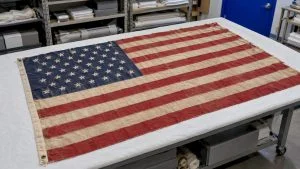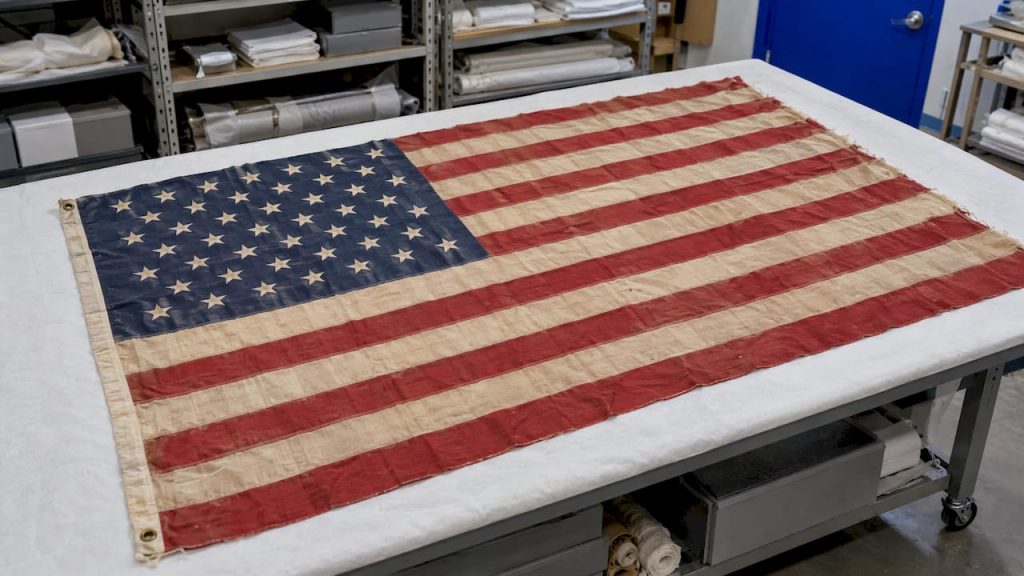
Most 49 star flags are worth modest money, and a few are worth a great deal. A common cotton or ceremonial flag from 1959 usually lands in the low hundreds of dollars at auction, while a flag with documented history, such as one flown over a landmark on July 4, 1959, or made for the Navy, is valued for its story far more than its stars. Provenance, condition, size and maker decide where your flag falls.
The 49 star flag carries one of the most compact chapters in American history. It marks Alaska’s arrival as the 49th state and flew officially for just one year. That brevity feeds its legend, and also the confusion about its price. Here is how to read the market honestly, so you know what you hold or what you are about to buy.
TL;DR
- The 49 star flag was official only from July 4, 1959, to July 3, 1960, so the design is scarce in time but was made in large numbers.
- One documented auction result: a ceremonial 49 star flag, circa 1959, estimated at $300 to $500, sold for $531 with buyer’s premium in November 2019.
- Value rests on authenticity, rarity, provenance, condition, size and association, according to the North American Vexillological Association (NAVA).
- Documented history, like flying over a famous site, matters more than the star count alone.
- If you want a 49 star flag to fly or display rather than to invest in, a new Alaska-era flag is the practical, proud answer.
Table of Contents
- Why the 49 Star Flag Exists, and Why Its Window Was So Short
- What a 49 Star Flag Is Actually Worth
- The Six Factors That Move the Number
- The One-of-a-Kind Flag: Eisenhower’s Presidential 49 Star
- Don’t Confuse the 1935 Hawaiian Flag With the 1959 Design
- Before You Sell or Buy: A Simple Routine
- Displaying the Story Without Risking the Heirloom
- Bring Alaska’s Year Home
- Perspective
- FAQ
- Sources
Why the 49 Star Flag Exists, and Why Its Window Was So Short
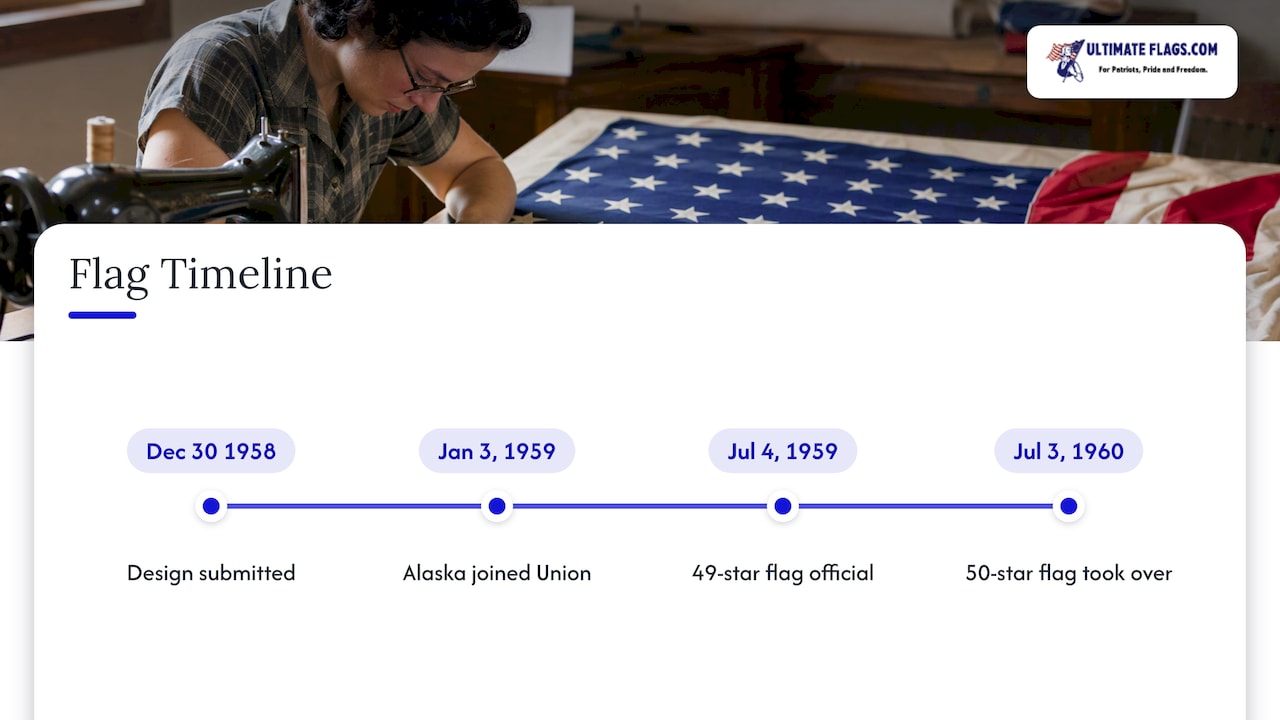
Alaska entered the Union on January 3, 1959. The new flag was unfurled right after President Eisenhower signed the admission documents, and the new design became official on July 4 of that year. According to the Smithsonian, the 49 star flag stayed official until July 3, 1960, when the 50 star flag took over after Hawaii joined.
The Eisenhower Presidential Library records that the design committee formally submitted its design on December 30, 1958, and that the flag was first raised officially at Fort McHenry on July 4, 1959, with the Secretary of the Interior presiding. Fort McHenry, where the song that became our national anthem was born, was the natural stage.
If you want the whole story of that single year, from the Alaska statehood debate to the arrangement of the stars, we tell it in our 49 star flag history.
What a 49 Star Flag Is Actually Worth
The honest answer is a range, because “49 star flag” describes everything from a mass-produced commercial flag to a one-of-a-kind presidential banner. A fair picture comes from documented sales and from the people who study flags for a living.
A documented auction result
A ceremonial 49 star flag commemorating Alaska statehood, circa 1959, came up at Hindman Auctions in Philadelphia on November 24, 2019. It had embroidered stars on a rayon canton, rayon stripes, a sleeve hoist and gold fringe, and measured 39 by 46 inches. It carried an estimate of $300 to $500 and realized $531 including the buyer’s premium. That is a useful anchor: a handsome, well-made ceremonial flag from a serious collection, sold in the low hundreds.
How collectors frame older American flags
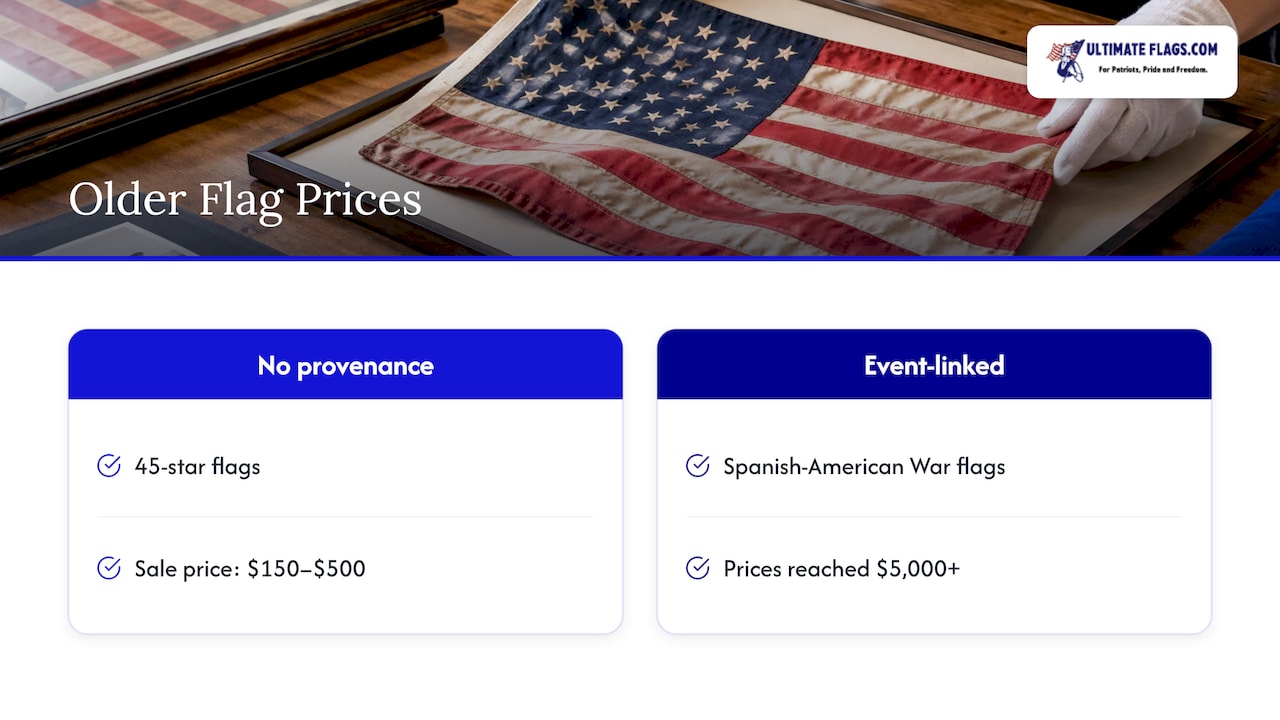
Jim Ferrigan, curator of the Zaricor Flag Collection, answers collector questions for NAVA. He gives comparables across the older flag market: 45 star flags without provenance sell for roughly $150 to $500, while flags tied to events such as the Spanish-American War have reached $5,000 and beyond. The same page explains that for common 48 and 49 star flags, the cost of a professional appraisal would likely exceed the flag’s value, and that family sentimental value may well exceed the monetary value.
That matches the supply picture. When Hawaii’s admission was voted on in March 1959, the Dettra Flag Company of Oaks, Pennsylvania, lost about $150,000 in canceled orders and unsalable inventory, and the Saturday Evening Post reported the 49 star flag set off the biggest boom the flag business had ever known. Flags made in that volume are not rare objects by count.
The practical value ladder
| Type of 49 star flag | What to expect |
|---|---|
| Common commercial cotton or nylon flag, no history | Modest value; sentimental worth often exceeds market worth |
| Ceremonial flag with embroidered stars and fringe, good condition | Low hundreds of dollars at auction (one 2019 sale: $531 with premium) |
| Flag with documented flight, military or naval origin, or a named owner | Priced on its story; can climb well beyond the others |
| Unofficial 49 star flags made before 1959 | Different category; judged on their own history, not as the 1959 design |
| Presidential flag made for the Oval Office | Effectively unique, preserved by its family rather than traded |
As always with antiques, one or two sales do not make a price list. Auction results move with who is bidding and what else is in the room, so treat any figure as a snapshot of its year.
The Six Factors That Move the Number
NAVA’s guidance names six drivers: authenticity, rarity, provenance, condition, size and association. Here is what each means in plain terms for a 49 star flag.
Authenticity
Is it truly a flag from the 1959 to 1960 era, or a later reproduction? The star count alone proves nothing, because 49 star flags are made today for display and reenactment. Fabric, stitching, hardware and age-appropriate wear all matter. Our guide on telling a replica from an antique walks through the same habits of inspection for the 48 star flag, and they carry over.
Rarity
Rarity here is subtle. The design lasted one year, but production was heavy. The flags that are truly scarce are the ones that are scarce in survival: intact, unfaded, undamaged and unaltered.
Provenance
Provenance is the paper trail, the story that travels with the flag. It is the single biggest lever. The Anchorage Museum holds two 49 star flags, one that flew over the U.S. Capitol on July 4, 1959, and one that flew over Juneau the same day. Museum staffer Adam Baldwin says the Capitol flag has a level of national significance no other flag would have. The design is the same as thousands of others. The documented history is what makes it extraordinary.
The Star Spangled Banner Flag House and Museum shows the same principle: its collection includes the first 49 star flag officially hoisted at Fort McHenry at midnight on July 4, 1959, along with other 49 star flags collected between 1959 and 1997.
Condition
Fading, staining, moth holes, tears and old repairs all cost value. Cotton and wool-blend flags of that era are fragile, so a clean, bright flag is worth meaningfully more than a damaged one of the same type. Store it flat or rolled with acid-free materials, away from sunlight and damp.
Size
Size matters less than people expect. A big flag is not automatically a valuable one, and large flags are harder to display and store. A well-preserved flag of a standard size, with a good story, beats an oversized flag with problems.
Association
Association means a connection to a person or event: a funeral, a ceremony, a ship, a unit, a landmark. Here the Navy connection is worth knowing. One long-time flag researcher notes that Navy-made 49 star flags are the main exception to the generally low value of common ones, so any markings tying a flag to naval manufacture deserve a closer look.
The One-of-a-Kind Flag: Eisenhower’s Presidential 49 Star
At the top of the scale sits a flag no collector can buy. The Defense Logistics Agency reports that only one 49 star presidential flag was ever made, placed in Eisenhower’s Oval Office in 1959. Its fringes are real gold and silver, unlike the metallic thread on today’s presidential flags. The Douglas family inherited it from a former Army Quartermaster supply officer who served under Eisenhower, and they keep it in a secured vault in Lakeland, Florida, at 78 degrees Fahrenheit and 50 percent humidity to protect the silk.
That flag shows the top of the range: a maker’s one-off, a verified chain of custody, and professional conservation.
Don’t Confuse the 1935 Hawaiian Flag With the 1959 Design
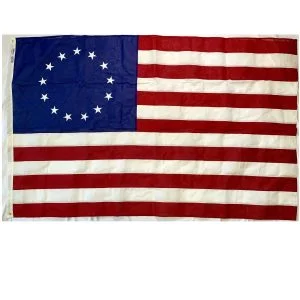
Some “49 star” flags predate 1959 entirely. The U.S. House of Representatives collection includes a small unofficial 49 star flag from 1935, stitched by four Hawaiian women while Hawaii hoped for statehood. It is a lovely piece of history, but it is not the official 1959 to 1960 flag. If a seller describes a flag this way, understand which story you are being offered, because the two are valued on completely different grounds.
Before You Sell or Buy: A Simple Routine
- Look at the flag closely. Note the fabric, how the stars are applied (printed, sewn or embroidered), the stitching, any tags, markings or stamps, and the hoist.
- Gather the story. Who owned it? Was it flown at a landmark, a base, a ship or a ceremony? Letters, photographs and receipts raise confidence and price.
- Compare with recorded sales. Look at completed auction results for similar flags in similar condition, not asking prices.
- Think about the appraisal. NAVA’s curator advises that for common 48 and 49 star flags, an appraisal may cost more than the flag is worth, which makes a general auction the logical venue. A flag with a real documented history justifies a specialist’s opinion.
- Protect it meanwhile. Keep it out of direct light, off wood and cardboard that release acids, and do not wash or press an old cotton flag.
Sentimental value deserves a place in this routine too. A flag that draped a grandfather’s mantel or flew at a hometown celebration may be worth far more to your family than any bidder will pay.
Displaying the Story Without Risking the Heirloom
One fact surprises many owners: no American flag ever becomes obsolete. Anchorage Museum staff note that all official versions of the flag remain valid and can still be flown officially. So a 49 star flag is a legal flag to fly, but an aging 1959 cotton flag does not belong on a pole in wind and rain. Wear is exactly what destroys its collector value.
The practical answer is to separate the two jobs. Keep the antique protected, and fly or display a new flag that can take the weather. For that, we carry the 49 Star USA Flag for Alaska, an outdoor flag made in America. If your collecting reaches into the 48 star era that preceded it, our 48 star flag value guide covers the same questions for the flag that flew for 47 years.
Bring Alaska’s Year Home
At Ultimate Flags, we have offered flags online longer than any other flag store in America, and our catalog runs from everyday USA flags to historic war flags, state flags, military flags and the poles and hardware to fly them. If the 49 star design is what drew you here, the Alaska outdoor flag above is ready to fly, and our 48 star flag collection is the natural next stop for the era just before it.

Browse the full range of American flags and accessories to build a display that honors every chapter of the Stars and Stripes.
Perspective
Every flag whispers a story, and the 49 star flag tells one of the shortest and sharpest. For twelve months, Alaska’s star stood on the field of blue, then gave way to Hawaii’s. That brevity gives the flag its romance, and it is why collectors ask what it is worth.
Our view is simple. The value of an old flag lives in its history: where it flew, who raised it, who kept it safe. A stack of unmarked 1959 flags is just cloth and thread. A flag with a witness behind it is a piece of the nation’s memory. Respect that difference, and you will never overpay or undersell.
We also believe flags are made to be flown. A fragile heirloom deserves a quiet, protected place. The flag that greets your neighbors each morning should be a fresh one, built for sun and wind, carrying the same stars. That is why we keep the full story of the Stars and Stripes in stock, from the 48 star flag of two world wars to Alaska’s 49, so you can honor the past and still raise it high today.
John Hough
FAQ
Are old flags worth any money?
Some are, but most are worth more as keepsakes than as investments. NAVA’s curator notes that value turns on authenticity, rarity, provenance, condition, size and association, and that flags tied to a documented event can bring thousands while ordinary ones sell for far less.
Did they ever make a 49 star flag?
Yes. It became official on July 4, 1959, after Alaska’s admission, and was replaced on July 4, 1960, by the 50 star flag. It was made in volume and flown officially at Fort McHenry, among many other places.
How much is a 48 star flag worth today?
It depends on age, condition and provenance, and our 48 star flag value guide breaks down the range. Because the 48 star flag was official for 47 years, many survive, and the same rule applies: documented history lifts the price.
Is there a 49 star flag available for sale?
Yes, both ways. Vintage examples turn up at auction and from private collectors. For flying or display, we offer a new 49 star Alaska outdoor flag made in America.
Sources
- Smithsonian: Flag Day facts
- Eisenhower Presidential Library: Design of the 49 and 50 star flags
- American Presidency Project: Remarks upon signing the Alaska proclamation
- Hindman Auctions: ceremonial 49 star flag, Lot 184
- North American Vexillological Association: United States national flag FQ&A
- Saturday Evening Post: the short-lived 49 star flag
- Alaska’s News Source: 49 stars for the 49th state
- Star Spangled Banner Flag House collection: 49 and 50 star flags
- Defense Logistics Agency: the only 49 star presidential flag
- U.S. House of Representatives: 49 Stars for Old Glory
- Availability and Value of Antique American Flags