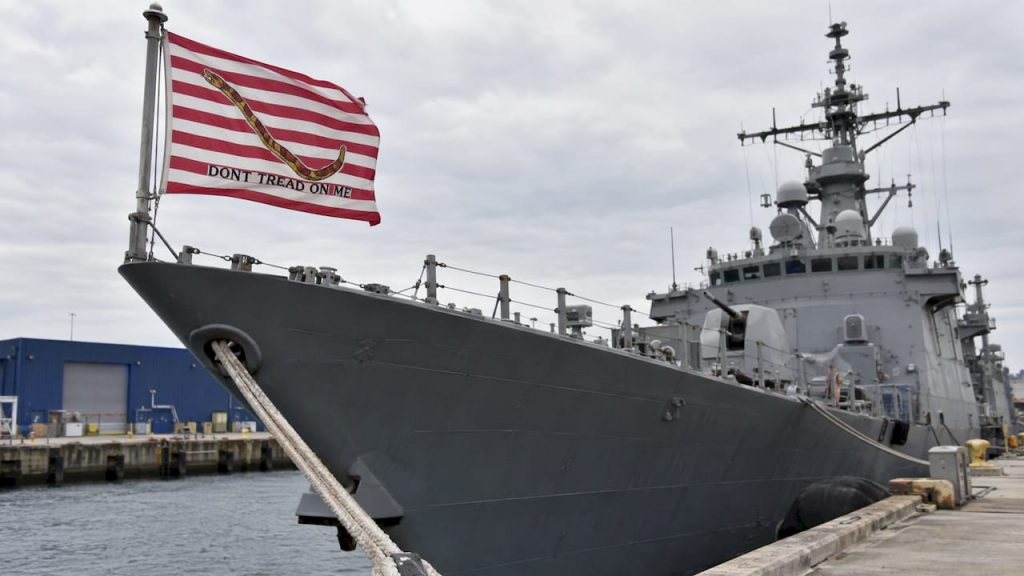
The First Navy Jack is the flag of thirteen red and white stripes crossed by a coiled rattlesnake and the warning “Don’t Tread on Me,” and today the U.S. Navy reserves it as an honor for its oldest active ship. Its roots in the Continental Navy are a matter of tradition more than proof, and that is part of what makes it so enduring. If you want to fly this banner at home, our Navy jack flag collection carries it.
TL;DR
- The First Navy Jack pairs a rattlesnake and the motto “Don’t Tread on Me” over thirteen stripes, symbolizing vigilance, unity and liberty.
- A “jack” is a small flag flown at the bow of a ship in port or at anchor.
- The Navy’s own historians call the evidence that the Continental Navy flew this exact design inconclusive.
- Ships flew it fleetwide from 2002 until June 4, 2019, when the Navy returned to the Union Jack.
- Today it belongs to the commissioned ship with the longest total time in active status, excluding USS Constitution.
Table of Contents
- What a jack is, and why this one is “first”
- What the rattlesnake and the motto mean
- What the evidence says about 1775 and 1776
- First Navy Jack or Gadsden flag?
- From the Bicentennial to a fleetwide jack
- Why the Navy returned to the Union Jack in 2019
- Why the First Navy Jack still moves people
- Choosing a First Navy Jack flag for display
- Fly the First Navy Jack
- FAQ
- Sources
What a jack is, and why this one is “first”
Before the rattlesnake, there is the word itself. In naval usage, a jack corresponds to the union, the blue canton of stars on the national ensign, and on a sailing vessel it is hoisted at the bow while the ship is at anchor or in port. The ensign speaks for the nation from the stern. The jack greets the harbor from the bow.
The “first” in First Navy Jack points back to the earliest days of American sea power, when the Continental Navy was born in the autumn of 1775. Tradition holds that its ships flew a jack of thirteen stripes with a rattlesnake stretched across them and the motto beneath. That is the picture the name carries, and it is the picture that sailors, collectors and patriots have carried ever since.
What the rattlesnake and the motto mean
The rattlesnake was no random choice. The U.S. Fish and Wildlife Service describes the timber rattlesnake as a Revolutionary-era emblem of unity, vigilance, resistance to tyranny and liberty. Its warning rattle before it strikes made it a natural voice for the motto.
Benjamin Franklin admired the creature for just that reason. According to the same Fish and Wildlife account, he wrote that the rattlesnake never begins an attack and, once engaged, never surrenders. It is peaceful when left alone and dangerous when disturbed. A young nation facing the greatest navy on earth could hardly have asked for a better emblem.
The thirteen stripes carry the other half of the message. Each stands for one of the original colonies, so the flag speaks of many wills bound into one. Coiled snake, united stripes, plain warning: it is a banner that does not shout, and for that reason it is feared.
What the evidence says about 1775 and 1776
Here the honest historian must slow down. The story that this exact flag flew from Continental Navy ships is beloved, but the Navy’s own history office treats it carefully.
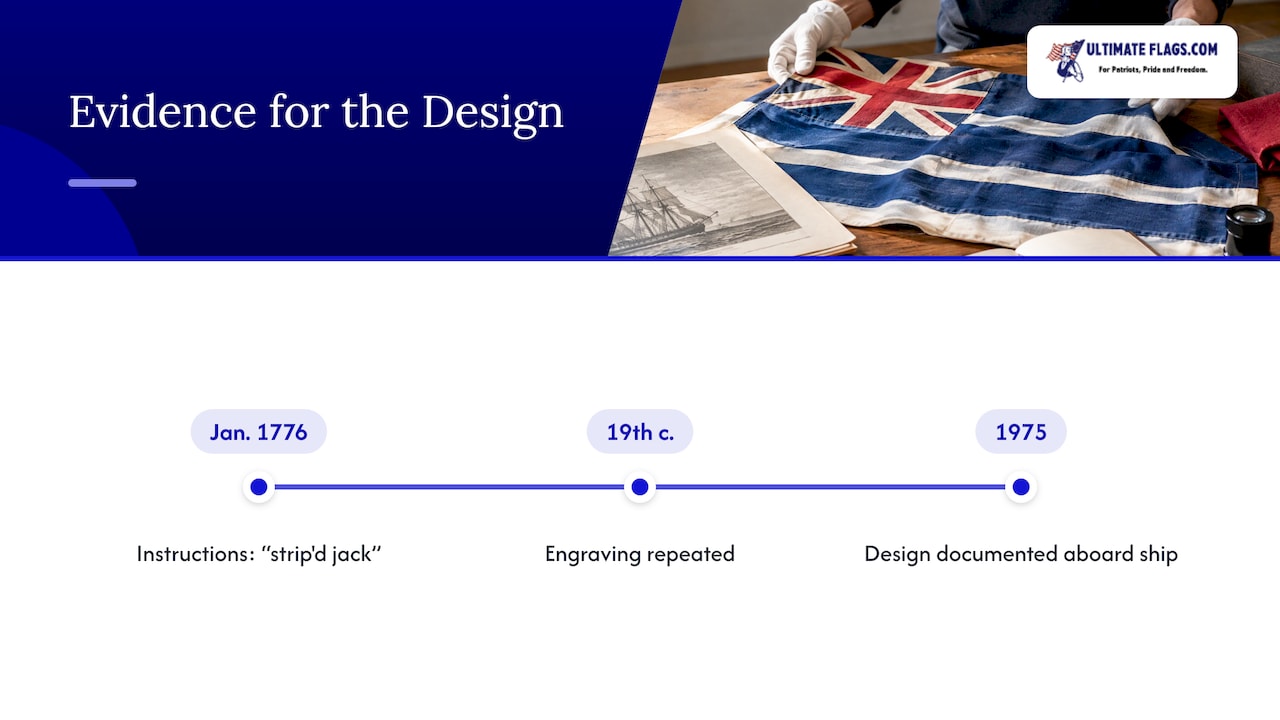
Commodore Esek Hopkins’s January 1776 instructions mention only a “strip’d jack.” There is no snake and no motto in them. The Naval History and Heritage Command says the evidence is inconclusive and suggests that a plain striped flag may have been what the ships carried.
The snake and the motto did unquestionably appear together on other Revolutionary-era flags, and later tradition tied them to the fleet. A February 2019 account in the Naval Institute’s Proceedings adds that the familiar design was not documented aboard a U.S. Navy ship until 1975 and may trace to an erroneous 1776 engraving repeated in the nineteenth century.
What does that mean for the reader who loves the flag? It means the First Navy Jack is best understood as a symbol the Navy and the public have chosen to honor, built from authentic Revolutionary ingredients: the stripes, the snake, the defiant words. The spirit is as old as the Republic, even if the exact arrangement of the pieces is a later inheritance.
First Navy Jack or Gadsden flag?
People often ask whether the “Don’t Tread on Me” Navy jack and the Gadsden flag are the same thing. They are cousins, not twins.
The Gadsden flag was Hopkins’s personal standard: a coiled snake on a yellow field. The First Navy Jack is the striped design with the rattlesnake over it, and its exact Revolutionary use is the disputed point above. Both share the motto and the rattlesnake, which is why they are so often mixed up. When you shop, look for the field: yellow means Gadsden, stripes mean the Navy jack.
| Feature | First Navy Jack | Gadsden flag |
|---|---|---|
| Background | Thirteen red and white stripes | Solid yellow field |
| Emblem | Rattlesnake across the stripes | Coiled rattlesnake |
| Motto | “Don’t Tread on Me” | “Don’t Tread on Me” |
| Role | Naval jack flown at the bow | Commodore Hopkins’s personal standard |
From the Bicentennial to a fleetwide jack
The flag’s modern story begins in 1975, the Bicentennial era. Navy ships flew the First Navy Jack to mark the 200th anniversary of the service, and it was seen again on vessels through 1976. After that the Navy returned to the Union Jack.
The tradition of honoring the oldest ship came next. In 1998 a Navy Wire Service report told how USS Independence passed the First Navy Jack to USS Kitty Hawk after Kitty Hawk became the oldest ship in the fleet, and Kitty Hawk displayed it in place of the Union Jack. The old flag had become a mark of seniority: the ship that had served longest carried the oldest banner.
In the years after September 2001 the Navy widened the practice, and all ships flew the First Navy Jack. The Naval Institute article quoted above notes that for 17 years, all Navy ships flew it. For many sailors and for many Americans watching ships come into port, the rattlesnake jack became the face of the fleet.
Why the Navy returned to the Union Jack in 2019
On February 21, 2019, the Chief of Naval Operations issued NAVADMIN 039/19. It directed all Navy ships and craft to display the Union Jack in place of the First Navy Jack at morning colors on June 4, 2019, the anniversary of the Battle of Midway.
The message framed the change as the start of a new era of competition and stressed the Union Jack’s symbolism of the cumulative strength of the nation and its Navy. It also restored an older honor: the First Navy Jack is reserved for the commissioned ship in active status with the longest total period in active status, excluding USS Constitution. The Pacific Fleet announcement is the clearest place to read how the order was framed.
That is the answer to the question most readers actually bring: the flag was not abolished or disowned. It went back to being a distinction. Reporting on the changeover named USS Blue Ridge as the ship flying it, and Blue Ridge, commissioned in 1970, is described as flying it because she is the oldest actively commissioned warship in U.S. service. Because ships retire and the title passes, check the Navy’s official pages for the ship that holds it now.
Why the First Navy Jack still moves people
There is a reason a flag with a disputed pedigree has lasted. It says in six words what a whole generation of revolutionaries meant: leave us be, or face the consequences. Sailors who stood their watches beneath it could read it as pride in a service older than the Constitution itself. Civilians read it as a reminder that liberty is guarded, not granted once and forgotten.
For veterans, the jack is often personal. It recalls ships, shipmates and the ports of a career. For history enthusiasts it is a puzzle with real documents behind it, from Hopkins’s instructions to a century of engravings. For collectors it is one of the most recognizable naval designs ever stitched. Each of those readers is looking at the same snake, and each finds something different in the coil.
Choosing a First Navy Jack flag for display
A few practical points help you pick well.
- Decide where it will fly. A jack was made to be flown at the bow, but on land it looks right on a porch bracket, a garage wall, a boat, or a pole beside the national flag.
- Match the size to the pole. A small flag on a tall pole looks lost, and a large one on a short pole wraps and tears. Our guide to flagpole types and footing rules walks through the sizing questions.
- Think about the wind. Outdoor flags wear faster in constant wind, so choose a quality level that suits the spot, and bring it in during storms.
- Mind the order of honor. When displayed with the Stars and Stripes, the U.S. flag takes the position of honor. Keep the jack beneath or beside it, never above.
- Pair it with the right hardware. Our flagpoles and hardware collection covers brackets and poles, and an anti-furl rotating pole keeps a small flag from wrapping.
If you collect, the same shelf extends naturally to the rest of the Revolutionary story. Our historic war flags sit alongside the jack for readers who want the full sweep from Lexington to the Civil War.
Our perspective
We have spent our years telling the stories of history through flags, and the First Navy Jack is one we return to often, because it teaches a lesson about symbols. The record is honest about what is uncertain: a striped jack in 1776, a rattlesnake and motto on other banners of the era, a design that settled into the Navy’s practice over the following two centuries. None of that dims the flag. A symbol earns its place by what people do with it, and generations of sailors and citizens have made this one their own.
That is why we believe a flag like this belongs in a home, on a boat, in a classroom or at a veterans’ hall, not only in a museum. Flying it is a way of remembering that liberty has always had defenders, some of them afloat. Our collection of Navy jack flags exists so that anyone who feels that pull can raise the banner properly, with the right pole and the right care.
John Hough
Fly the First Navy Jack
America’s oldest online flag store keeps the First Navy Jack in stock alongside the poles and hardware to display it. Browse the full Navy jack flags for sale, or see every category on our flag collections page, from USA and state flags to military and historic war banners.

From one flag to a full display, you can find everything on the same site, including the military flags guide for a home flagpole.
FAQ
What does the First Navy Jack look like?
It has thirteen alternating red and white stripes with a rattlesnake laid across them and the words “Don’t Tread on Me” beneath. The stripes stand for the original colonies, and the snake stands for vigilance and resistance to tyranny. It is different from the yellow Gadsden flag, which has no stripes.
Does the Navy still fly the First Navy Jack?
Yes, but only on one ship at a time. Since June 4, 2019, ships have flown the Union Jack, and the First Navy Jack is reserved for the oldest active commissioned ship, excluding USS Constitution. As ships retire, the honor passes to the next one.
Did the Continental Navy really fly it?
The record is uncertain. Hopkins’s 1776 instructions mention a striped jack only, and the Navy’s historians call the evidence inconclusive. The rattlesnake and motto did appear together on other Revolutionary flags, and tradition connected them to the Navy afterward.
What does “Don’t Tread on Me” mean?
It is a warning, in the manner of the rattlesnake itself. The Fish and Wildlife Service notes that the timber rattlesnake gives its warning before it strikes, and Franklin described it as an animal that never starts a fight and never surrenders once engaged. The motto carries that same message of peaceful strength.
Sources
- The U.S. Navy’s Jack, Naval History and Heritage Command
- Let’s Restore the Navy Jack, U.S. Naval Institute Proceedings
- Return to Flying the Union Jack, navy.mil
- USS Kitty Hawk hoists “Don’t Tread On Me” Navy Jack
- Don’t Tread on Me, U.S. Fish & Wildlife Service
- USS Blue Ridge (LCC-19)