A pirate flag hangs on a boat from the gaff at the stern, the masthead, the spreaders or a rail-mounted pole, hoisted on a short halyard with snap hooks. Size comes first: roughly an inch of flag height per foot of boat length, so 12×18 inches for small craft and 2×3 or 3×5 feet for bigger hulls. Pick sewn double-nylon embroidery for the water and keep cotton flags at the dock — cotton soaks up salt spray and rots fast.
- Hoist from the gaff, masthead, spreaders or a rail-mounted pole with snap hooks.
- Size about 1 inch of flag height per foot of boat length; 12×18 for small boats, 3×5 for larger.
- Sewn double-nylon embroidered flags handle salt and spray; cotton belongs indoors.
- Strike the flag at planing speed or the wind will shred it.
- Rinse saltwater flags in fresh water and dry them fully before stowing.

How do you hang a pirate flag on a boat?
Traditional rig and modern fiberglass both come down to the same six moves. Take them in order and the flag will fly straight instead of wrapping the rigging.
- Pick the hoist point. The classic spot is the peak of the gaff at the stern, where sailing ships flew their colors. On a modern boat, a stern flagstaff, the upper spreaders or a clamp-on rail pole all work; just give the flag a clear path so nothing rubs it.
- Run a dedicated halyard. A short length of light braided line from the hoist point down to a cleat within reach. A dedicated line means you can raise and strike the flag in seconds without touching anything else on the boat.
- Clip, don't lash. Brass or stainless snap hooks on each end of the flag's header let you hoist it flat and swap flags without knots. Lashing a flag to a pole with twine leaves it twisted and hard to take down in a hurry.
- Hoist it clear of everything. The flag needs free air on both sides. If the halyard crosses a shroud or the flag can slap a backstay, add a chafe guard or move the lead — a flag that rubs while you sail is a flag that frays.
- Mind the speed and the sea. At anchor, adrift or on a slow cruise, hoist it full and let it snap. Underway at speed, either strike it or fly it from a stiff pole where the breeze still fills it; a loose flag flapping in the wind of a fast run shreds in a single afternoon.
- Strike, rinse, dry. At the end of the day, douse the flag, rinse it in fresh water if you ran saltwater, and let it dry completely before stowing. Salt left in the fibers and mildew in a wet roll shorten a flag's life more than any single storm does.
What size pirate flag fits your boat?
Flagmakers size boat flags at about 1 inch of fly height per foot of boat length. That puts a 12×18-inch flag on boats up to roughly 16 feet, a 2×3-foot flag in the 20-to-24-foot range, and a full 3×5-foot flag coming into its own around 30 feet and up. Plenty of 20-footers fly a 3×5 anyway — usually at anchor or on a stern pole, where a bigger flag looks right and the breeze is gentler than it is at speed.
| Boat length | Flag size | Best hoist point |
|---|---|---|
| Under 16 ft | 12×18 in. | Rail-mount pole or stern staff |
| 16 to 30 ft | 2×3 ft. to 3×5 ft. | Gaff, spreaders or staff at anchor |
| 30 ft and up | 3×5 ft. and larger | Gaff peak or masthead |
Treat the table as a starting point, not a law: a big flag on a slow pontoon at the sandbar reads better than the rule of thumb suggests, and a small flag on a fast center console survives longer than a big one will.
 Shop NowThe red-bandana Jolly Roger, sewn and embroidered in outdoor double nylon — a 3×5 ft. size that suits bigger boats and porch poles alike.
Which flag material survives salt water?
Material decides whether a boat flag lasts one season or several. The catalog at Ultimate Flags covers all three, so match the cloth to how you actually use the boat.
- Sewn double-nylon embroidered — the marine choice. Nylon dries fast and shrugs off spray, and embroidered stitching holds its shape where a print would flatten. This is the construction to look for in a 2026 flag that flies all season.
- Sewn cotton — the historic-look choice. Cotton carries the classic handmade character collectors want, but it absorbs salt spray, mildews when rolled wet and belongs on the porch or the den wall, not the gaff.
- Printed nylon or polyester — the light-budget choice. Fine for an occasional weekend, but a print fades and stiffens sooner than embroidery in full sun.
Ready to raise the black? Shop Ultimate Flags Store for sewn and embroidered pirate flags in sizes from 12×18 inches up to 10×15 feet.
Why pirates flew the black flag at the masthead
The name "Jolly Roger" was in use by the early 1700s, and the earliest recorded skull-and-crossbones on a pirate flag belongs to the French captain Emanuel Wynn — an English report from 1700 describes his black flag with a skull, crossbones and an hourglass beneath. The hourglass was a message: your time was running out.
Pirates rarely sailed under the black flag full-time. The usual play was false colors — sailing under a friendly nation's flag until a quarry was in range — then hoisting the black flag at the last moment to demand surrender without a fight. Most merchant crews took the deal, which is exactly why the flag worked as a weapon.
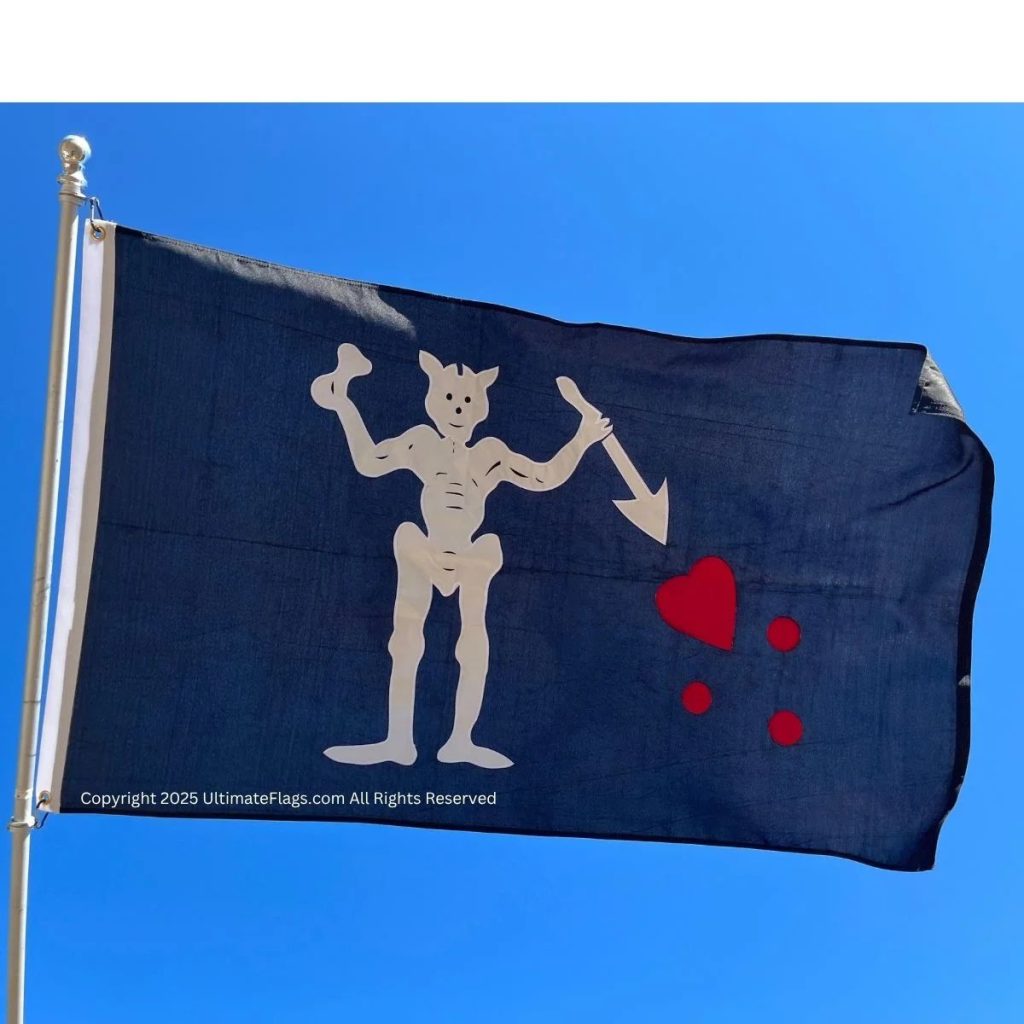
The most famous individual design belongs to Blackbeard, the pirate whose real name was Edward Teach. His flag showed a horned skeleton toasting while spearing a bleeding heart, and he died in battle at Ocracoke Inlet in November 1718. Reproductions sold in the Ultimate Flags catalog today keep these historic details — the hourglass, the horned skeleton, the crossed swords of Calico Jack — faithful to the old descriptions.
 Flag Sale – Shop Now!The classic skull-and-crossbones Jolly Roger in sewn cotton, 3×5 ft. — the historic look collectors want for indoor and fair-weather display.
Why the setup varies
Two boats rarely hang a pirate flag the same way, and none of the differences are wrong. What moves the setup from boat to boat:
- Rig layout. A boat with a gaff hoists where a sailing ship would; a center console clamps a pole to the rail.
- Where you fly. At anchor a big flag looks right; at speed a small one survives.
- Cloth weight. A heavy sewn flag needs more wind to fly than a light print.
- Chafe. Every shroud, stay and antenna near the flag is a wear point.
- Courtesy flags. The national ensign and any port flags keep their own spots; the Jolly Roger takes a place of fun, not of protocol.
Can you legally fly a pirate flag on a boat?
In the United States, no law stops a private boat from flying a Jolly Roger for fun. The U.S. flag rules govern how and when the national ensign is displayed — they do not forbid other flags alongside it. Two cautions still apply: in foreign waters the national ensign and local courtesy requirements come first, so check the rules of any country you visit before dressing the boat, and never fly the Jolly Roger in a way that could be mistaken for an official or distress signal. Historically, that is the one mistake actual pirates made — and hanging was the penalty in 1720.
How do you keep a pirate flag from shredding?
- Strike it at speed. Above a slow cruise, either douse the flag or move it to a stiff pole.
- Add chafe gear. A leather sleeve or reinforced webbing where the halyard crosses a stay doubles a flag's working life.
- Choose double-nylon over cotton for the water. Save the cotton design for the porch.
- Rinse and dry. Fresh-water rinse after saltwater runs, full air dry before stowing, always.
FAQ
What size pirate flag fits a 20-foot boat?
A 2×3 ft. flag fits a 20-foot boat by the one-inch-per-foot rule. Many owners fly a 3×5 ft. at anchor or on a stern pole instead, and the 3×5 remains the most popular size sold in 2026.
Where should a pirate flag go on a boat?
From the gaff peak at the stern on a traditional rig, or from the masthead, spreaders or a rail-mounted pole on a modern boat. Pick the spot with the clearest air path.
Can you fly a pirate flag while underway?
At slow speed, yes. At planing speed the wind shreds a loose flag quickly, so strike it or fly it from a stiff staff where the breeze still fills the cloth.
Is it legal to fly a Jolly Roger on a boat?
In the United States, yes — no law forbids a private boat from flying a pirate flag. The national ensign rules still apply on their own, and foreign waters may have stricter requirements.
What material is best for a boat pirate flag?
Sewn double-nylon with embroidered details. Nylon dries fast and handles salt spray, while cotton absorbs water and mildews, so cotton flags belong indoors.
Why did pirates fly black flags?
To demand surrender without a fight. Pirates sailed under false colors first, then raised the black flag at close range. The earliest recorded skull-and-crossbones design dates to Emanuel Wynn in 1700.
How do you attach a pirate flag to a halyard?
Use brass or stainless snap hooks clipped to the flag’s header grommets. Clipped flags hoist flat and swap fast; lashing one to a pole leaves it twisted.
One last thing
Wynn's 1700 flag hid an hourglass under the skull — a warning that the time of the ship it chased had run out. When you shop for a Jolly Roger in 2026, look closely at the details: the hourglass, the crossed swords, the horned skeleton. Those small marks are what separate a faithful historic design from a generic skull print, and they are the reason collectors keep coming back to the sewn versions.
Related guides