The United States flag flies 50 stars today — one for each state — and that count has not changed since July 4, 1960. Between the first Flag Act in 1777 and Hawaii's admission in 1959, the official star count changed 28 times, from 13 stars on the Revolutionary-era flag to the 15-star Star-Spangled Banner flag to a 48-star version that flew for 47 straight years. The table below lists every official US flag star count by year, the state each change honored and how long each version was the flag of the United States.

- The US flag has flown 50 stars since July 4, 1960 — 66 years without a change.
- The 48-star flag (1912-1959) served the longest: 47 years.
- The Flag Act of 1818 set the rule: one new star each July 4 after a state joins.
- Stripes stay fixed at 13 for the original colonies — only the star count moves.
- The official star count changed 28 times between 1777 and 1960.
Why the US flag's star count changes
Congress has passed three Flag Acts, and each one wrote a different rule. The first, on June 14, 1777, set the flag at 13 stripes and 13 stars, one of each for the states in the Union. The second, in 1795, raised both to 15 after Vermont (1791) and Kentucky (1792) joined — that 15-star, 15-stripe flag is the one Francis Scott Key saw over Fort McHenry in 1814.
The Flag Act of 1818 settled the system the country still uses. It restored the stripes to 13 permanently, in honor of the original colonies, and ordered that a new star be added on the July 4 following a state's admission. That is why star counts change on Independence Day, not on the day a state actually joins: Alaska became a state in January 1959, and the 49-star flag followed that July 4.
One more milestone matters for collectors. Before President Taft's Executive Order 1559 of June 24, 1912, the government fixed the number of stars but not their arrangement, so flags of the same count were made in circles, rows and staggered patterns. From 1912 on, the official pattern was standardized for every count.
US flag star count by year: the complete table
| Years flown | Stars | New state(s) honored | Years at that count |
|---|---|---|---|
| 1960-2026 (today) | 50 | Hawaii (admitted August 1959) | 66 — current |
| 1777-1795 | 13 | The original 13 states | 18 |
| 1795-1818 | 15 | Vermont (1791), Kentucky (1792) | 23 |
| 1818-1819 | 20 | Tennessee, Ohio, Louisiana, Indiana, Mississippi | 1 |
| 1819-1820 | 21 | Illinois (1818) | 1 |
| 1820-1822 | 23 | Alabama (1819), Maine (1820) | 2 |
| 1822-1836 | 24 | Missouri (1821) | 14 |
| 1836-1837 | 25 | Arkansas (1836) | 1 |
| 1837-1845 | 26 | Michigan (1837) | 8 |
| 1845-1846 | 27 | Florida (1845) | 1 |
| 1846-1847 | 28 | Texas (1845) | 1 |
| 1847-1848 | 29 | Iowa (1846) | 1 |
| 1848-1851 | 30 | Wisconsin (1848) | 3 |
| 1851-1858 | 31 | California (1850) | 7 |
| 1858-1859 | 32 | Minnesota (1858) | 1 |
| 1859-1861 | 33 | Oregon (1859) | 2 |
| 1861-1863 | 34 | Kansas (1861) | 2 |
| 1863-1865 | 35 | West Virginia (1863) | 2 |
| 1865-1867 | 36 | Nevada (1864) | 2 |
| 1867-1877 | 37 | Nebraska (1867) | 10 |
| 1877-1890 | 38 | Colorado (1876) | 13 |
| 1890-1891 | 43 | Idaho, Montana, North Dakota, South Dakota, Washington | 1 |
| 1891-1896 | 44 | Wyoming (1890) | 5 |
| 1896-1908 | 45 | Utah (1896) | 12 |
| 1908-1912 | 46 | Oklahoma (1907) | 4 |
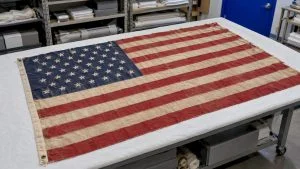
| 1912-1959 | 48 | New Mexico and Arizona (1912) | 47 |
| 1959-1960 | 49 | Alaska (January 1959) | 1 |
| 1960-present | 50 | Hawaii (August 1959) | 66 and counting |
The table skips a 42-star flag on purpose. Five states joined in a rush between November 1889 and July 1890, and the 42- and 43-star designs were obsolete almost as fast as they could be sewn, so very few 42-star flags were ever produced and standard chronologies list 43 as the count that followed 38.
The leaders and the laggards are easy to name. The 48-star flag leads at 47 years, followed by the 15-star flag at 23 years and the original 13-star flag at 18. At the other end, a dozen counts — 20, 21, 25, 27, 28, 29, 32 and more — flew for a single year each, most of them in the westward-expansion rush between 1818 and 1859. The single biggest jump was 38 stars to 43, when five states joined within eleven months.
These dates come from the Flag Acts of 1777, 1795 and 1818, under which each new star took effect on the July 4 after admission. One limitation: before the 1912 executive order the star pattern was not standardized, so the count dates a flag but the arrangement can narrow its age further.
Reading star counts on real and reproduction flags
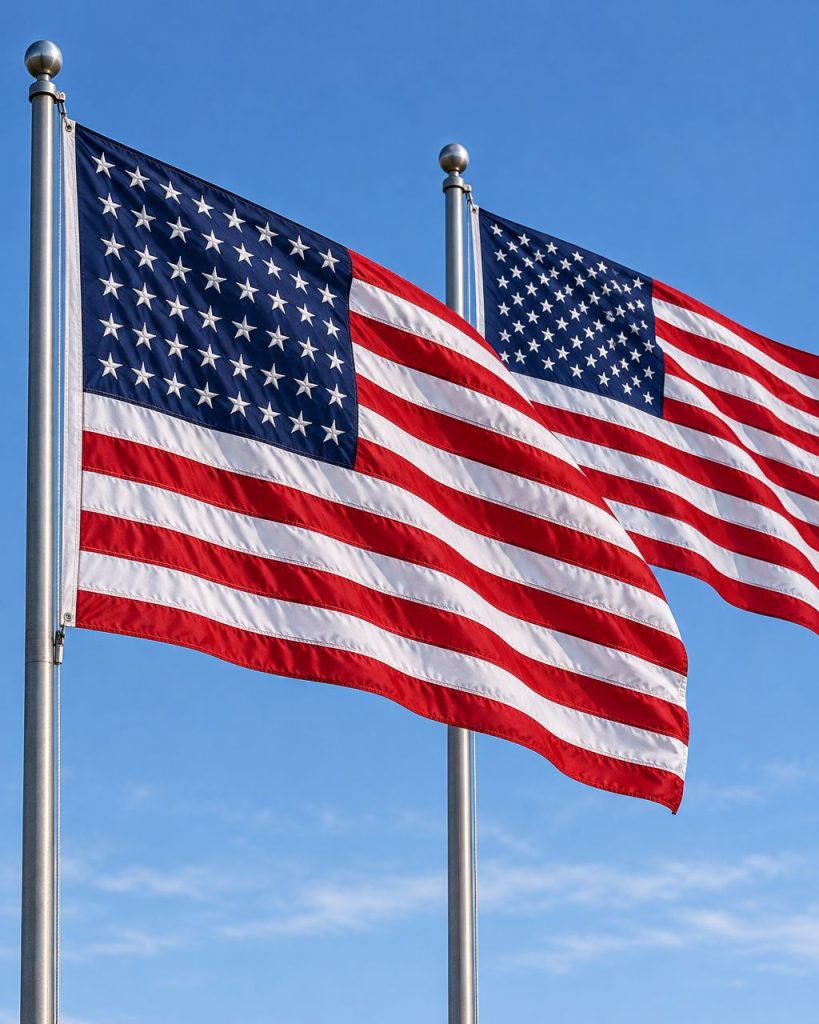
The star count is the fastest way to date a flag. A modern embroidered nylon 50-star flag shows five staggered rows of ten — the pattern every flag has carried since 1960, and the build most buyers want for a daily-flying pole.

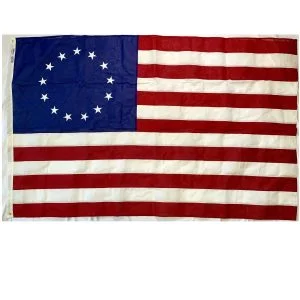
Earlier counts turn a flag into a dated historical piece. The 13-star circle pattern tied to Betsy Ross stands for 1777-1795, and it remains the most recognized historic count in the country — the design Colonial-era reenactments and early-America displays reach for first.

When you are ready to Shop Ultimate Flags, the historic USA collection groups the dated star counts together — 13, 15, 33, 34, 35, 48 and more — so a collector can match a flag to a specific year from the table above.
FAQ
How many stars are on the US flag in 2026?
The US flag has 50 stars in 2026, one for each state. That count has been official since July 4, 1960, after Hawaii’s admission in 1959.
When did the US flag last change its star count?
July 4, 1960, when the 50-star flag replaced the 49-star version. Alaska made the 49-star flag official in 1959, and Hawaii pushed the count to 50 just one year later.
Which star count flew the longest?
The 48-star flag, official from 1912 to 1959 — 47 years. The 15-star flag of 1795-1818 is second at 23 years, and the original 13-star flag flew 18 years.
What is the rule for adding stars to the US flag?
Under the Flag Act of 1818, a new star is added on the July 4 following a state’s admission. The 13 stripes never change — they honor the original colonies.
Was there ever a 42-star US flag?
Barely. Five states joined between November 1889 and July 1890, and the 42-star count was superseded so quickly that very few 42-star flags were ever made. Standard chronologies go from 38 stars to 43.
How do I tell what year a historic US flag is from?
Count the stars and match the number to the dated table above. Before 1912 the star arrangement was not standardized, so the pattern — rows, circles or staggered stars — can narrow the date further.
What flag did Francis Scott Key see in 1814?
The 15-star, 15-stripe flag of 1795-1818, flown over Fort McHenry during the War of 1812. It is the flag the Star-Spangled Banner describes.
Can you still fly a historic star count flag today?
Yes. The US Flag Code places no restriction on flying a historic star count, and 48-star and 13-star flags are flown regularly at heritage displays and patriotic homes.
One last thing
If you want one dated flag that covers the most American history per square inch, make it the 48-star flag — it flew through the Great Depression, World War II and Korea, and our guide to whether you can fly a 48-star flag today walks through its design dates and display etiquette. Count the stars before you buy any historic American flag: the number is the date stamp, and now you can read it.
Historical sources consulted for this 2026 guide: the Flag Acts of 1777, 1795 and 1818, Executive Order 1559 (June 24, 1912) standardizing the star pattern, and state admission dates recorded by the US National Archives.