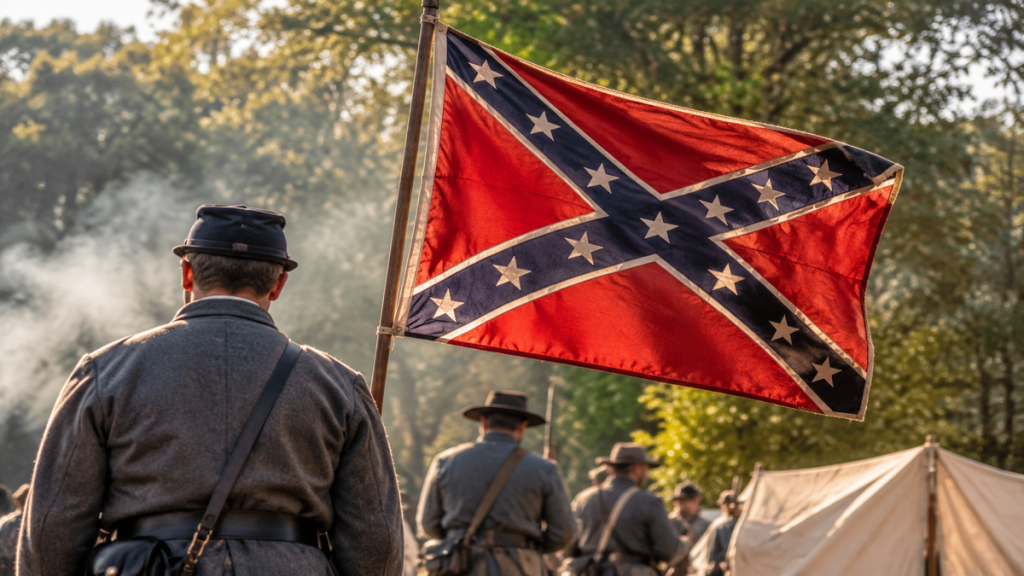
The familiar red flag with a blue diagonal cross and white stars remains one of the most recognizable and debated symbols in American history. Although commonly associated with the Confederate States of America, its origins and later uses have shaped discussions about what does the rebel flag mean in relation to military identity, regional traditions, and racial conflict.
Originally used as a Confederate military banner during the American Civil War, the design later became associated with Southern heritage, segregation, and political resistance. Its historical purpose and changing interpretations continue to influence how Americans understand it.
For some individuals, the emblem represents family ancestry, military remembrance, or Southern pride. Others associate it with racial oppression and opposition to civil rights. These interpretations reflect different experiences, although the historical connection between the Confederacy and slavery is firmly documented.
Knowing the history behind the design helps collectors, history enthusiasts, and families understand its place in American history and why it continues to carry different meanings today.
Those interested in historical reproductions can also examine available Confederate-era designs to compare the symbols associated with different periods and military traditions.
The Confederate Flag Explained: Origins and Historical Meaning
The Confederate States of America formed in 1861 after several Southern states seceded from the United States. Their decision followed growing political conflict over slavery, federal authority, and the election of Abraham Lincoln. Secession documents and statements from Confederate leaders identified the preservation of slavery as a central reason for separation. The Confederate government sought to protect an economic and social system built around enslaved labor.
During the conflict, Confederate forces used several military banners to identify troops and distinguish their positions on the battlefield. The familiar diagonal-cross design developed because the Confederacy’s first national banner resembled the United States flag. Similar colors and arrangements created identification problems, particularly during combat when smoke and distance made distinguishing military units difficult.
General P. G. T. Beauregard supported adopting a separate military standard that soldiers could recognize quickly. The resulting design featured a red background, a blue diagonal cross outlined in white, and white stars representing Confederate states. It became particularly associated with the Army of Northern Virginia.
Although commonly called the rebel flag, this design was not originally the Confederacy’s national banner. Understanding the origins and defining features of this historic emblem helps distinguish the familiar battle design from the Confederacy’s official national flags.
The original battle flag served several military purposes. It identified Confederate formations, helped commanders recognize troop positions, and provided soldiers with a shared regimental or military identity. Military standards also carried emotional associations. Soldiers often developed strong attachments to their unit colors because those banners represented comrades, service, and battlefield experiences.
Yet the military function of the emblem cannot be separated from the political objectives of the government whose forces carried it. The emblem represented Confederate forces fighting against the United States under a government committed to preserving slavery. This distinction matters when evaluating claims that the symbol originally represented only military bravery or regional independence.
Individual soldiers had different personal motivations, including loyalty to their communities and military obligations. Soldiers’ individual motivations varied, even though they served the Confederate government and its documented objectives. Soldiers’ personal experiences and the Confederate cause both shaped the flag’s place in American military history.
Confederate National Flags and Civil War Battle Designs
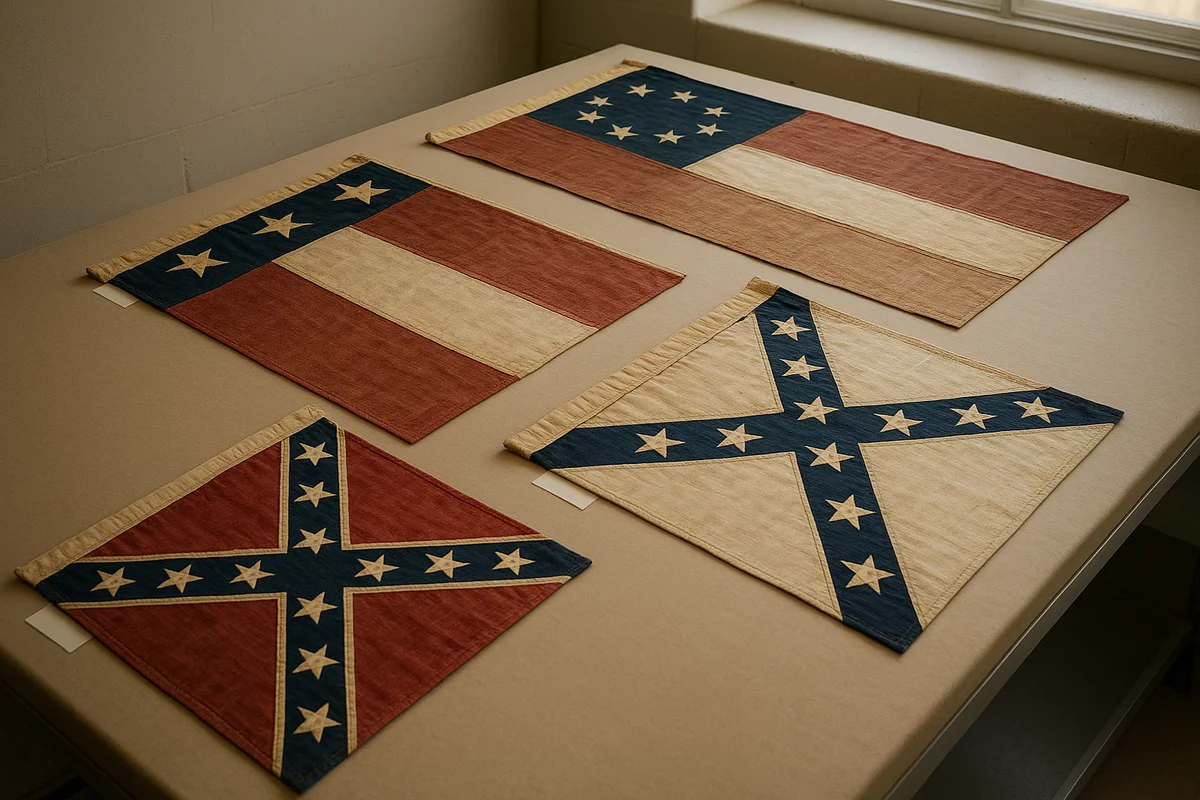
The Confederate States adopted three national banners between 1861 and 1865. Their designs changed as military needs and political circumstances developed. Confederate military formations used the diagonal-cross design alongside the government’s three national banners.
Understanding these differences helps collectors, reenactors, and history enthusiasts identify authentic designs and select reproductions that reflect specific periods of American history.
|
Historical Design |
Period |
Appearance |
Original Purpose |
|---|---|---|---|
|
First National Flag, or Stars and Bars |
1861–1863 |
Three horizontal red, white, and red stripes with a blue canton containing white stars |
Official national banner of the Confederacy |
|
Army of Northern Virginia Battle Flag |
Introduced in 1861 |
Square red field with a blue diagonal cross, white border, and white stars |
Military identification during combat |
|
Second National Flag, or Stainless Banner |
1863–1865 |
Predominantly white field with the battle emblem in the upper-left corner |
Second official Confederate national banner |
|
Third National Flag |
1865 |
Similar to the Stainless Banner, with an additional vertical red stripe |
Final Confederate national design |
|
Army of Tennessee Battle Flag |
Used during the Civil War |
Rectangular red field with a blue diagonal cross and white stars |
Military identification for Confederate units |
The first national banner, commonly known as the Stars and Bars, featured three horizontal stripes and a blue canton containing stars. Its resemblance to the American flag created confusion during military engagements. This problem encouraged the development of a separate battlefield standard, and the square design associated with the Army of Northern Virginia became especially recognizable.
Other Confederate military formations used variations, including rectangular versions. Differences in proportions, construction, and military use explain why historical reproductions don’t always look identical. The second national banner, adopted in 1863, incorporated the diagonal-cross emblem into a predominantly white design.
Its large white field created another problem. When the fabric hung without wind, observers could mistake it for a flag of surrender. In 1865, the Confederate government adopted a third national design that added a vertical red stripe. Battlefield identification problems influenced how Confederate flag designs changed during the war.
The term Confederacy flag can therefore describe several historically distinct banners. Identifying the correct version requires attention to its date, appearance, and intended use.
For collectors, the red, white, and blue arrangements also provide useful clues about a design’s identity. Examining the historical associations of different flag colors can help explain how these visual elements are interpreted, although color symbolism alone cannot establish a banner’s original purpose. For collectors seeking a particular military standard or uncommon historical design, these details help distinguish one reproduction from another.
How the Rebel Flag Became a Symbol of Southern Heritage
Following the Confederate defeat in 1865, veterans’ organizations and memorial associations incorporated military banners into reunions and ceremonies honoring deceased soldiers. For some families, these displays commemorated relatives who served in Confederate units.
Over time, the emblem became associated with regional identity across the South. The phrase Southern heritage often reflects connections to family ancestry, local customs, and historical remembrance rather than support for the Confederate government’s political objectives.
Families researching their ancestors may encounter military records, photographs, uniforms, and regimental banners. Historical reproductions can help preserve connections to relatives’ military service and stories passed down through generations.
Collectors study historical proportions, military insignia, manufacturing methods, and differences between national and regimental standards. Accurate reproductions also serve in reenactments, commemorative events, and educational exhibits.
The Confederacy’s commitment to preserving slavery remains part of this history, even when families remember ancestors through their military experiences. Museums and historical organizations present those experiences alongside the political circumstances of the conflict, helping visitors understand both personal histories and the broader historical record.
During the twentieth century, the diagonal-cross design also appeared on automobiles, clothing, and entertainment merchandise. Some individuals adopted it as a symbol of independence or rebellion, while others associated it with rural Southern culture and regional pride.
These interpretations don’t reflect every Southern community’s experience. For Black Southerners whose ancestors endured enslavement, segregation, and racial discrimination, the emblem may carry a different meaning.
Recognizing these different historical experiences supports respectful discussion of the emblem’s place in American history.
How the Confederate Flag’s Meaning Changed During the Civil Rights Era
During the twentieth century, Confederate imagery became increasingly visible in political movements opposing racial integration, expanding beyond its earlier use by veterans’ organizations.
In 1948, the States’ Rights Democratic Party, known as the Dixiecrats, adopted Confederate battle imagery during a presidential campaign opposing federal civil rights initiatives. The movement supported racial segregation and resistance to federal intervention, strengthening the emblem’s association with opposition to racial equality.
In 1956, Georgia incorporated the battle emblem into its state flag amid resistance to school desegregation. Confederate imagery also appeared at segregationist demonstrations and was adopted by white supremacist organizations, reinforcing its associations with racial exclusion and intimidation.
These historical connections continue to influence debates over public displays. A military reproduction in a museum serves an educational purpose, while the same design at a political demonstration may represent allegiance to a contemporary movement.
Displaying Confederate imagery on government property raises questions about official endorsement. Critics argue that such displays conflict with equal representation because of the Confederacy’s defense of slavery and the emblem’s later segregationist associations. Supporters of historical displays argue that removal may obscure regional experiences and military history.
The setting matters. Museums can preserve historical banners while explaining their origins, whereas government displays may suggest institutional support for the ideas associated with them.
Public reactions also reflect different historical experiences. Many Americans associate the emblem with slavery, segregation, and racial oppression, regardless of the display owner’s intentions. Others connect it with family ancestry, military service, or regional customs.
Personal remembrance remains meaningful to many collectors, but the Confederacy’s commitment to slavery and the emblem’s later use against civil rights are documented historical facts. Studying or collecting the design doesn’t automatically indicate support for those causes. Its original military purpose and later political uses explain why the emblem continues to generate different reactions.
Understanding Confederate Flag Symbols in Historical Collections
Historical banners appeal to collectors, veterans, military families, reenactors, genealogists, and educators interested in American military history. Collectors often look for details that distinguish national banners, regimental standards, and military reproductions.
Original nineteenth-century artifacts differ from modern reproductions. Collectors should consider several factors when selecting or displaying Confederate designs:
-
Compare proportions, colors, star arrangements, and borders with documented historical designs.
-
Identify whether the banner represents the Confederacy, a particular army, or another military formation.
-
Examine the fabric, stitching, printing methods, and finishing details.
-
Consider whether the reproduction will be used in a private collection, reenactment, commemorative event, or educational exhibit.
-
Consult museum records and military histories to verify the design’s origins.
-
Consider how viewers may associate Confederate imagery with slavery, segregation, or racial intimidation.
Modern reproductions vary in size, fabric, and proportions. Some follow documented military patterns, while others feature rectangular designs popularized during the twentieth century. A square Army of Northern Virginia standard and a rectangular reproduction may look similar but represent different historical forms.
Construction affects appearance and durability. Printed polyester suits many displays, while embroidered nylon and sewn cotton offer different textures and finishes. Indoor collectors may prioritize historical appearance, while outdoor displays require greater attention to weather resistance and reinforced stitching.
Educational labels can identify each banner’s military association, period of use, and documented historical background.
Responsible historical presentations should identify the organization associated with each design, its period of use, and its connection to slavery, secession, and later segregationist movements. Such context also distinguishes historical documentation from contemporary political endorsement.
Private collectors, historical societies, and reenactment organizations preserve reproductions for different purposes. Some document military units or family service records, while others compare banners from different periods.
Clear identification helps viewers understand each design’s origins and historical associations while allowing collectors to preserve materials connected to their interests.
Preserve American History with Ultimate Flags
Historical flag reproductions help collectors, veterans, reenactors, and history enthusiasts preserve American military traditions and family connections. Choosing an accurate design begins with identifying its historical period or military unit.
Ultimate Flags is a family-owned American flag retailer established in 1997, offering Confederate battle flags, historical military banners, and Southern heritage flags in various materials and sizes. Its extensive inventory includes familiar and uncommon designs, with custom flag options for collectors and organizations seeking specific reproductions.
Shoppers can compare Confederate national flags, Army of Northern Virginia standards, and other Civil War designs in printed polyester, embroidered nylon, and sewn cotton.
With decades of experience, extensive selection, and custom design options, Ultimate Flags helps customers find reproductions suited to their collections and display needs.
Browse the Rebel Flags collection at Ultimate Flags to find a historical design that matches the intended display, preferred materials, and personal connection to American history.