


Sale!

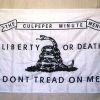
Culpeper MinuteMen Flag Don’t Tread On Me White -Sewn Nylon Embroidered 3 x 5 ft.
$59.95 Original price was: $59.95.$55.95Current price is: $55.95.
In stock


Culpeper Minutemen Flag — Don’t Tread on Me | White
Size: 3×5 ft | Civic Quality Nylon Embroidered
The Snake Is a Map
Look closely at the rattlesnake on this flag. Its body doesn’t coil randomly — it curves in the deliberate shape of the American colonial coastline, from the tip of the tail representing Florida in the south to the raised head representing New England in the north. Every colony, rendered in the body of a single serpent. The warning written beneath it applies to the whole of them, from one end to the other.
It’s one of the most quietly remarkable design details in early American vexillology — and it’s been flying on this flag since before the Revolution officially began.
The Culpeper Minutemen — First Into the Fight
The Culpeper Minutemen were organized in Culpeper County, Virginia in 1775 — volunteer fighters who drilled under the expectation that they could be called to action at a moment’s notice. They were among the earliest organized militia companies of the Revolutionary period, and historical accounts suggest they were among the first Minutemen to engage British troops in engagements that preceded and precipitated the formal outbreak of the Revolutionary War.
Their flag combined the rattlesnake tradition already established in colonial political imagery with two phrases that left no ambiguity about their intentions: “Don’t Tread on Me” and “Liberty or Death” — the latter drawn from Patrick Henry’s electrifying speech to the Second Virginia Convention in March 1775, which had moved Virginia to join the armed resistance only months before.
Whether this specific white flag design is the precise banner carried by the Culpeper Minutemen into those early engagements cannot be confirmed from surviving documentation — it is described as a stylized version of the attributed original, historically grounded but not definitively proven. What is clear is that the design represents a genuine tradition of Virginia colonial resistance that existed at the very moment the war was starting.
White Field — A Different Visual Tradition
The Gadsden Flag flew a yellow field. The Culpeper Minutemen’s attributed flag flew white — a distinct visual choice that places it in a different tradition within Revolutionary-era flag design.
White fields in 18th-century flag design carried connotations of purity of cause and clarity of intent — a blank declaration rather than a colored one, the rattlesnake and the words doing all the work without a colored ground to frame them. Against white, the snake reads with sharp contrast and the text carries a starkness that the yellow Gadsden’s warmer tone doesn’t produce.
The two flags share the same rattlesnake tradition and the same motto. The difference in field color gives each a distinct visual character — the Gadsden warm and defiant, the Culpeper stark and absolute.
Flag Details & Construction
Quality Tier: Civic Quality — Nylon Embroidered
- Size: 3 feet x 5 feet
- Material: Outdoor nylon — waterproof, tear and fray resistant
- Construction: Fully embroidered on both sides — not printed
- Thread: Bright embroidery thread adds texture and visual weight
- Edges: Double and quad stitched throughout
- Header: Reinforced metal grommet rings for added durability
- Reverse: Per traditional flag construction, design reads correctly from front and appears mirrored on reverse
- Built for: Permanent outdoor pole display and extended outdoor use
Recommended Uses
- Permanent outdoor pole display — homes, businesses, and civic buildings
- Year-round display not taken down at night or in rain
- Schools, civic organizations, and historical society display
- Parades and patriotic outdoor events
- Indoor honor guard and institutional display
- Gift for Revolutionary War history enthusiasts and patriots who want lasting quality
Frequently Asked Questions
Is the rattlesnake really shaped like the American colonies? Yes — the snake on this flag is deliberately arranged to trace the rough outline of the colonial coastline, with the tail tip representing Florida and the head representing New England. It’s one of the most intentional and underappreciated design details in early American flag history, embedding a geographic statement directly into the warning symbol.
Is this the actual flag the Culpeper Minutemen carried? The design is attributed to the Culpeper Minutemen and is historically grounded in their visual tradition, but the specific flag cannot be confirmed as the exact banner carried into early Revolutionary engagements from surviving documentation. It is described accurately as a stylized version of the attributed original.
Why is this flag white instead of yellow like the Gadsden? The Gadsden Flag flew a yellow field as its commander-in-chief naval standard. The Culpeper Minutemen’s attributed flag used white — a different visual tradition that gives the rattlesnake and motto a starker, more absolute quality. Both designs share the same rattlesnake symbolism and “Don’t Tread on Me” motto but carry distinctly different visual characters.
Who were the Culpeper Minutemen? A volunteer militia company from Culpeper County, Virginia, organized in 1775. They were among the earliest organized fighting forces of the Revolutionary period and are historically associated with some of the first engagements between colonial militia and British troops. Their motto — “Liberty or Death” — was drawn directly from Patrick Henry’s March 1775 speech to the Second Virginia Convention.
Is Civic Quality appropriate for permanent outdoor display? Yes — nylon embroidered construction is built for flags that stay up permanently through changing weather. The embroidered design holds up to sustained outdoor exposure significantly better than printed alternatives, making it the right choice for long-term institutional and residential pole display.
Check out our Full Collection of Gadsden Flags
Check out our full Collection of Revolutionary War Flags
“At Ultimate Flags Inc., we are more than just a flag store; we are custodians of history, supporters of freedom, and believers in the power of symbols. Located in O’Brien, Florida, our family-owned business has been serving patriots, history enthusiasts, and flag collectors since 1997. We pride ourselves on offering an unparalleled selection of over 10,000 flags, including American flags, Confederate flags, military flags, historic flags, and custom designs. Each flag tells a story, and we are committed to preserving these narratives through our high-quality products.
Our passion for flags is matched only by our dedication to our customers. Whether you’re seeking a flag for personal expression, historical reenactments, or to honor your heritage, our experienced team is here to help you find the perfect flag. We understand the importance of quality, which is why we offer flags in various materials and sizes, suitable for all needs and occasions.
At Ultimate Flags, we believe in giving back. We actively support veterans, first responders, and non-profit organizations, ensuring that the brave men and women who serve our country are honored and remembered. Our online presence is not just about sales; it’s about educating our audience on the rich tapestry of American history and the significance of flags in our society.
Explore our vast collection in our online flag store and join us in celebrating the virtues, history, and ideas that shape our nation. For Patriots, Pride, & Freedom – Ultimate Flags Inc.”
SKU: C2D2F17-RU-FL3x5NEMB-845596-841888
Description
Description
Jolly Roger Pirate Flag — Classic Skull & Crossbones,
Size: 3×5 Feet, Cotton Sewn & Embroidered
The Most Authentic Jolly Roger You Can Fly
This is the real Jolly Roger — no eye patch, no Hollywood embellishment, no modern novelty additions. Just the pure, historically accurate skull and crossed bones that struck terror into the hearts of merchant sailors across the Caribbean, Atlantic, and Indian Ocean during the Golden Age of Piracy (1650s–1730s). Sewn and embroidered in heavy-duty 100% cotton, this flag is as close to the original as any reproduction flag can get — a genuine piece of maritime history you can hold in your hands.
The True History of the Jolly Roger
The Jolly Roger is one of the most immediately recognizable symbols in the world, and its real history is far more fascinating — and far more calculated — than the romanticized version most people know.
During the Golden Age of Piracy, the skull and crossbones was not merely a decoration or a statement of identity. It was a precision psychological weapon — a carefully designed instrument of intimidation deployed at a very specific moment in the hunt for prey. A pirate captain spotting a target on the horizon would typically approach under a false flag — flying the colors of a friendly nation to get close without raising alarm. Only at the last moment, when escape was no longer possible, would the false colors be struck and the Jolly Roger run up the mast.
The message was instantaneous and universally understood across every language and nationality: surrender immediately and your lives will be spared. Most merchant captains, staring down the barrel of a well-armed pirate vessel with a skull-and-crossbones flying overhead, made the sensible decision. This is precisely what pirates wanted — a swift, bloodless transaction with minimal risk to their own crew.
The origin of the name “Jolly Roger” remains one of maritime history’s most debated questions. Leading theories include a derivation from the French “joli rouge” (pretty red) — referencing the blood-red flags flown by early pirates before the skull-and-crossbones became standard — or from “Old Roger,” period English slang for the devil. A third theory suggests it derived from a Tamil pirate commander known as “Ali Raja” (King of the Sea), whose name was anglicized by British sailors into “Jolly Roger.”
The Pirates Who Made This Flag Famous
Every great pirate captain of the Golden Age flew a personalized Jolly Roger — making flag design a genuine form of personal branding that was reported in newspapers, trial records, and naval dispatches across Europe and the Americas. This no-patch skull-and-crossbones design is among the most historically accurate renditions, closely matching the earliest documented versions:
Blackbeard (Edward Teach, c.1680–1718) — the most feared pirate of the Golden Age — operated primarily along the American Atlantic coast and Caribbean, blockading the port of Charleston, South Carolina in 1718 with a fleet of four ships and holding the city hostage for medical supplies. His personal flag depicted a horned skeleton holding an hourglass and spear, but the plain skull-and-crossbones flew alongside it on his vessels. He was killed in battle off Ocracoke Island, North Carolina on November 22, 1718 by Lieutenant Robert Maynard of the Royal Navy — reportedly sustaining five gunshot wounds and over twenty sword cuts before finally falling.
Calico Jack (John Rackham, ?–1720) — named for his fondness for calico clothing — flew a skull above two crossed cutlasses and is perhaps better known today as the captain who sailed with Anne Bonny and Mary Read, two of the most famous female pirates in history. His career ended when a Royal Navy sloop caught his crew drunk in Jamaican waters in 1720. He was hanged in Port Royal, Jamaica, and his body was displayed in an iron cage as a warning to other pirates.
Bartholomew “Black Bart” Roberts (1682–1722) — the single most successful pirate in the Golden Age, capturing an estimated 400+ ships across the Caribbean, Atlantic, and West African coast — flew multiple personal flags, including one depicting himself standing triumphantly on two skulls labeled “A Barbadian’s Head” and “A Martinican’s Head,” representing governors who had pursued him. He was killed in battle off Cape Lopez, Gabon in 1722 and buried at sea in full pirate regalia per his own instructions.
Frequently Asked Questions & Little-Known Facts
Q: What does the Jolly Roger symbolize? The Jolly Roger represents piracy, rebellion, and maritime dominance — historically flown as a psychological weapon to intimidate enemy crews into immediate surrender, signaling that a pirate attack was imminent but that mercy was available to those who yielded without a fight.
Q: Is this an authentic historical version of the Jolly Roger? Yes — the no eye-patch skull-and-crossbones design closely matches the earliest documented versions flown by real pirates in the 17th and 18th centuries. The eye patch is a much later fictional addition popularized by novels and films. Historical accounts and court records describing actual pirate flags consistently describe plain skulls without embellishment.
Q: Why does this version have no eye patch? Because real pirates didn’t use one on their flags. The eye-patched skull is a 19th and 20th century fictional invention — popularized by illustrations for books like Treasure Island (1883) and later cemented by Hollywood films. The historically accurate Jolly Roger features a plain skull, making this cotton version one of the most authentic reproductions available.
Q: Can this flag be flown on a boat? Yes — for ceremonial or decorative purposes this flag is ideal for dockside display, boat shows, and nautical events. However cotton is not designed for extended exposure to salt air, rain, or harsh marine conditions. For permanent weather-resistant marine use, our all-weather nylon Jolly Roger is the recommended choice.
Q: Were there female pirates who flew the Jolly Roger? Yes — most famously Anne Bonny and Mary Read, who sailed under Calico Jack Rackham in the Caribbean around 1720. Both women disguised themselves as men and were reportedly among the fiercest fighters on the ship. When Rackham’s crew was captured drunk by the Royal Navy, accounts suggest Bonny and Read were among the only crew members sober enough to put up a fight.
Q: What happened to pirates after the Golden Age ended? The Golden Age of Piracy effectively ended in the early 1720s as the British Royal Navy mounted an aggressive anti-piracy campaign. The hanging of Bartholomew Roberts’ crew in 1722 — the largest piracy trial in history, with 52 men executed at Cape Coast Castle, Ghana — is widely regarded as the event that broke the back of organized Atlantic piracy. The gibbet cages displaying executed pirates’ bodies in harbor entrances became an effective deterrent across the Caribbean and Atlantic coast.
Cotton Sewn & Embroidered — 3×5 Feet
- Heavy-duty 100% cotton construction — authentic weight, texture, and drape that no polyester flag can replicate
- Sewn and embroidered skull and crossbones — not printed, delivering superior visual depth and a genuinely striking display piece
- Double-stitched construction for indoor and ceremonial durability
- Grommets compatible with all standard flagpoles and display mounts
- Note: Cotton is not designed for extended outdoor or wet-weather exposure. For exterior or marine use, see our all-weather nylon Jolly Roger.
Recommended Uses
- Pirate-themed events, parties, and reenactments
- Gasparilla Festival and pirate parade displays
- Nautical and maritime collections
- Man caves, bars, restaurants, and gaming rooms
- Museum and historical exhibits
- Indoor display and tribute pieces
- Theatrical productions — film, television, and stage
Check out our full Pirate Flag Collection Here
“At Ultimate Flags Inc., we are more than just a flag store; we are custodians of history, supporters of freedom, and believers in the power of symbols. Located in O’Brien, Florida, our family-owned business has been serving patriots, history enthusiasts, and flag collectors since 1997. We pride ourselves on offering an unparalleled selection of over 10,000 flags, including American flags, Confederate flags, military flags, historic flags, and custom designs. Each flag tells a story, and we are committed to preserving these narratives through our high-quality products.
Our passion for flags is matched only by our dedication to our customers. Whether you’re seeking a flag for personal expression, historical reenactments, or to honor your heritage, our experienced team is here to help you find the perfect flag. We understand the importance of quality, which is why we offer flags in various materials and sizes, suitable for all needs and occasions.
At Ultimate Flags, we believe in giving back. We actively support veterans, first responders, and non-profit organizations, ensuring that the brave men and women who serve our country are honored and remembered. Our online presence is not just about sales; it’s about educating our audience on the rich tapestry of American history and the significance of flags in our society.
Explore our vast collection in our online flag store and join us in celebrating the virtues, history, and ideas that shape our nation. For Patriots, Pride, & Freedom – Ultimate Flags Inc.”
SKU: C6D4F7-RU-FL3x5LC-60083
Recently Viewed Flags

David Walsh
 Customer
5/5
10 months ago
 Unhappy With Your Product? We’ll Take It Back!


