The Christian Flag carries a white field, a blue canton in the upper corner, and a red Latin cross set inside that blue field, a design first raised in 1897 through the vision of Charles C. Overton and later carried across denominations by Ralph E. Diffendorfer. White stands for purity and peace, blue for faithfulness and the waters of baptism, and red for the blood of Christ. Various retailers offer the flag in multiple sizes and materials for churches, schools, and homes that want to display it with the same reverence its designers intended.
TL;DR:
- The Christian Flag’s design originated in 1897 during a Brooklyn Sunday school lesson and was promoted ecumenically, with formal adoption by the Federal Council of Churches in 1942.
- Its imagery features a white background for purity, a blue canton symbolizing faithfulness and baptism, and a red cross representing Christ’s sacrifice, with standard color codes used by manufacturers.
- Display practices follow U.S. Flag Code rules, placing the American flag in the highest position, mounted separately, and requiring respectful arrangements for simultaneous display.
- While widely used by mainline Protestant denominations in North America and regions influenced by Protestant missions, Catholic churches typically display the Vatican or national flags instead.
- The flag remains relevant today as a visual symbol of faith, with variations and adaptations across different traditions and regions, and is freely available for purchase without legal restrictions.
Ultimate Flags
Find A Flag For Your Display
Explore Ultimate Flags for national, military, historical, political, holiday, nautical, and novelty flags, plus poles and hardware.
Browse Ultimate Flags
Table of Contents
The Origins and Early History of the Christian Flag
Every enduring symbol begins with a single moment of conviction, and the Christian Flag’s moment arrived on a Sunday in 1897. Charles C. Overton, superintendent of a Sunday school in Coney Island, Brooklyn, found himself short a planned speaker for Rally Day. Standing before his class with an American flag nearby, he improvised a lesson built around the idea of a banner for the whole faith, not just one nation. That improvisation became a design, and the design became a movement.

Overton’s concept might have stayed local if not for Ralph E. Diffendorfer, a Methodist minister and mission leader who took up the flag’s cause and promoted it through church networks and missionary channels over the following decades. What began as a Brooklyn classroom gesture spread through Sunday schools, youth groups, and mission boards, riding the same currents that carried American Protestant missionaries to Latin America, Africa, and Asia.
The flag’s path toward formal recognition followed a clear arc:
- 1897: Charles C. Overton conceives the design during an improvised Rally Day lesson.
- 1907: Ralph E. Diffendorfer begins actively promoting the flag through Methodist mission circles.
- 1942: The Federal Council of Churches formally adopts the flag on January 23, giving it the closest thing to official ecumenical standing it has ever held.
That 1942 adoption never created a governing body to enforce the design or control its use. The flag’s champions intended it as a shared emblem for all of Christendom, not a trademarked product of one denomination or council, and that founding choice still shapes how freely churches manufacture and fly it today.
What Do the Colors and Design of the Christian Flag Mean?
Picture a rectangle of white cloth, unbroken except in its upper left corner, where a smaller blue square holds a red cross reaching to each edge. That is the entire design vocabulary of the Christian Flag, and its restraint is deliberate. Nothing distracts from the cross; nothing competes with the field.
The white field represents purity and peace, the moral clean slate that Christian teaching associates with a life turned toward God. The blue canton, positioned where a field of stars would sit on many national flags, symbolizes faithfulness and points directly to baptism, the ritual immersion that marks entry into Christian life. The red Latin cross carries the weightiest symbolism of all: it stands for the blood of Christ, shed at the crucifixion, and it sits inside the blue field the way a cross sits at the center of Christian theology, inseparable from the faith it represents.
A quick reference for the flag’s symbolism:
| Element |
Position |
Meaning |
| White field |
Entire background |
Purity and peace |
| Blue canton |
Upper hoist corner |
Faithfulness, baptism |
| Red Latin cross |
Centered within the canton |
Christ’s blood and sacrifice |
Because no single authority governs its production, dimensions and materials vary from one manufacturer to the next. Some flags use nylon for lightweight outdoor durability, while others use polyester or a heavier sewn construction meant for indoor sanctuary display. A vendor’s reference file hosted on Wikimedia Commons offers standard color codes and proportions that many flag makers use as a practical starting point, though nothing legally requires them to follow it. That flexibility is a feature, not a flaw. It let a Brooklyn Sunday school idea become a flag any congregation, in any country, could reproduce without asking permission.
Which Christian Denominations Use This Flag?
The Christian Flag’s ecumenical birth gave it a home across a wide swath of Protestant church life, even as it never became universal. Its adoption tracks closely with the mainline Protestant denominations that built the Federal Council of Churches in the first place, and those roots still show up in sanctuaries today.
Congregations across these traditions commonly display the flag:
- Anglican and Episcopal parishes
- Baptist congregations
- Lutheran churches
- Methodist churches, tracing directly back to Diffendorfer’s promotional work
- Presbyterian and other Reformed congregations
- Mennonite and Moravian communities
Roman Catholic institutions represent the clearest exception. Catholic parishes and schools more commonly display the Vatican flag or their national flag rather than the Christian Flag, a pattern rooted in Catholicism’s separate liturgical and institutional traditions rather than any formal rejection of the design.
Geography tells its own part of the story. The flag’s strongest and most consistent presence remains in North America, where it began, but missionary work carried it into Latin America, parts of Africa, and Asia throughout the twentieth century. Wherever Protestant mission boards planted churches, the flag often traveled with them, making it a genuinely international symbol even though its footprint is far from uniform across world Christianity.
How Should the Christian Flag Be Displayed With the American Flag?
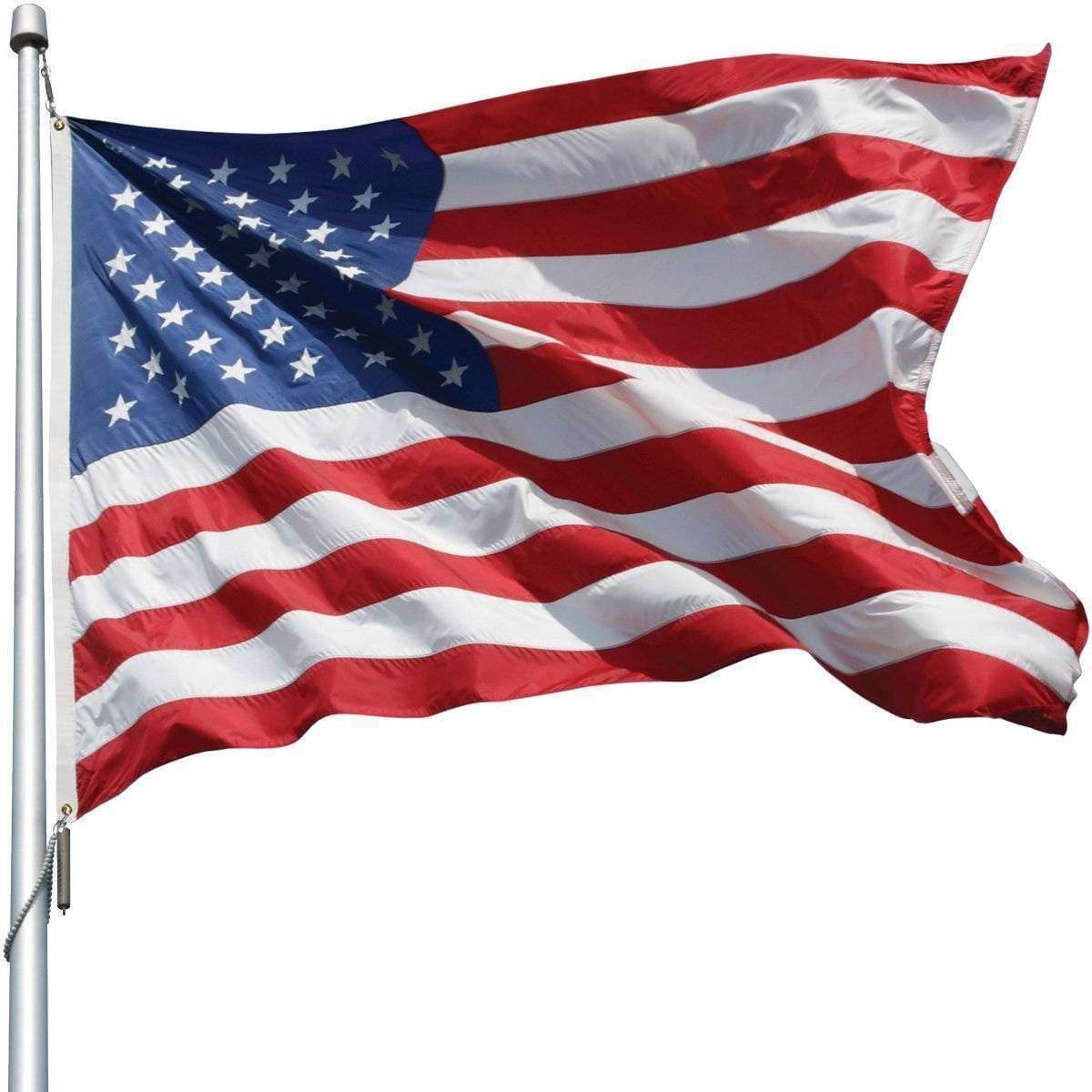
Placement questions come up in nearly every sanctuary that owns both a Christian Flag and an American flag, and the answer has real legal grounding, not just tradition. Federal guidance is unambiguous on the hierarchy: the U.S. Flag Code establishes that the American flag holds the position of superior prominence whenever it appears alongside any other flag, civic or religious.
On a speaker’s platform, that principle translates into a specific arrangement: the American flag stays at the speaker’s right, while the Christian Flag and any other flags move to the speaker’s left, which puts the U.S. flag to the audience’s own left as they face the platform. Many congregations extend this same logic to processional order and altar placement, keeping the Christian Flag to what churches often call the “gospel side” while the American flag occupies the position nearest the clergy’s right hand.
A few practical habits keep this arrangement respectful:
- Mount each flag on its own separate staff rather than crossing them on one pole.
- Follow whatever written sanctuary policy your congregation already has before improvising a new arrangement.
- Lower both flags to half-staff together when official mourning periods call for it, never just one.
- Keep both flags illuminated if displayed after dark, matching the same courtesy the Flag Code expects for outdoor U.S. flag display.
Pro Tip: If your church regularly hosts weddings, funerals, or civic events where flag placement questions come up, write your positioning rule down once and post it where the altar guild or ushers can reference it. A single laminated card saves you from relitigating flag etiquette every time a new volunteer sets up the sanctuary.
For a deeper walkthrough of proper positioning, Ultimate Flags has a full guide on how to properly display and respect the American flag that applies directly to mixed-flag settings like this one.
Is There a Pledge or Anthem for the Christian Flag?
Yes, though neither carries the formal weight of the national equivalents most Americans grew up reciting. Several pledge versions have circulated since the flag’s early decades, including one associated with Lynn Harold Hough, and most follow the same familiar gesture: right hand placed over the heart while facing the flag, echoing the posture used for the Pledge of Allegiance.
An anthem exists too. Fanny Crosby, the prolific hymn writer, composed a hymn for the flag in 1903 that some congregations still sing during dedication services or youth programs.
A few things worth knowing before you assume every church does this the same way:
- Pledge and anthem use appears most often in Sunday schools, youth groups, and Christian school assemblies rather than regular adult worship services.
- Wording varies by congregation and denominational tradition, and no single version has been adopted as standard.
- Reciting the pledge is entirely voluntary. Nothing in church governance or civil law requires it, and plenty of congregations skip it altogether.
Is the Christian Flag Copyrighted or Restricted?
No one owns the Christian Flag, and that absence of ownership is baked into its founding intent. Overton and Diffendorfer dedicated the design to all of Christendom rather than claiming it for one denomination or filing for legal protection, which means any manufacturer, church, or individual can produce and sell the flag without licensing fees or permission.
That freedom explains why quality and sizing vary so widely between vendors. A few practical factors to weigh before you buy or purchase a Christian flag:
- Material: nylon holds up better outdoors against wind and UV exposure; polyester or a heavier sewn construction suits indoor sanctuary display where durability against weather is not a concern.
- Finishing: canvas headers with brass grommets work for pole mounting, while pole sleeves suit smaller indoor stands.
- Size: indoor pulpit flags typically run smaller than outdoor flags meant to fly alongside a full-size American flag on a matching pole.
- Construction quality: stitched seams and a reinforced header hold up far longer than a flag with only printed edges and no reinforcement.
Because no governing body inspects or certifies these flags, the responsibility for quality control lands on the buyer. Check seam construction, ask about UV-resistant dye or stitching for outdoor use, and confirm the flag’s grommet spacing matches your existing pole hardware before you order.
Common Objections to Displaying the Christian Flag
Not every congregation welcomes the flag without debate, and the disagreements tend to fall into a few recurring categories. Some worshippers worry that a national-style banner in the sanctuary edges toward nationalism, blending civic symbolism with worship in a way that feels theologically uncomfortable. Others argue that any flag, however well-intentioned, pulls visual attention away from the altar or the cross itself, competing with the very symbol it claims to honor. A smaller but persistent objection is more foundational still: critics note there is no biblical command instructing believers to create or pledge allegiance to any flag, Christian or otherwise.
Supporters counter that the flag functions as a visual teaching tool, not a rival to Scripture, and that its symbolism reinforces rather than distracts from core Christian teaching about sacrifice and faith. Most of these disputes get resolved locally, through pastoral judgment rather than denominational edict, since no central authority mandates the flag’s use one way or the other.
Congregations wrestling with this decision have a few workable paths forward:
- Draft a short written policy on display and placement so the decision does not get relitigated every season.
- Take five minutes during a service or newsletter to explain the flag’s symbolism, which defuses most nationalism concerns once people understand the colors’ actual meaning.
- Offer an alternative, such as a banner featuring only the cross, for congregations that want visual symbolism without the flag format itself.
Where Is the Christian Flag Recognized Outside the United States?
The flag’s reach extends well past American sanctuaries, though its recognition abroad tracks closely with where Protestant missionary work took root over the past century. Congregations in the Philippines, parts of sub-Saharan Africa, and various Latin American countries display versions of the flag, often introduced by missionaries trained in the same denominational networks that adopted it back in the United States.
That international spread rarely comes with formal governmental recognition the way a national flag would. No country has adopted the Christian Flag as an official civic symbol, and its presence abroad remains almost entirely a matter of individual church practice rather than state sanction. In some regions, local Christian communities have adapted the color palette or cross style slightly to reflect regional artistic traditions, while still preserving the white field, blue canton, and red cross that make the design recognizable.
South Korea’s large Protestant church population displays the flag with notable frequency, a reflection of the country’s twentieth century missionary history and its subsequent growth into one of the largest Protestant populations outside the West. Similar patterns show up in parts of Nigeria and Kenya, where Anglican and Baptist congregations trace their founding directly to missionary efforts that carried the flag alongside their doctrine and hymnals.
What unites all of this international use is the absence of central control. Because the flag was never trademarked, communities anywhere in the world can adopt it, modify small design details, and fly it according to their own local custom, exactly the outcome its original designers intended when they dedicated it to Christendom broadly rather than to any single nation.

When and Where Do Churches Fly the Christian Flag?
Sanctuary display is the most familiar setting, but far from the only one. Inside churches, the flag typically stands near the altar or on the platform beside the pulpit, often mounted on its own staff opposite the American flag when both are present. Many congregations bring it out for baptisms, confirmations, and dedication services, moments where the blue canton’s link to baptismal faithfulness carries direct symbolic weight.
Christian schools raise the flag alongside the American flag during morning assemblies, and youth organizations use it during camp ceremonies and Sunday school programs, the same settings where the pledge and Fanny Crosby’s anthem still get occasional use. Vacation Bible school programs frequently incorporate the flag into opening exercises, introducing children to its symbolism as part of broader lessons on faith and history.
Beyond the church calendar, the flag shows up at Christian conferences, religious rallies, and community events organized by faith-based nonprofits. Funeral services for active church members sometimes include it near the casket or at the entrance to the sanctuary, a quieter use that echoes the flag’s original purpose as a marker of Christian identity rather than a purely decorative object.
Outdoor display has grown more common too, with some churches flying the Christian Flag on a dedicated pole beside their building alongside the American flag, following the same superior-prominence positioning the Flag Code establishes. Homes belonging to clergy or particularly devout families sometimes fly a smaller version as well, though this remains far less common than church-based display.
How Do Different Christian Traditions Adapt the Flag?
The core design rarely changes, but small variations have emerged as different traditions have made the flag their own. Some Orthodox-adjacent and Eastern-influenced congregations that have adopted the flag occasionally swap the Latin cross for a design closer to their own liturgical cross style, while keeping the same white field and blue canton arrangement intact.
Youth ministries and camps have produced simplified versions for banners, patches, and printed materials, often reducing the cross to a bolder, thicker line for visibility at a distance or on smaller fabric. Some Methodist and Baptist historical societies have also produced commemorative versions marking anniversaries of the 1942 Federal Council of Churches adoption, incorporating small text elements around the border while preserving the central symbolism.
A handful of nondenominational and independent churches have experimented further, occasionally adjusting the shade of blue or the proportions of the canton relative to the whole field, though these remain minority practices rather than any organized movement toward redesign. Because no central authority ever standardized exact dimensions, this kind of regional and denominational drift was arguably inevitable from the start.
What has stayed remarkably consistent across nearly a century of independent manufacturing and denominational adoption is the three core elements: white field, blue canton, red cross. That consistency, despite zero legal enforcement, says something about how well the original 1897 design captured what it needed to say.
Why the Christian Flag Still Matters in Worship Today
History explains where the flag came from, but its staying power comes from something simpler: a white field, a blue square, and a red cross still communicate faith at a glance, without a single word of explanation needed. That kind of visual shorthand is rare and worth protecting, whatever side of the display debate a congregation lands on.
The tension between civic symbolism and faith expression is real, but it is also manageable. It causes conversation, which is usually the point.
— John Hough
How to Buy a Christian Flag From Ultimate Flags
Some retailers stock flags in nylon for outdoor durability and in polyester or sewn construction for indoor sanctuary use, with grommet or pole-sleeve finishing options depending on how a church or home already mounts flags.

Sizing matters more than most first-time buyers expect. A flag meant to stand beside a full-size American flag on a matching outdoor pole needs different proportions than a pulpit flag meant for indoor display near an altar. If you are setting up an outdoor pole for the first time, Ultimate Flags’s guide on flagpole types and footing rules walks through the mounting decisions that come before the flag ever gets ordered. When you are ready to browse the flag itself, the full flag collections page is the direct place to compare sizes and materials and place an order.
Sources
The historical and design facts throughout this article draw from a small set of sources worth reading directly if you want to dig deeper:
FAQ
What Is the Official Christian Flag?
There is no single legally official version, since no government or denomination holds a trademark on the design. The widely recognized standard is the white field, blue canton, and red Latin cross that Charles C. Overton conceived in 1897 and the Federal Council of Churches formally adopted in 1942.
Is the Christian Flag Used by Catholics?
Rarely, at least not in the way Protestant congregations use it. Catholic parishes and schools more commonly display the Vatican flag or their national flag, reflecting Catholicism’s distinct institutional and liturgical traditions rather than any objection to the design itself.
Can I Fly the Christian Flag Above the American Flag?
No. U.S. Flag Code guidance places the American flag in the position of superior prominence whenever displayed with any other flag, including the Christian Flag, so it should never be flown lower or positioned as secondary to another flag on the same pole or platform.
Which Denominations Use the Christian Flag?
Mainline Protestant traditions use it most consistently, including Methodist, Baptist, Lutheran, Presbyterian, and Anglican congregations. Its use spread internationally through missionary work, though it never became universal across all of Christianity, particularly within Catholic institutions.
Where Can I Purchase a Christian Flag?
Ultimate Flags carries the Christian Flag in multiple materials and sizes suited to indoor and outdoor display, available directly through its flag collections page. Current pricing and size options are listed on the site itself.
Recommended


 6. The Right Way of Viewing the Flag. During a parade or review, when the flag is out for display. Everyone, with the exception of the police is supposed to face the American flag with the right arm over the heart, saying the flag laws. This is the same when one witnesses the national flag raised as a part of the ceremony.