
Two months after the first shots at Lexington and Concord, nobody yet knew whether a ragtag army of New England farmers could stand up to the most professional soldiers in the world. On June 17, 1775, on a small hill overlooking Boston Harbor, they found out. The Battle of Bunker Hill ended in a British victory on paper, but it cost the Redcoats so dearly that it became one of the great morale-builders of the American Revolution.

Boston Under Siege
After the fighting at Lexington and Concord on April 19, 1775, thousands of militiamen from Massachusetts, Connecticut, New Hampshire and Rhode Island poured into the countryside around Boston. They bottled up General Thomas Gage and his British garrison inside the city, beginning what became known as the Siege of Boston.
Boston in 1775 was almost an island, connected to the mainland by a narrow neck. Two pieces of high ground could put the city and its harbor within cannon range: Dorchester Heights to the south and the hills of the Charlestown peninsula to the north, including Bunker Hill and the smaller Breed’s Hill. In June, the Americans learned that Gage planned to occupy Dorchester Heights, and they decided to move first by seizing the Charlestown heights.
A Night of Digging on Breed’s Hill
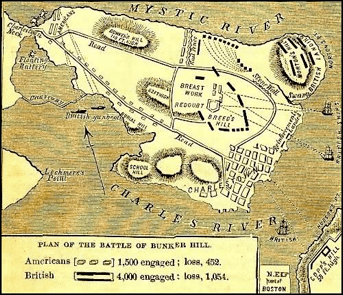
On the night of June 16, Colonel William Prescott led roughly a thousand men out of Cambridge and onto the Charlestown peninsula. Their orders were to fortify Bunker Hill, but after some debate they chose Breed’s Hill, which was lower but closer to Boston. Working through the dark hours, the men built an earthen redoubt about 130 feet on a side, with walls about six feet high.
At dawn on June 17, British sailors were astonished to see the new fort. Warships in the harbor and a battery on Copp’s Hill in Boston opened fire, but the Americans kept digging, extending a breastwork down the slope. General Israel Putnam of Connecticut helped organize reinforcements, and Colonel John Stark brought New Hampshire men to hold a rail fence and a stone wall along the Mystic River beach on the American left.
The British Assault
Gage decided to attack head-on. In the early afternoon, Major General William Howe landed about 2,200 to 3,000 British regulars on the peninsula under the cover of naval guns. During the fight, British shells set the town of Charlestown ablaze, and it burned to the ground.
The Americans were short on gunpowder, so their officers ordered them to hold their fire until the enemy was close. The famous command, “Don’t fire until you see the whites of their eyes,” is often credited to Prescott or Putnam, though historians are not certain who said it, or whether it was said at all.
The first British attack went up the slope in neat lines. At close range the Americans fired, and whole ranks of Redcoats fell. Howe’s men fell back, re-formed and attacked a second time, and again they were driven down the hill with terrible losses.
The Third Assault and the Fall of the Redoubt
Reinforced, Howe ordered a third assault, this time concentrating on the redoubt. By now the defenders were almost out of ammunition. As the British came over the walls with bayonets, the Americans fought back with musket butts and stones before Prescott ordered a retreat across Bunker Hill and over Charlestown Neck. Among the last to fall was Dr. Joseph Warren, the Boston patriot leader who had sent Paul Revere on his famous ride. Warren had just been commissioned a major general but chose to fight as a volunteer in the redoubt, and he was killed during the retreat.
A Costly Victory
The British held the field, but the price was staggering. Of the British troops engaged, roughly 1,054 were killed or wounded, including many officers. American losses were about 450 killed, wounded or captured. British General Henry Clinton called it “a dear bought victory,” adding that another such victory would ruin them.
The heavy losses shook British confidence. Gage abandoned plans to push out of Boston and seize Dorchester Heights. For the Americans, the battle proved that militia fighting behind earthworks could stand up to British regulars.
What Came Next
Just two weeks later, on July 3, 1775, General George Washington took command of the new Continental Army at Cambridge. Over the winter, Colonel Henry Knox hauled the heavy guns captured at Fort Ticonderoga across the snowy mountains to Boston. On the night of March 4, 1776, Washington’s men fortified Dorchester Heights, putting the city and the British fleet under their cannon. On March 17, 1776, the British evacuated Boston for good.
Today the 221-foot granite Bunker Hill Monument, completed in 1843, stands on Breed’s Hill where the redoubt once stood.
Frequently Asked Questions
When was the Battle of Bunker Hill?
The Battle of Bunker Hill was fought on June 17, 1775, in Charlestown, Massachusetts, across the harbor from Boston.
Was the Battle of Bunker Hill actually fought on Bunker Hill?
Most of the fighting took place on nearby Breed’s Hill, where the Americans built their redoubt. The battle still carries the name of Bunker Hill.
Who won the Battle of Bunker Hill?
The British won by capturing the hill, but they suffered over 1,000 casualties. The Americans lost about 450 men.
Who said “Don’t fire until you see the whites of their eyes”?
The order is usually credited to Colonel William Prescott or General Israel Putnam, but no one knows for certain who said it.
Who commanded the Americans at Bunker Hill?
Colonel William Prescott commanded the redoubt, with General Israel Putnam and Colonel John Stark also playing major roles.
Why was the Battle of Bunker Hill important?
It showed that American militia could fight British regulars and inflicted losses that made the British more cautious, boosting patriot morale.
What happened to Joseph Warren at Bunker Hill?
Patriot leader Dr. Joseph Warren fought as a volunteer in the redoubt and was killed as the Americans retreated.
Remember the Patriots of 1775
Learn about the man who sent Paul Revere riding in The Man Who Dispatched Paul Revere. Fly the banner of New England’s patriots with our Bunker Hill Flag, show the spirit of the Revolution with the We the People Don’t Tread on Me Flag, or honor those who serve with the Home of the Free Because of the Brave Flag.
Thanks for reading! We hope you enjoyed our post. Please share with all your fellow patriots. Brought to you by: Ultimate Flags