
Millions of travelers pass through Chicago’s O’Hare International Airport every year, and most have no idea who it is named for. The answer is a young Navy fighter pilot who, less than three months after Pearl Harbor, flew alone into a formation of enemy bombers to protect his aircraft carrier. His name was Edward Henry “Butch” O’Hare, and his fight on February 20, 1942, made him the Navy’s first ace of World War II.

Who Was Butch O’Hare?
Butch O’Hare was born in St. Louis, Missouri, on March 13, 1914. He graduated from the U.S. Naval Academy in 1937, trained as a naval aviator and joined Fighting Squadron 3, known as VF-3. By early 1942 the squadron was flying Grumman F4F Wildcats from the carrier USS Lexington, nicknamed “Lady Lex.”
The Lexington Off Rabaul, February 1942
In the dark weeks after Pearl Harbor, the U.S. Navy looked for ways to strike back. In February 1942 the Lexington task force steamed toward Rabaul, the major Japanese base on New Britain, planning a raid. On the afternoon of February 20, Japanese patrol planes spotted the carrier, and land-based bombers set out to attack it.
The first wave of nine twin-engine Mitsubishi G4M bombers, which the Allies called “Bettys,” was met by the Lexington’s fighters and largely destroyed. But as the American fighters chased the remnants, the ship’s radar picked up a second formation of bombers coming in from the opposite side. Only two Wildcats were in position to meet them: O’Hare and his wingman, Lieutenant (j.g.) Marion “Duff” Dufilho.
One Wildcat Against a Formation of Bombers
The two pilots climbed above the enemy formation about nine miles from the carrier. As they prepared to attack, Dufilho discovered his guns had jammed. That left O’Hare as the only fighter between the bombers and the Lexington.
He did not hesitate. Diving in from above and to the side, he raked the bombers one after another, pulling up, repositioning and attacking again while their gunners fired back. His Wildcat carried four .50-caliber machine guns with about 450 rounds each, enough for only around half a minute of total firing. Every burst had to count.
The Navy credited O’Hare with shooting down five bombers in roughly four minutes and damaging another. Postwar research by historians, including Japanese records, suggests he destroyed three and damaged others so badly that the attack fell apart. Either way, the remaining bombers lost their formation, dropped their bombs wide of the ship and were finished off by other fighters and the Lexington’s antiaircraft guns. The Lexington was not hit.
Back on Deck
A well-known story about that day says O’Hare came back aboard calm and cool, telling the deck crew to load his ammunition so he could get back up, even after a jumpy antiaircraft gunner fired at his plane on approach. The exact words vary with each retelling, but the spirit fits everything his shipmates said about him: modest, steady and focused on the next job.
The Medal of Honor and a Hero’s Welcome
Back home, America needed heroes, and O’Hare became one overnight. On April 21, 1942, President Franklin D. Roosevelt presented him with the Medal of Honor at the White House, the first awarded to a naval aviator in World War II, and he was promoted to lieutenant commander. His citation called the action one of the most daring, if not the most daring, single action in the history of combat aviation.
O’Hare would rather have stayed with his squadron. He went back to the Pacific and later commanded fighter units, helping develop new tactics including night fighting from carriers.
His Last Flight
On the night of November 26, 1943, during the Gilbert Islands campaign, O’Hare led one of the Navy’s first carrier-based night interceptions against Japanese torpedo bombers. In the confused action his Hellcat disappeared and was never found. He was 29 years old.
In 1949, Chicago renamed its Orchard Field airport in his honor. Today O’Hare International displays a restored Wildcat painted in the markings he flew on February 20, 1942, so travelers can see the plane behind the name. The Navy also named the destroyer USS O’Hare after him.
Frequently Asked Questions
Who is O’Hare Airport named after?
Chicago’s O’Hare International Airport is named for Lieutenant Commander Edward “Butch” O’Hare, a Navy fighter pilot and Medal of Honor recipient.
What did Butch O’Hare do on February 20, 1942?
He attacked a formation of Japanese bombers alone to protect USS Lexington and was credited with shooting down five of them.
How many planes did Butch O’Hare shoot down?
The Navy credited him with five bombers that day. Later historians believe he destroyed three and damaged several others.
Was Butch O’Hare the first Navy ace of WWII?
Yes. His February 20, 1942, fight made him the U.S. Navy’s first fighter ace of World War II.
What plane did Butch O’Hare fly?
He flew a Grumman F4F Wildcat with Fighting Squadron 3 aboard USS Lexington.
How did Butch O’Hare die?
He went missing during a night fighter mission near the Gilbert Islands on November 26, 1943, and was never found.
Honor Our Navy Aviators
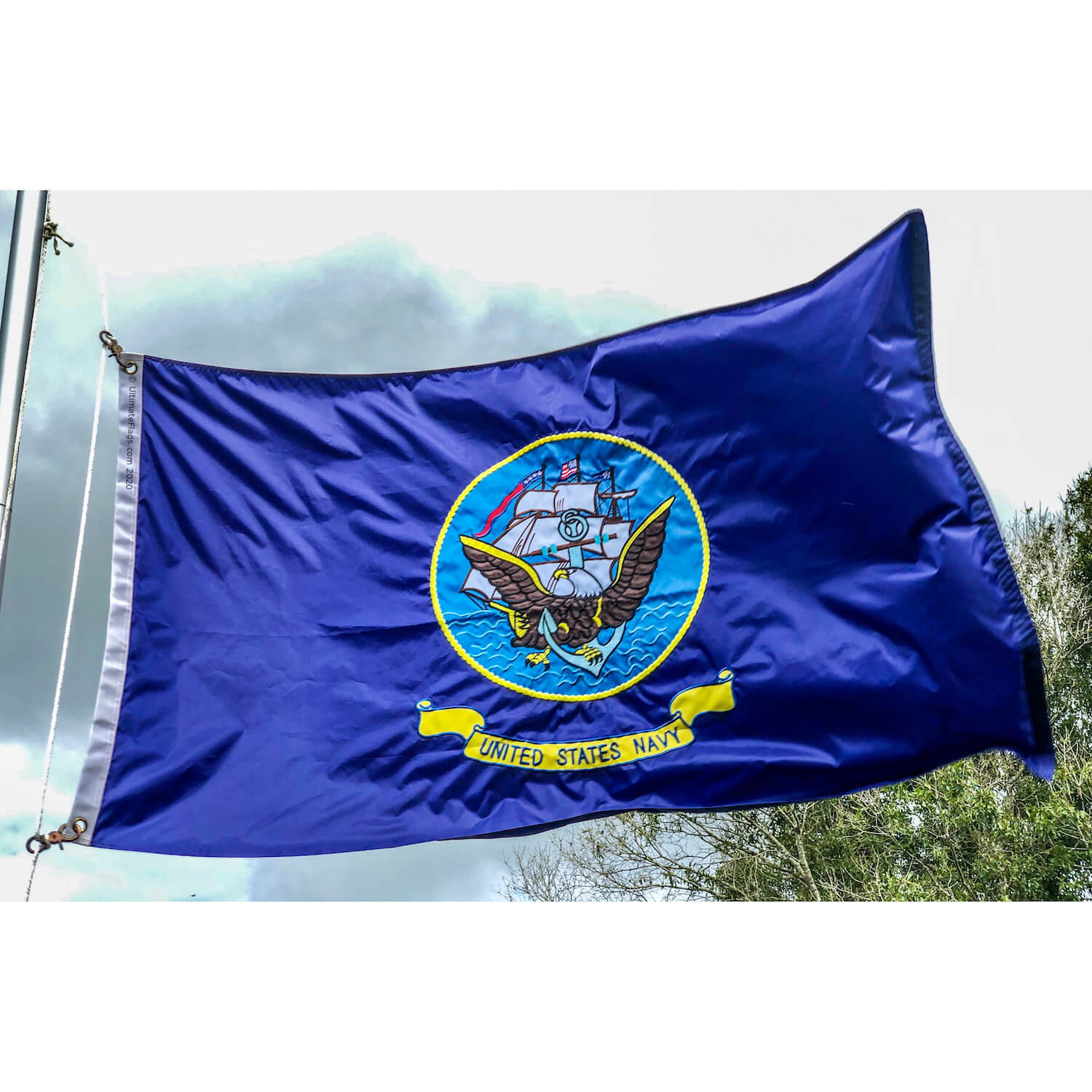
Read about another Pacific fighter pilot in Dogfighter of the Pacific, or meet a Navy hero from the war’s first day in Brave Texas Cook Is Pearl Harbor Hero. Show your pride with the US Navy Flag in double nylon embroidered, fly the 48-Star American Flag that flew in O’Hare’s day, or remember those still missing with our POW MIA Flag in Poly-Max, made in America.
Thanks for reading! We hope you enjoyed our post. Please share with all your fellow patriots. Brought to you by: Ultimate Flags