
Most people know Jimmy Stewart as George Bailey in It’s a Wonderful Life, the stubborn senator in Mr. Smith Goes to Washington or the photographer stuck in his apartment in Rear Window. Fewer know that in the middle of his career, with an Academy Award on his shelf, Stewart walked away from Hollywood to fly heavy bombers over Nazi Germany. He did not go as a celebrity or a morale booster. He went as a combat pilot, and he came home a colonel.

A Movie Star Who Loved to Fly
James Maitland Stewart was born on May 20, 1908, in Indiana, Pennsylvania, where his father ran the family hardware store. He went to Princeton University, studied architecture and drifted into acting with a college theater group. By the late 1930s he was one of Hollywood’s biggest stars, and in early 1941 he won the Academy Award for Best Actor for The Philadelphia Story.
Away from the cameras, Stewart’s real passion was flying. He earned a private pilot’s license in the 1930s, later added a commercial license, and logged hundreds of hours in the air before the United States entered the war.
“I’m In! I’m In!”
When the peacetime draft began, Stewart wanted to serve. There was one problem: at 6 feet 3 inches tall he weighed only about 138 pounds, below the Army’s minimum for his height, and he was turned away. Stewart went on a determined eating campaign and returned for a second physical. This time he passed, and he reportedly ran out shouting, “I’m in! I’m in!”
He was inducted as a private on March 22, 1941, nine months before Pearl Harbor, becoming the first major American movie star to put on a uniform for World War II. His pay dropped from a star’s salary to a private’s $21 a month. He trained at Moffett Field in California, and his flying experience helped him earn a commission as a second lieutenant in January 1942.
Fighting to Get Overseas
The Army was happy to use Stewart for recruiting films and public appearances. Stewart was not. He served as a flight instructor, training bomber pilots on B-17s and B-24s, and pressed his superiors again and again for a combat assignment. In 1943 he finally got it with the newly formed 445th Bombardment Group, which flew the four-engine B-24 Liberator.
Stewart became operations officer and then commander of the group’s 703rd Bomb Squadron. In November 1943 he led his squadron’s bombers across the Atlantic to their new base at Tibenham in Norfolk, England, part of the Eighth Air Force’s 2nd Air Division. His first combat mission was a December 1943 raid on the naval yards at Kiel, Germany.
The Ludwigshafen Mission: A Leader’s Decision
On January 7, 1944, the Eighth Air Force sent bombers against the chemical works at Ludwigshafen, Germany. On the way home, Stewart saw that the group leading the formation, the 389th Bomb Group, had turned well off course and was heading toward German fighter bases in France. His radio warnings were brushed aside.
Stewart faced a hard choice. He could stay on the correct course and leave the 389th alone, or follow it and add his squadron’s guns to its defense. He chose to stay with the lost group. When German fighters struck, the 389th lost its commander and several other bombers, but Stewart’s squadron kept the formation together and every one of his planes made it home.
Big Week and a Close Call
In late February 1944, the Allies launched “Big Week,” a massive air offensive against German aircraft factories. On February 25, 1944, Stewart led the 445th against targets at Fürth. His B-24 was hit by flak, and when the battered bomber landed back in England, its fuselage buckled. The crew walked away unhurt.
Stewart was later moved to the 453rd Bomb Group at Old Buckenham as operations officer, where he helped steady a group that had suffered heavy losses, and he continued to fly missions as a command pilot. By the end of the war he had flown about 20 credited combat missions and risen from private to colonel.
Honors and Homecoming
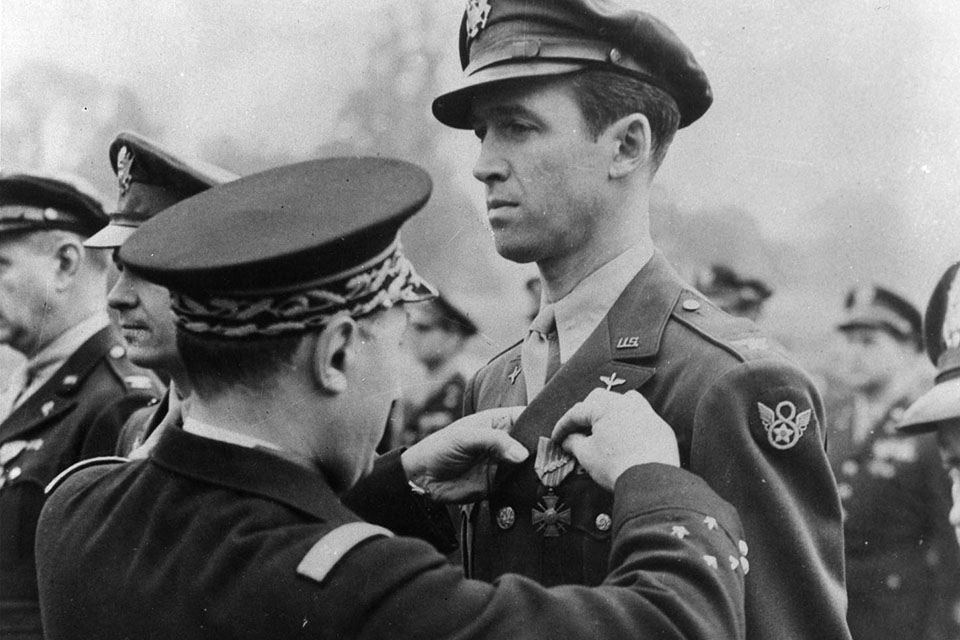
Stewart’s decorations included the Distinguished Flying Cross with oak leaf clusters, the Air Medal with oak leaf clusters and the French Croix de Guerre with Palm. When he came home in 1945, he turned down a big public welcome. He said simply:
“Thousands of men in uniform did far more meaningful things.”
He went back to Hollywood, and his very first postwar film was It’s a Wonderful Life (1946). Many viewers have noticed a new depth and darkness in his performances after the war. Stewart stayed in the Air Force Reserve, was promoted to brigadier general in 1959 and retired in 1968. He died on July 2, 1997, at age 89.
Frequently Asked Questions
Did Jimmy Stewart fight in World War II?
Yes. Jimmy Stewart flew about 20 combat missions over Europe as a B-24 Liberator pilot and commander with the Eighth Air Force.
What plane did Jimmy Stewart fly in WW2?
He flew the Consolidated B-24 Liberator, a four-engine heavy bomber, with the 445th and later the 453rd Bomb Groups.
Why was Jimmy Stewart rejected by the Army at first?
He was underweight. At 6 feet 3 inches tall he weighed about 138 pounds, so he gained weight and passed on his second try.
What rank did Jimmy Stewart reach?
He rose from private to colonel during World War II and was promoted to brigadier general in the Air Force Reserve in 1959.
What medals did Jimmy Stewart receive?
His awards included the Distinguished Flying Cross with oak leaf clusters, the Air Medal with oak leaf clusters and the French Croix de Guerre with Palm.
Where was Jimmy Stewart stationed in England?
He was first based at Tibenham in Norfolk with the 445th Bomb Group, and later at Old Buckenham with the 453rd Bomb Group.
What was Jimmy Stewart’s first movie after the war?
His first postwar film was It’s a Wonderful Life, released in 1946.
Honor America’s World War II Airmen
Read more World War II history in Omaha Beach on D-Day and “NUTS!” General McAuliffe’s Famous Reply at Bastogne. Fly the flag Stewart served under with our 48 Star USA Flag, honor today’s airmen with the embroidered U.S. Air Force Flag, or show your gratitude with the Home of the Free Because of the Brave Flag.
Thanks for reading! We hope you enjoyed our post. Please share with all your fellow patriots. Brought to you by: Ultimate Flags