

 BUY Rebel Flags For Sale
History books usually tell the story of the 1864 Atlanta Campaign through generals: Sherman and Johnston, Hood and McPherson, Peachtree Creek and Jonesboro. But some of the most vivid testimony about the siege of Atlanta was written in pencil by a little girl. Carrie Berry turned ten years old in the middle of the bombardment, and the diary she kept that summer gives us a rare view of what Union shelling meant for the families who stayed in the city.

Who Was Carrie Berry?
Carrie Berry was born on August 3, 1854, the daughter of Maxwell and Harriet Berry. The family lived on Harris Street in Atlanta with Carrie’s sisters Fannie, Zuie and Maggie and her brother, Maxwell Jr.
Her wartime diary runs from 1864 into 1866, and she kept a second diary from 1868 to 1874. Both are preserved today in the Kenan Research Center at the Atlanta History Center. Carrie married William Macon Crumley in 1875, raised three children and died in 1921. She is buried in Atlanta’s historic Oakland Cemetery.
Why Atlanta Mattered in 1864
By 1864 Atlanta was one of the most important cities left to the Confederacy. Four railroads met there, and its depots, foundries, rolling mills and warehouses kept supplies flowing to Southern armies. The city’s population had swollen to about 22,000 by the spring of 1864, crowded with refugees, wounded soldiers and war workers.
That May, Union General William Tecumseh Sherman marched south from Chattanooga with roughly 100,000 men. General Joseph E. Johnston’s Army of Tennessee fell back step by step through North Georgia, fighting at Resaca, New Hope Church and Kennesaw Mountain. On July 17, with Sherman across the Chattahoochee, Jefferson Davis replaced Johnston with General John Bell Hood, who attacked at Peachtree Creek on July 20 and in the Battle of Atlanta on July 22.
The Shells Begin to Fall
The first Union shells landed in Atlanta on July 20, during the fighting at Peachtree Creek. Sherman soon turned his guns on the heart of the city, hoping to pressure Hood into giving it up. The bombardment went on for more than a month. On August 9 alone, an estimated 3,000 to 5,000 shells fell on downtown Atlanta.
Families like the Berrys dug in. Carrie wrote that they could hear the cannon and muskets “very plane,” but that it was the shells they dreaded. One burst under the dining room, and another tore through the smokehouse. Whenever the firing picked up, the family crowded into the cellar.
“Aug. 1. Monday. It was raining this morning and we thought we would not have any shelling today… but before night we had to run to the cellar.”
A Tenth Birthday Under Fire
Two days later came Carrie’s birthday. Her entry for August 3, 1864, is one of the most quoted lines of the entire siege:
“I was ten years old, But I did not have a cake times were too hard so I celebrated with ironing. I hope by my next birthday we will have peace in our land so that I can have a nice dinner.”
Even in the cellar, life went on. Carrie knit stockings so they would be finished before school started. Some nights the shells fell so thick that the family ran to her aunt’s house to share a stronger cellar. “How I wish the federals would quit shelling us,” she wrote on August 11, longing for fresh air. Yet she also thought of the Southern boys holding the lines: she did not like being shut up in the cellar, she admitted, “but our soldiers have to stay in ditches.”
On August 15, Carrie and her sister Zuie were standing outside between the house and the dining room when a shell slammed into the garden, blowing a large hole and throwing dirt across the yard. “I never was so frightened in my life,” she wrote. Zuie, she said, was “as pale as a corpse.” Newspaper reports suggest the shelling killed perhaps a score of civilians, and hundreds more were likely wounded, though no medical records survive to give an exact count.
A Brief Calm, Then the End
On August 22 the Berrys moved to a house closer to the center of town, but Carrie’s mother lived in constant fear of fire, which broke out in the city nearly every day. Then, in late August, the Union guns fell quiet. Sherman had pulled most of his army out of the trenches to swing south against Hood’s last railroad. Carrie hoped the Yankees were heading back to Tennessee, and on August 27 the family moved home, glad to have “no shells around us.”
The quiet was a trick of strategy. On August 31 and September 1, Sherman’s columns fought and defeated Hood’s men at the Battle of Jonesboro, cutting the Macon & Western Railroad. With his supply line gone, Hood had no choice but to give up the city. On the evening of September 1, Confederate troops marched out, blowing up an ammunition train and supply depot as they left.
“Directly after dinner Cousin Emma came down and told us that Atlanta would be evacuated this evening and we might look for the federals in the morning.”
That same day the Berrys learned that a beloved cousin, Henry, had been badly wounded. On September 2, Mayor James M. Calhoun rode out and surrendered Atlanta to the Union army.
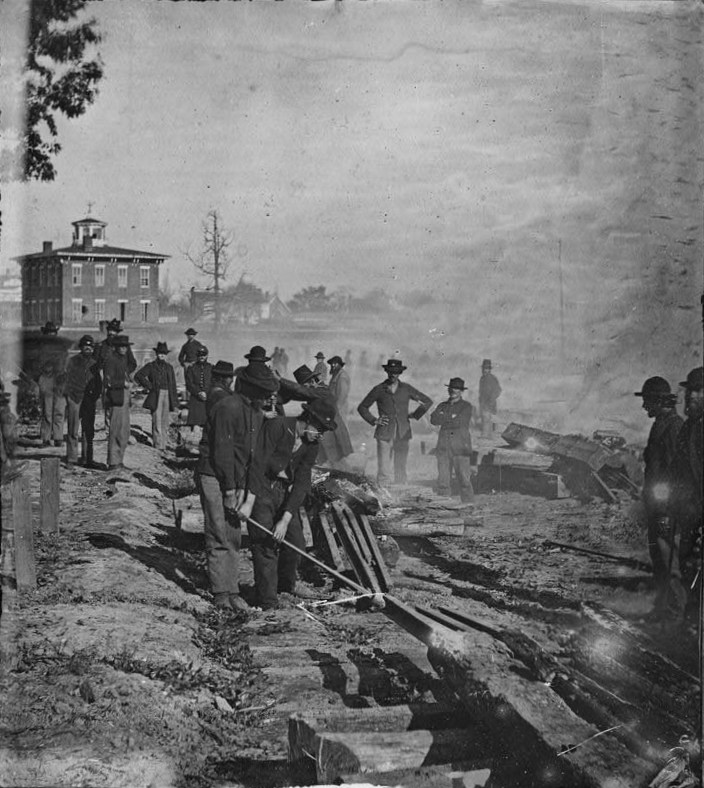
What Came Next for Atlanta
The fall of Atlanta was a heavy blow to the South. Within days Sherman ordered nearly all remaining civilians to leave the city. In a telegram to Ulysses S. Grant on October 9, 1864, he proposed abandoning the railroads and striking across the state, promising, “I can make the march, and make Georgia howl.” When his army left Atlanta in mid-November on the March to the Sea, much of the city was put to the torch. Carrie recorded those days too, and you can read her account in “They came burning Atlanta to day…”, Part II of this series.
Frequently Asked Questions
Who was Carrie Berry?
Carrie Berry (1854-1921) was an Atlanta girl who kept a diary during the Union siege and occupation of the city in 1864. She turned ten during the bombardment.
Where is Carrie Berry’s diary today?
Her original diaries are held by the Kenan Research Center at the Atlanta History Center in Atlanta, Georgia.
How long was Atlanta shelled in 1864?
Union artillery fired into the city from July 20 until late August 1864, more than a month. The heaviest day was August 9.
When did Atlanta fall in the Civil War?
Confederate forces evacuated Atlanta on the night of September 1, 1864, after the Battle of Jonesboro. Mayor James Calhoun surrendered the city on September 2.
Did the March to the Sea begin in the summer of 1864?
No. The Atlanta Campaign was fought that summer, but the March to the Sea did not begin until mid-November 1864, ending at Savannah in December.
When did Sherman say he would “make Georgia howl”?
Sherman used the phrase in a telegram to Grant sent from Allatoona, Georgia, on October 9, 1864, while planning the march across Georgia.
Honor Georgia’s Heritage
Carrie Berry’s diary reminds us that the people of Atlanta, young and old, endured the siege with courage and faith. Learn more in Sherman’s Slash and Burn, and honor the soldiers who defended the city with our Hardee Flag of the Army of Tennessee, the Old Georgia Flag (1956-2001) or the Confederate 2nd National Flag.
Thanks for reading. Please share our posts with your friends and family so they too can learn more about Southern Heritage and History.
Brought to you by: Ultimate Flags
Comments are closed.