
 BUY Rebel Flags For Sale
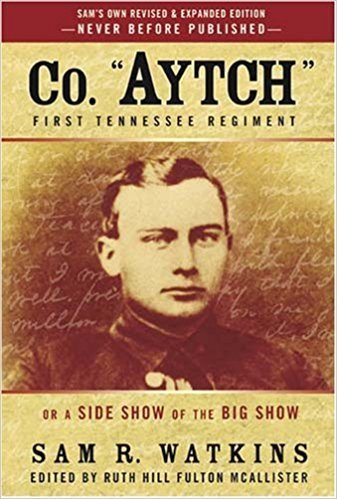
Few stories capture the hungry, good-humored spirit of the Army of Tennessee better than a short scene Private Sam Watkins set down in his memoir Co. Aytch. His father had come all the way to camp to see him, and Sam, ashamed of how little his mess had to eat, came up with a plan to get the old man a proper dinner. The plan led straight to his colonel’s tent, and to a meal neither of them forgot.

Who Was Sam Watkins?
Samuel Rush Watkins was born in 1839 near Columbia, in Maury County, Tennessee. When Tennessee left the Union in 1861, the 21-year-old enlisted in the Maury Grays, which became Company H of the 1st Tennessee Infantry. He served from the first months of the war to the surrender in North Carolina in April 1865, fighting at Shiloh, Perryville, Murfreesboro, Chickamauga, Missionary Ridge, the Atlanta Campaign, Franklin and Nashville.
About two decades later he wrote down his memories, first as newspaper installments and then as a book published in 1882. He called it a “side show of the big show,” written by a “high private” in the rear rank. That modest description is exactly why it endures. Historians, reenactors and documentary filmmakers, including Ken Burns, keep returning to it because it shows the war the way a common Southern soldier lived it. You can read more of his stories in our posts on Sam’s canoe trip home down the Duck River and the corn patch raid at Tupelo.
Back to Chattanooga in the Summer of 1863
Earlier versions of this story placed the visit during the siege of Chattanooga, with Grant’s army on the way. The memoir tells it differently. The visit falls in Watkins’ chapter titled “Back to Chattanooga,” which follows the Tullahoma Campaign of late June and early July 1863. General Braxton Bragg’s Army of Tennessee had fallen back from Middle Tennessee to Chattanooga, and the men were put to work digging forts and breastworks while General William S. Rosecrans’ Federal army gathered to the north and west.
Watkins remembered that work bitterly, because the same forts were later held by the Federals while the Confederates looked down on them from Lookout Mountain and Missionary Ridge. In early September 1863 Bragg evacuated the town, and later that month the two armies collided at Chickamauga. So the dinner took place in the weeks of hard digging and short rations before that great battle.
The Visit, in Sam’s Own Words
Here is how Watkins opened the episode:
“About this time my father paid me a visit. Rations were mighty scarce. I was mighty glad to see him, but ashamed to let him know how poorly off for something to eat we were. We were living on parched corn.”
His father was Frederick Henry Watkins of Maury County, the same man who later helped pay for the printing of Co. Aytch. Sam had no intention of serving him a handful of roasted kernels. So he walked him over to the regimental commander and made his introduction, asking whether the colonel, who surely had “a little better,” might give his father a good dinner. The colonel graciously agreed to share his rations and invited Sam to stay and eat as well. Sam, as he told his readers, “gladly accepted.”
Then came the punch line. The colonel’s camp servant, a young man Watkins called Whit, came in carrying a frying pan, dumped its contents onto an old oilcloth and announced that dinner was ready. It was parched corn. As Sam put it, the colonel “was living like ourselves—on parched corn.”
Colonel Hume R. Feild of the 1st Tennessee
The officer in this story was Hume R. Feild. Watkins spelled the name “Field” throughout his book, and many later writers followed him, but the regimental records and his own gravestone use Feild. He had entered the war as a captain in the 1st Tennessee, served as its major, and took command of the regiment when Colonel George Maney was promoted to brigadier general after Shiloh. Feild was elected colonel at the reorganization in the spring of 1862 and kept the 1st Tennessee for the rest of the war, later commanding Maney’s old brigade at Nashville. He survived the war and lived until 1921.
Watkins admired him enormously. He compared Feild to Stonewall Jackson in looks, speech and soldierly bearing, and wrote that he was “the bravest man, I think, I ever knew.” He also noted that Feild was no strict disciplinarian. He led by example, often walking on the march while a worn-out private rode his gray mare. A colonel who ate the same corn as his privates fits that picture perfectly.
What Was Parched Corn?
Parched corn was one of the simplest foods a soldier could make. Dried kernels were roasted in a pan or skillet over the fire until they browned and crisped. The result was something like a hard, nutty half-popped popcorn. It kept well, was easy to carry in a haversack and could be eaten on the march. American frontiersmen and Native peoples had relied on it for generations.
For the Army of Tennessee it became a symbol of hard times. Watkins mentions parched corn again and again, and later in the year, on Missionary Ridge, he described men living on corn picked out of the mud where officers’ horses had been fed. Rations in that army depended on long rail lines, overworked commissaries and a Confederacy short of nearly everything, and the private soldier felt every shortfall in his stomach.
Why This Small Story Matters
There are no cannon in this story and no casualties. Yet it tells us a great deal about the Southern soldier. The men of the 1st Tennessee were far from rich, but they took pride in hospitality and in looking after family. Their colonel, for all his rank, shared the same hardships. And the private who told the tale could laugh about it twenty years later instead of complaining. That mix of pride, sacrifice and humor runs through all of Co. Aytch, and it is one reason the book still has so many readers.
Frequently Asked Questions
Who was Colonel Field in Co. Aytch?
He was Colonel Hume R. Feild, commander of the 1st Tennessee Infantry from 1862 to the end of the war. Sam Watkins spelled his name “Field” in the book.
What is parched corn?
Parched corn is dried corn kernels roasted over a fire until crisp. Confederate soldiers often lived on it when regular rations ran short.
When did Sam Watkins’ father visit him?
According to Co. Aytch, the visit came at Chattanooga in the summer of 1863, while the army was fortifying the town before the Battle of Chickamauga.
What regiment was Sam Watkins in?
Watkins served in Company H, the Maury Grays, of the 1st Tennessee Infantry in the Army of Tennessee.
Is Co. Aytch a true story?
Yes. It is Watkins’ personal memoir, written from memory about twenty years after the war. He admitted some details might be imperfect, but historians value it as an honest soldier’s account.
Why did Confederate soldiers have so little food?
The Confederacy struggled with damaged railroads, shortages and poor supply management. In the Army of Tennessee, soldiers frequently went on short rations, especially in 1863.
Honor the Men of the 1st Tennessee
Watkins and Colonel Feild served under General Leonidas Polk, whose story we tell in General Leonidas Polk, the Beloved Fighting Bishop. Remember the Volunteer State’s soldiers with a State of Tennessee Flag, fly the Polk Battle Flag in double nylon embroidered, or browse our full collection of Rebel flags.
Thanks for reading. Please share our posts with your friends and family so they too can learn more about Southern Heritage and History.
Brought to you by: Ultimate Flags