
 BUY Rebel Flags For Sale
Some places seem to hold on to their history. After we shared our story on The Ghosts of Gettysburg, readers wrote in with their own first-hand experiences at Civil War sites. Two of them stood out: a strange photograph taken among the boulders of Devil’s Den, and a television host’s unsettling visit to an eight-sided Kentucky mansion that sheltered Southern soldiers. Here are their stories, along with the real history that makes each place so haunting.

A Reader’s Photograph at Devil’s Den
A reader named Mike told us about a family trip to Gettysburg. While exploring Devil’s Den, he took two photographs of the same spot only about ten seconds apart. When the family got home and looked through the pictures, the first one was perfectly ordinary. The second showed what looked like campfire smoke drifting up from behind the rocks, though no one had seen any smoke or fire at the time.
Was it a trick of the light, a flaw in the camera or something else? We can’t say. But if any place on the battlefield seems likely to leave an impression, it is Devil’s Den.
The History of Devil’s Den
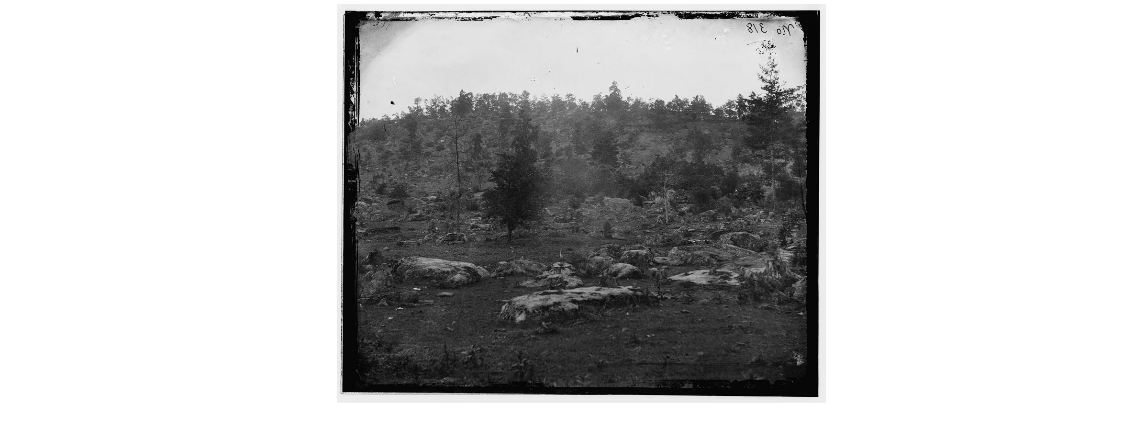
Devil’s Den is a jumble of enormous granite boulders on a ridge at the southern end of the Gettysburg battlefield, just west of Little Round Top. On the afternoon of July 2, 1863, the second day of the battle, it became one of the bloodiest corners of the field.
General John Bell Hood’s division of Longstreet’s corps launched the attack. The 1st Texas and 3rd Arkansas of Robertson’s brigade drove at the Union line, while the 44th and 48th Alabama of Law’s brigade pushed up Plum Run valley. Georgia brigades under Henry Benning and George T. Anderson followed in a second wave. Defending the rocks were Union General J. H. Hobart Ward’s brigade, including the 4th Maine, 20th Indiana, 86th New York and 124th New York, along with Captain James Smith’s 4th New York Battery, whose guns stood on the crest.
The fighting surged back and forth among the boulders until the Southern attackers carried the position and captured three of Smith’s cannon. Once the ground was taken, Confederate sharpshooters slipped into the crevices of Devil’s Den and fired on Union officers and gunners on Little Round Top. Losses in the fighting around the Den numbered in the thousands on both sides, and the jagged rocks became the resting place, for a time, of many brave men.
A Kentucky Television Host at Octagon Hall
Another reader, Jerry, wrote to us about Dave Shuffett, the longtime host of Kentucky Life, the KET public television series that visited towns and counties across the Bluegrass State. Jerry described him as a humble and very believable man.
According to Jerry, Shuffett visited Octagon Hall near Franklin, Kentucky, and filmed a ladle hanging by the fireplace that began rocking on its own. Flashlights that had been firmly twisted off reportedly switched back on. Jerry told us that Shuffett left the house badly shaken.
The History of Octagon Hall
Octagon Hall stands in Simpson County, just outside Franklin, a short distance north of the Tennessee line. Andrew Jackson Caldwell, a mason and planter, laid its foundation in 1847 and built an unusual eight-sided, two-story brick home on his farm. Octagon houses were a popular fashion in the mid-1800s, and Caldwell’s is one of the best surviving examples in the South.
Caldwell was a Southern sympathizer. When General Albert Sidney Johnston’s Confederates abandoned Bowling Green in February 1862 after the fall of Fort Henry and fell back toward Nashville, retreating troops passed along the road near Franklin, and local accounts say many of them stopped at Octagon Hall for a night. Union soldiers later occupied the property as well. Tradition holds that Caldwell hid Confederate soldiers in concealed spaces within the house, and the home is said to have served as a hospital for wounded men of both sides.
Tragedy touched the family before the war. In 1851, Caldwell’s young daughter Mary Elizabeth died after her dress caught fire in the basement kitchen. Today many visitors say her presence lingers there. Ghost hunters also report shadowy figures, a soldier’s apparition, sudden cold spots and unexplained voices. The house was listed on the National Register of Historic Places in 1980, and since 2001 it has been run by the Octagon Hall Foundation as a museum and Kentucky Confederate studies archive.

Why Battlefields Feel Haunted
Whether you believe in spirits or not, there is no denying the weight these places carry. Thousands of young men fought and died at Gettysburg in three days, many of them far from home and buried where they fell. Houses like Octagon Hall saw wounded soldiers, frightened families and enslaved people living through the upheaval of war. Visiting them with respect is a way of remembering the people whose lives were changed there.
Frequently Asked Questions
Is Devil’s Den haunted?
Devil’s Den is one of the most commonly reported haunted spots at Gettysburg. Visitors often describe strange photographs, sounds and sightings among the boulders.
What happened at Devil’s Den during the Battle of Gettysburg?
On July 2, 1863, Hood’s Confederate division attacked Union troops holding the boulders. After fierce fighting, the Confederates took the position and captured three Union cannon.
Who fought at Devil’s Den for the Confederacy?
Texas, Arkansas, Alabama and Georgia troops of Hood’s division fought there, including the 1st Texas, 3rd Arkansas, 44th and 48th Alabama, and Benning’s Georgians.
Where is Octagon Hall located?
Octagon Hall is near Franklin in Simpson County, Kentucky, close to the Tennessee state line. It operates today as a museum.
Who built Octagon Hall?
Andrew Jackson Caldwell began building the eight-sided brick house in 1847. He was a Southern sympathizer during the Civil War.
Who is the ghost of Octagon Hall?
The best-known spirit is said to be Mary Elizabeth Caldwell, who died in 1851 when her dress caught fire. Visitors also report soldiers and other figures.
Can you visit Octagon Hall?
Yes. It is run as a museum and Confederate studies archive by the Octagon Hall Foundation, and it has hosted paranormal tours and events.
Remember the Brave Men of Gettysburg and Kentucky
For more Gettysburg history, read about General Robert E. Lee’s Headquarters at Gettysburg. Honor the Texans who stormed Devil’s Den with our Hood’s Texas Brigade Flag in embroidered nylon, remember Kentucky’s Orphan Brigade with the 4th Kentucky Regiment Orphan Brigade Flag, or fly the State of Kentucky Flag.
Thanks for reading. Please share our posts with your friends and family so they too can learn more about Southern Heritage and History.
Brought to you by: Ultimate Flags