
 BUY Rebel Flags For Sale
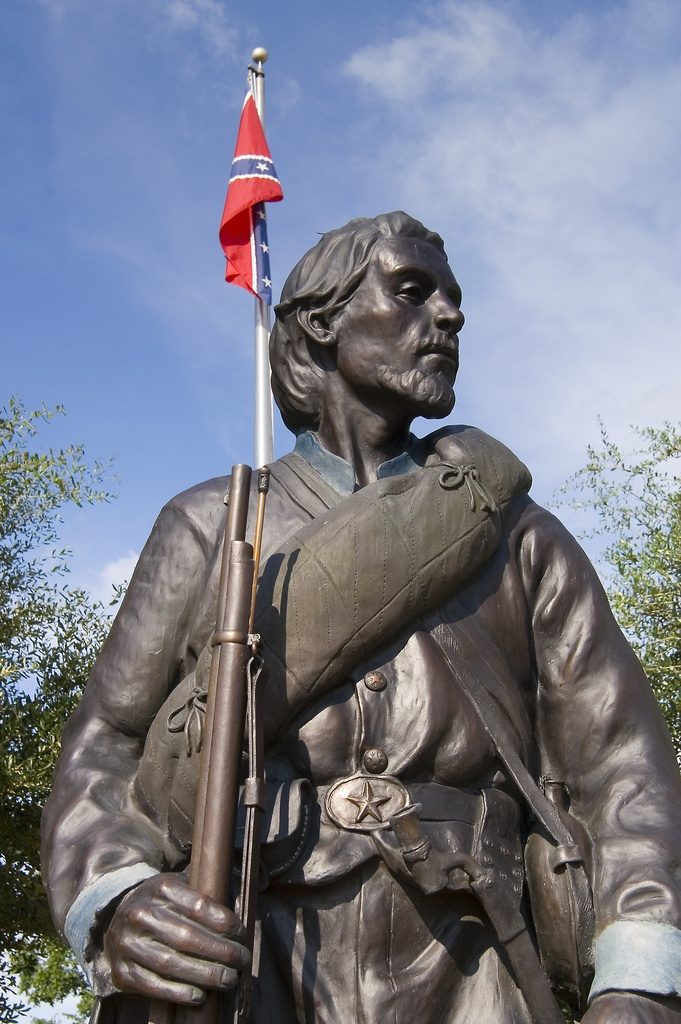
Christmas Day 1861 found most of the young men of the 4th Texas Infantry far from home for the first time, wintering in the damp woods of Northern Virginia. For nineteen-year-old Val C. Giles, the holiday meant a cold shift of picket duty on the Virginia bank of the Potomac River, within sight of the enemy camps in Maryland. Years later he wrote about that day in his memoir, and his account of a false alarm on the river and a voice he could not explain is one of the most haunting Christmas stories of the war. Here is the story, and the history behind it.

Who Was Val C. Giles?
Valerius Cincinnatus Giles was born on January 26, 1842, in Shelby County, Tennessee. When he was about seven, his family moved to a farm outside Austin, Texas. In 1861 he enlisted in Company B of the 4th Texas, a company raised in Travis County, and he served with the regiment through its hard campaigns, rising to the rank of sergeant.
After the war Giles came home to Austin. He married Lou Barnhart in 1873, worked as a clerk in the Texas General Land Office and served on the board of managers of the Confederate Home in Austin. He died on January 31, 1915, and is buried in Austin’s Oakwood Cemetery. His recollections were edited by Mary Lasswell and published in 1961 as Rags and Hope: The Recollections of Val C. Giles, Four Years with Hood’s Brigade, Fourth Texas Infantry, 1861-1865.
The 4th Texas and Hood’s Texas Brigade
The 4th Texas Infantry was organized on September 30, 1861, with ten companies and nearly 1,200 men, each company drawn from a different Texas county. Its first colonel, Robert T. P. Allen, was a hard disciplinarian who quickly wore out his welcome and resigned. He was replaced in October 1861 by a young Kentucky-born West Pointer named John Bell Hood.
The regiment was brigaded with the 1st and 5th Texas under Louis T. Wigfall, the fiery former U.S. senator from Texas. When Hood took command of the brigade in March 1862, it began to earn the name that would follow it through history: Hood’s Texas Brigade. Over the next three years the 4th Texas fought at Gaines’ Mill, Second Manassas, Sharpsburg, Gettysburg, Chickamauga, the Wilderness and Petersburg. Of the 1,343 men who served in its ranks, only 15 officers and 143 men were left to surrender at Appomattox in April 1865.
That was all still ahead in December 1861. In November the Texans had marched to Dumfries, Virginia, where they spent the winter drilling, building huts and fighting an enemy more deadly than any Yankee: disease. Measles, pneumonia and camp fevers swept through the regiments, and hundreds of men fell sick.
Guarding the Potomac Blockade
The Texans were in Prince William County for a reason. In October 1861 the Confederate army had built a chain of artillery batteries along the Virginia shore of the Potomac at Evansport (today’s Quantico), Shipping Point, Freestone Point and Cockpit Point. Their purpose was bold: close the river to Union shipping and cut Washington off from the sea. By mid-December the Confederates had 37 heavy guns overlooking the river, and for nearly five months Northern vessels ran the gauntlet at their peril.
The Cockpit Point position sat atop a steep bluff known as Possum Nose, about 75 feet above the water, with several gun emplacements, a powder magazine and rifle pits. Across the river, on the Maryland shore, lay the winter camps of Union General Daniel E. Sickles and his New York brigade. Infantry like the Texans were needed to picket the riverbank, protect the guns from a surprise landing and watch every boat that moved on the water.
Christmas Morning on Picket
On Christmas morning a detail of twenty men from the 4th Texas, commanded by Lieutenant R. J. Lambert, was sent down to relieve the picket guard along the river. Giles was posted near the battery at Cockpit Point. It was cold, the country was strange to the Texans, and the holiday only made the men think harder about home.
Sometime that day a steamer appeared on the river. A lookout posted high above the water called out that a gunboat was coming, and the gunners rushed to their pieces, ready to open fire. Then the lookout called again: the vessel was flying yellow flags, the signal of a hospital boat. The guns stayed silent, and the steamer turned toward the Maryland shore.
Giles later identified the boat as the Harriet Lane, a fast revenue cutter that had served with the Union navy since the Fort Sumter expedition. That identification is his own, and it cannot be confirmed from other records. If he was right, Texans would meet the ship again: on January 1, 1863, Confederate forces under General John B. Magruder attacked the Union fleet at Galveston, and Texas troops boarded and captured the Harriet Lane in one of the boldest victories of the war in Texas.
A Brother’s Voice
The part of the story Giles never forgot came later. Standing his post alone, homesick and tired, he was sure he heard his older brother Lew call his name. He looked around and saw no one.
Lewis L. Giles was serving in Kentucky with Terry’s Texas Rangers, the 8th Texas Cavalry. On December 17, 1861, the Rangers charged Union infantry at the Battle of Rowlett’s Station, also called Woodsonville, near the Green River bridge at Munfordville. Colonel Benjamin Franklin Terry, the regiment’s founder, was killed in that fight, and Lew Giles was mortally wounded in the same charge. He was carried to Gallatin, Tennessee, where, according to his brother, he died at about four o’clock on Christmas afternoon, close to the hour Val heard the voice on the Potomac. Lew’s service record gives his date of death as December 24.

The End of the Potomac Blockade
The blockade held through the winter. Union gunboats traded fire with the Cockpit Point guns in early January 1862 without either side gaining much. In March 1862, General Joseph E. Johnston pulled his army back from the Manassas and Centreville line toward the Rappahannock, and the river batteries were abandoned. On March 9 a Union landing party came ashore and destroyed what was left. Within weeks Hood’s Texans were on their way to the Peninsula and the great battles that made their name.

Frequently Asked Questions
Who was Val C. Giles?
Val C. Giles (1842-1915) was a soldier in Company B, 4th Texas Infantry, part of Hood’s Texas Brigade. His memoir, Rags and Hope, is one of the best firsthand accounts of the brigade.
What was picket duty in the Civil War?
Pickets were small details of soldiers posted ahead of the main army to watch for the enemy and give warning of an attack. It was lonely, cold and often dangerous work.
Where did Hood’s Texas Brigade spend the winter of 1861-1862?
The Texas regiments camped near Dumfries in Prince William County, Virginia, from November 1861 until the spring of 1862. Disease hit the camps hard that winter.
What was the Confederate blockade of the Potomac?
From October 1861 to March 1862, Confederate batteries at Evansport, Shipping Point, Freestone Point and Cockpit Point fired on Union ships to close the river to Washington. The batteries were abandoned when Johnston’s army withdrew in March 1862.
How did Colonel Benjamin Franklin Terry die?
Terry was killed leading his Texas Rangers at the Battle of Rowlett’s Station (Woodsonville), Kentucky, on December 17, 1861. He was the regiment’s founder and first colonel.
What happened to the Harriet Lane?
The Harriet Lane was captured by Confederate forces at the Battle of Galveston on January 1, 1863. Her commander, Jonathan Wainwright, was killed in the fight.
How many men of the 4th Texas surrendered at Appomattox?
Only 15 officers and 143 men remained when the regiment surrendered on April 9, 1865, out of more than 1,300 who served in it.
Remember the Texans This Christmas
Val Giles survived the war and lived to tell his story, but many of the boys who shared that cold Christmas picket did not. Honor them with our Hood’s Texas Brigade Flag, the Terry’s Texas Rangers Flag or the Texas Battle Flag. To read more about the man who led them, see John Bell Hood: Arrested, Then Promoted.
Thanks for reading. Please share our posts with your friends and family so they too can learn more about Southern Heritage and History.
Brought to you by: Ultimate Flags