
 BUY Rebel Flags For Sale
Every soldier who has ever filled out a leave request will recognize this story. In the winter of 1863-64, Private Sam Watkins of the 1st Tennessee Infantry asked for a furlough and then watched one sheet of paper travel from his corporal all the way up to the commanding general. His account of the journey, written in his memoir Co. Aytch, is one of the funniest chapters ever penned by a Confederate soldier, and it also tells us a good deal about life in the Army of Tennessee that winter.

Sam Watkins and Company Aytch
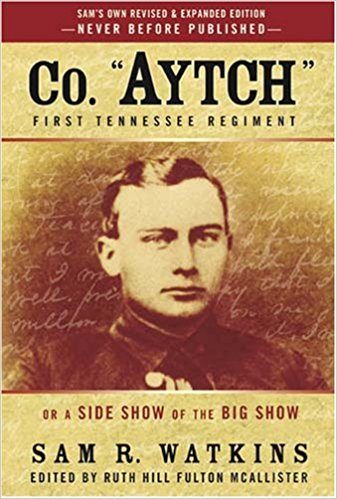
Samuel Rush Watkins was a young man from Columbia, in Maury County, Tennessee, who enlisted in the Maury Grays in 1861. The company became Company H of the 1st Tennessee, and “Co. Aytch” became the title of the book he published in 1882. Watkins served from the war’s first year to its last, at Shiloh, Perryville, Murfreesboro, Chickamauga, Missionary Ridge, the Atlanta Campaign, Franklin and Nashville. He wrote with a private’s eye and a storyteller’s gift, which is why we return to him so often, as in his costly canoe trip home down the Duck River.
Winter Quarters at Dalton, Georgia
The furlough story belongs to a specific time and place. After the Confederate defeat at Missionary Ridge on November 25, 1863, the Army of Tennessee fell back into north Georgia and went into winter quarters around Dalton. Watkins recalled roughly four months there during the cold, wet winter of 1863-64, broken up by snowball battles, religious revivals and endless camp routine.
The army was in poor shape when it arrived. General Braxton Bragg had been relieved, desertion was heavy and morale was low. Then General Joseph E. Johnston took command in late December 1863. Watkins credited him with a near miracle. Johnston improved rations, issued new clothing and shoes, granted amnesty to men absent without leave and did something Watkins said Bragg had never allowed: he granted furloughs, rotating them through the army a portion at a time until every man had a turn.
A Furlough Climbs the Chain of Command
So Sam applied. What followed, in his telling, was “a series of red tapeism.” The request had to pass through every officer’s hands, and each one seemed to feel it was his duty to find something wrong with it.
- The corporal and sergeant found an informality in the wording or spelling.
- The lieutenants each had their say.
- The captain read and reread it to see that every “i” was dotted and “t” crossed, then sent it back over a word he could not make out.
- The colonel snatched it, scrawled “app.” in pencil and handed it over, only for it to come back with instructions that he must write “approved” plainly in pen and ink.
- The brigadier general was in the middle of a poker game and told Sam to wait. When he finally read it, he sent Sam back for the adjutant’s signature.
- The major general, whom Sam described as sour as vinegar, kept repeating that the paper was “informal” before at last telling his adjutant to sign it.
- The lieutenant general was deep in a learned conversation about “the war in Chili,” and Sam waited anxiously for that war to end before an adjutant signed for him.
- The commanding general’s headquarters took it in at the guard post and promised it would come back through the colonel at roll call the next morning.
Watkins never named the officers involved, and we will not guess at which general was holding the cards that day. The joke works without names, because every soldier who heard it knew the type. When the major general’s adjutant finally signed, Sam wrote that he felt as if “the anaconda’s coil had been suddenly relaxed.” And he closed the chapter with a wink: “Now, reader, the above is a pretty true picture of how I got my furlough.”
The Furlough Itself
The sequel is just as funny. By the time the paper came back, Sam said, it looked as if it had been “beat with a soot-bag.” He boarded a train at Dalton and rode in a first-class passenger car for the first time since he became a soldier. But at every stop a captain and a detail of guards wanted to see his furlough, until he wished it were at the bottom of the ocean. He traveled into Alabama, spent time around Selma in the company of a handsome cavalry captain named G. M. V. Kinzer, and admitted the captain, with his better clothes, won all the attention from the young ladies. By the end, Sam declared he wanted no more furloughs.
When he returned to Dalton in the spring of 1864, the Federal army under General William T. Sherman was advancing on Rocky Face Ridge. The long Atlanta Campaign was about to begin, and furloughs would be scarce again.
Why Furloughs Mattered So Much
For Confederate soldiers, leave was rare and precious. Most were farmers and tradesmen whose families were struggling at home, and many had not seen their loved ones in years. Under Bragg, furloughs had been almost unknown in Watkins’ experience, and men who slipped away without leave faced harsh punishment. Johnston’s willingness to send men home in rotation was one of the reasons the army’s spirit recovered so dramatically that winter. Watkins said simply that Johnston “restored the soldier’s pride.”
The story also shows something lasting about the Southern soldier. He could suffer short rations, cold and danger without losing his sense of humor, and he could poke fun at his officers while still following them into the next fight.
Frequently Asked Questions
What is a furlough in the Civil War?
A furlough was an official leave of absence that let a soldier go home for a set period. It required written approval up the chain of command.
Where was the Confederate army in the winter of 1863-1864?
The Army of Tennessee spent that winter in quarters around Dalton, Georgia, after its defeat at Missionary Ridge near Chattanooga.
Who commanded the Army of Tennessee at Dalton?
General Joseph E. Johnston took command in late December 1863, replacing General Braxton Bragg, and led the army into the Atlanta Campaign.
Did Confederate soldiers get leave?
Sometimes, but rarely. Sam Watkins wrote that Johnston furloughed his army a portion at a time, something the men had not experienced under Bragg.
What book did Sam Watkins write?
He wrote Co. Aytch, a memoir of his service in the 1st Tennessee Infantry, first published as a book in 1882.
Where did Sam Watkins go on furlough?
According to his memoir, he took the train from Dalton into Alabama and spent time around Selma before returning to the army in spring 1864.
Honor the Army of Tennessee
Follow Sam into the next battle in Yankees Were Swarming Everywhere, his account of Missionary Ridge. Watkins’ 1st Tennessee served in Hardee’s corps in 1864, so honor them with the Hardee Battle Flag in double nylon embroidered, fly the State of Tennessee Cotton Flag, or browse our full collection of Rebel flags.
Thanks for reading. Please share our posts with your friends and family so they too can learn more about Southern Heritage and History.
Brought to you by: Ultimate Flags