
 BUY Rebel Flags For Sale
Of all the close calls Private Sam Watkins describes in his memoir Co. Aytch, few are told as quickly as this one. In the middle of a desperate rear guard fight in November 1863, with his regiment outnumbered and men falling around him, Watkins drops a single plain sentence: “A minnie ball passes through my Bible in my side pocket.” Then the story rushes on. It is worth slowing down to look at where that Bible was, what the 1st Tennessee was doing there, and why that night mattered to the Army of Tennessee.

Who Was Sam Watkins?
Samuel Rush Watkins was born on June 26, 1839, near Columbia in Maury County, Tennessee. In May 1861, at 21, he joined a local company called the Maury Grays, which became Company H of the 1st Tennessee Infantry, the regiment raised under George Maney. Watkins served with it from the mountains of western Virginia in 1861 through Shiloh, Perryville, Murfreesboro, Chickamauga, the Atlanta Campaign, Franklin and Nashville, and he surrendered with General Joseph E. Johnston’s army in North Carolina in 1865.
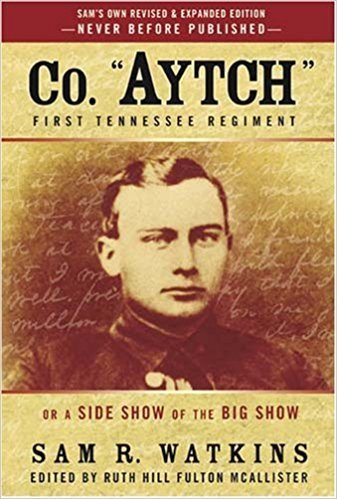
About twenty years later, with what he called a house full of young “rebels,” he began writing down what he remembered. The sketches ran in the Columbia Herald and were published as a book in 1882. Watkins said plainly that he was not writing about generals. He wrote about “the fellows who did the shooting and killing,” and that is why historians and readers still treasure his book. By his own count, only seven of the roughly 120 men who first enlisted in Company H were still with it at the end of the war.
Hunger on Missionary Ridge
After the great Confederate victory at Chickamauga in September 1863, General Braxton Bragg’s Army of Tennessee followed the beaten Federals to Chattanooga and settled onto Missionary Ridge and Lookout Mountain to besiege them. The plan was to starve the Union army out. Instead, Watkins remembered, it was the Southern soldiers who went hungry. Rations were scarce, clothing was ragged, and the men lived on parched corn for days at a time. Bragg also sent Longstreet’s corps away toward Knoxville, weakening the line just as the Federals were being reinforced and placed under General Ulysses S. Grant.
On November 23 to 25, 1863, Grant struck. The Federals took Orchard Knob, then Lookout Mountain in the “Battle Above the Clouds,” and on the afternoon of November 25 Union troops charged up the face of Missionary Ridge itself and broke the Confederate center. Watkins, who had been on picket duty for days and had been swept along in the Federal advance, scrambled back to his regiment just as the line gave way.
The 1st Tennessee Becomes the Rear Guard
Watkins found the 1st Tennessee, then under Colonel Hume R. Feild (often spelled Field), standing firm. The regiment had held its own part of the line and taken prisoners. As the rest of the army streamed away, Bragg rode up, and the regiment was ordered to cover the retreat. “We at once became the rear guard of the whole army,” Watkins wrote. The rear guard was placed under General States Rights Gist of South Carolina, with Maney’s brigade of Cheatham’s division and General Lucius E. Polk’s brigade of Cleburne’s division doing much of the work.
Rear guard duty after a defeat is slow, nerve-wracking work. Watkins described it in words every soldier who did it would recognize:
“You don’t move more than ten feet at furthest before you have to halt, and then ten feet again a few minutes afterwards, and so on all day long. You haven’t time to sit down a moment before you are ordered to move on again. And the Yankees dash up every now and then, and fire a volley into your rear.”
At Chickamauga Station, the brigade was ordered to burn huge piles of army stores so the Federals could not take them. Watkins was bitter that the hungry army had been starved while corn, bacon, flour and coffee sat in depots. Before the fire, the men filled corn sacks with hardtack and hung sides of bacon on their bayonets.
The Fight Watkins Called “Cat Creek”
Near dark, Federal cavalry dashed into the column, captured a cannon and took Colonel John F. House of Maney’s staff. Then Union infantry came out of the woods about two hundred yards away. Watkins called this skirmish “the battle of Cat Creek.” The men dropped their bacon and hardtack and formed a line.
“Our regiment is the only regiment in the action. They are crowding us; our poor little handful of men are being killed and wounded by scores. There is General George Maney badly wounded and being carried to the rear… A minnie ball passes through my Bible in my side pocket.”
General Maney was in fact wounded during the fighting of November 25, 1863. Watkins wrote from memory twenty years later and placed it in this rear guard action, so the exact moment may differ slightly from the official record. What is certain is that Watkins kept a small Bible in his coat, and it stopped or turned a ball that could have killed him.
Just as the line was about to break, a single gun from a Mississippi battery came “bouncing ten feet high, over brush and logs.” The cannoneers unlimbered and fired shrapnel almost every ten seconds. The infantry muskets rolled and rattled, “making music like the kettle and bass drum combined,” and the Federals fell back into the woods as night came on.
Wading the Chickamauga and Sleeping at Ringgold Gap
The regiment then had to cross Chickamauga Creek in the dark and cold. “It was up to our armpits, and was as cold as charity,” Watkins wrote, and the men carried their clothes over on the points of their bayonets. Fires had been built on the far bank to warm them. Watkins pushed on to Ringgold Gap in north Georgia, where he fell asleep beside a fire, “it being the fourth night that I had not slept a wink.”
The next day, November 27, 1863, General Patrick Cleburne’s division made its famous stand at Ringgold Gap and stopped the Federal pursuit cold. That fight saved the army’s wagons and artillery and allowed the Army of Tennessee to go into winter quarters around Dalton, where General Joseph E. Johnston soon took command and restored the men’s spirits.
Why the Story Endures
Many soldiers on both sides carried pocket Bibles, and stories of a Testament stopping a bullet appear in letters and memoirs across the war. Watkins’ version stands out because he does not make a sermon of it. He mentions it once and keeps going, just as he kept going with his regiment. It is a reminder that the common soldiers of the South fought on through hunger, cold and defeat, and that faith went into battle with them in their coat pockets.
Frequently Asked Questions
What happened to Sam Watkins’ Bible?
During the rear guard fighting after Missionary Ridge in November 1863, Watkins wrote that a minie ball passed through the Bible in his side pocket. He survived the fight and the war.
What regiment was Sam Watkins in?
He served in Company H, the Maury Grays, of the 1st Tennessee Infantry, part of Maney’s brigade in Cheatham’s division of the Army of Tennessee.
When was the Battle of Missionary Ridge?
Union troops carried Missionary Ridge on November 25, 1863, ending the Confederate siege of Chattanooga and forcing Bragg’s army to retreat into Georgia.
What is Co. Aytch about?
Co. Aytch is Watkins’ memoir of life as a private in the 1st Tennessee, first published in 1882. It is known for its humor, honesty and focus on ordinary soldiers.
How many men from Sam Watkins’ company survived the war?
Watkins wrote that of about 120 men who enlisted in Company H in 1861, only seven were present when the army surrendered in 1865.
Who saved the Confederate army at Ringgold Gap?
General Patrick Cleburne’s division held Ringgold Gap on November 27, 1863, stopping the Federal pursuit after Missionary Ridge.
Honor the Boys of the Army of Tennessee
Read more of Sam’s adventures in Dinner With Colonel Feild at Chattanooga and Sam Watkins and the Furlough Red Tape at Dalton. Fly the colors of the Volunteer State with our State of Tennessee Flag, honor Polk’s corps of the Army of Tennessee with the Polk Battle Flag in double nylon embroidered, or browse our full collection of Rebel Flags.
Thanks for reading. Please share our posts with your friends and family so they too can learn more about Southern Heritage and History.
Brought to you by: Ultimate Flags