

 BUY Rebel Flags For Sale
Every so often a news story appears about someone who claims to be deeply offended by the sight of a Confederate flag. Before passing judgment on that banner, it is worth remembering the men who actually followed it. For four years they marched hungry, fought sick and faced armies that usually outnumbered them. Many were poorly equipped, but they carried another kind of weapon: grit and determination. This is the story of two examples of that spirit, the soldiers of the 3rd Arkansas Infantry and General John Brown Gordon of Georgia.
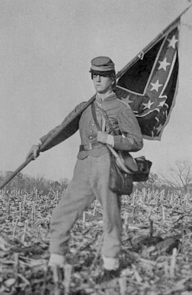
The Life of the Confederate Private
The average Confederate infantryman was a farmer or a farmer’s son. Most owned no slaves and had never been far from home before 1861. Once in the army, he lived on whatever the commissary could provide, often a little cornmeal and bacon, and sometimes nothing at all. Shoes and blankets wore out and were hard to replace. Disease killed more soldiers on both sides than bullets did, and Southern camps were hit hard by measles, dysentery and typhoid.
The fighting itself was brutal. The Confederacy had a much smaller population than the North, so its regiments were rarely brought back up to full strength. By 1864 and 1865, many units that had marched off with a thousand men could muster only a hundred or two. Yet those who remained kept going, march after march and battle after battle.
The 3rd Arkansas: “Arkansas Toothpicks” in Lee’s Army
The 3rd Arkansas Infantry was formed in the summer of 1861 from volunteers from southern Arkansas counties such as Ashley, Drew and Union. Hamburg lawyer Van H. Manning helped organize it, and he commanded the regiment for most of the war after Colonel Albert Rust was promoted. Its men were sometimes nicknamed the “Arkansas Toothpicks.”
The 3rd Arkansas was unusual. It was the only Arkansas regiment to serve in the Eastern Theater with Robert E. Lee’s Army of Northern Virginia. It fought at Cheat Mountain in western Virginia in 1861, then in the Seven Days Battles around Richmond in 1862. At Antietam it fought near the Sunken Road, and two of its companies were so badly cut up that they had to be combined.
In November 1862 the regiment was assigned to the famous Texas Brigade in General John Bell Hood’s division, joining the 1st, 4th and 5th Texas. The Arkansas men fought beside the Texans for the rest of the war, at Fredericksburg, Gettysburg, Chickamauga, the Wilderness and the siege of Petersburg. At Gettysburg on July 2, 1863, the regiment carried 479 men into the fighting near Devil’s Den and lost about 180 killed, wounded or missing. Colonel Manning was among the wounded.

The cost of that service was enormous. More than 1,300 men served in the 3rd Arkansas during the war. When Lee surrendered at Appomattox in April 1865, only about 144 were left to stack arms.
“I Do It Because I Love My Country”
A story long told among Confederate veterans, and attributed to General Gordon, describes an Arkansas regiment arriving late in camp after a hard night march. One weary soldier leaned his rifle against a tent pole and grumbled out loud. It was hard, he said, to fight all day and march all night. But he could go hungry, and he could march when he was sick, because he loved his country. And he was glad to do it.
We have not been able to confirm the exact wording or the date of that account, so it is best read as a reflection of the spirit of the men rather than a word-for-word record. Even so, it rings true. Diaries and letters from both armies are full of the same mix of complaint and stubborn loyalty. The Southern soldier grumbled constantly, then got up and did his duty anyway.
General John B. Gordon: Wounded Again and Again
General Gordon understood that kind of grit because he lived it. Born in Upson County, Georgia, on February 6, 1832, he had no military training when the war began. He was elected captain of a company of mountaineers, the “Raccoon Roughs,” who joined the 6th Alabama Infantry. He rose quickly through the ranks.
His most famous day came at Antietam, also called Sharpsburg, on September 17, 1862. Ordered to hold the Sunken Road at the center of Lee’s line, he promised General Lee his men would stay “till the sun goes down or victory is won.” He was shot through the right calf, then higher in the same leg, then through the left arm and the shoulder. He kept walking his line and encouraging his men. A fifth ball struck him in the face and knocked him unconscious. He fell face-first into his cap, and he later wrote that he might have drowned in his own blood if an earlier bullet had not put a hole in the cap to let it drain.

Gordon spent about seven months recovering, nursed by his wife, Fanny, who followed him through much of the war. He returned to lead a Georgia brigade at Chancellorsville and Gettysburg. On August 25, 1864, during the Shenandoah Valley Campaign, he was wounded again near Shepherdstown, West Virginia, with blood streaming from a head wound as he kept leading his men. By the end of the war he commanded a corps, and at Appomattox he led the last charge of the Army of Northern Virginia.
After the war Gordon served Georgia as a U.S. senator and governor and became the first commander-in-chief of the United Confederate Veterans. He died in 1904 and is buried in Atlanta’s Oakland Cemetery.
Read more about Gordon in Burning of the Wrightsville Bridge, 1863: Gordon’s Georgians and a Can of Gunpowder, and about the commander he served in Traveller: The Story of Robert E. Lee’s Famous War Horse.
Why So Many Still Honor These Men
Whatever one thinks of the politics of the 1860s, the courage and endurance of the Confederate soldier are a matter of record. Former enemies recognized it. Union veterans and Confederate veterans met at reunions in the decades after the war and shook hands over the same fields where they had fought. For many Southern families today, the battle flag is a way to remember great-great-grandfathers who marched, starved and bled for their homes and their states.
Frequently Asked Questions
Was the 3rd Arkansas part of Hood’s Texas Brigade?
Yes. The 3rd Arkansas joined the Texas Brigade in November 1862 and served with the 1st, 4th and 5th Texas for the rest of the war. It was the brigade’s only non-Texas regiment at that time.
How many men of the 3rd Arkansas surrendered at Appomattox?
Only about 144 men were left of the more than 1,300 who had served in the regiment, according to the Encyclopedia of Arkansas.
How many times was John B. Gordon wounded at Antietam?
Gordon was wounded five times at Antietam while holding the Sunken Road. The fifth wound, to the face, knocked him unconscious.
What happened to John B. Gordon after the Civil War?
He became a U.S. senator and governor of Georgia, and he was the first commander-in-chief of the United Confederate Veterans. He died in January 1904.
What did Confederate soldiers eat?
Common rations were cornmeal, bacon or salt pork and hardtack when available. As the war went on, rations grew smaller and soldiers often went hungry or foraged for food.
Who were the Raccoon Roughs?
They were the company of mountaineers from Georgia, Alabama and Tennessee that John B. Gordon led at the start of the war. They wore coonskin caps and became part of the 6th Alabama Infantry.
Fly the Flags They Followed
Honor the Arkansas Toothpicks with our Arkansas State Flag or the Army of the Trans-Mississippi Flag. For General Gordon’s Georgians, see the 2nd Georgia Infantry Cotton Flag, or browse all of our Rebel Flags.
Thanks for reading. Please share our posts with your friends and family so they too can learn more about Southern Heritage and History.
Brought to you by: Ultimate Flags