
 BUY Rebel Flags For Sale
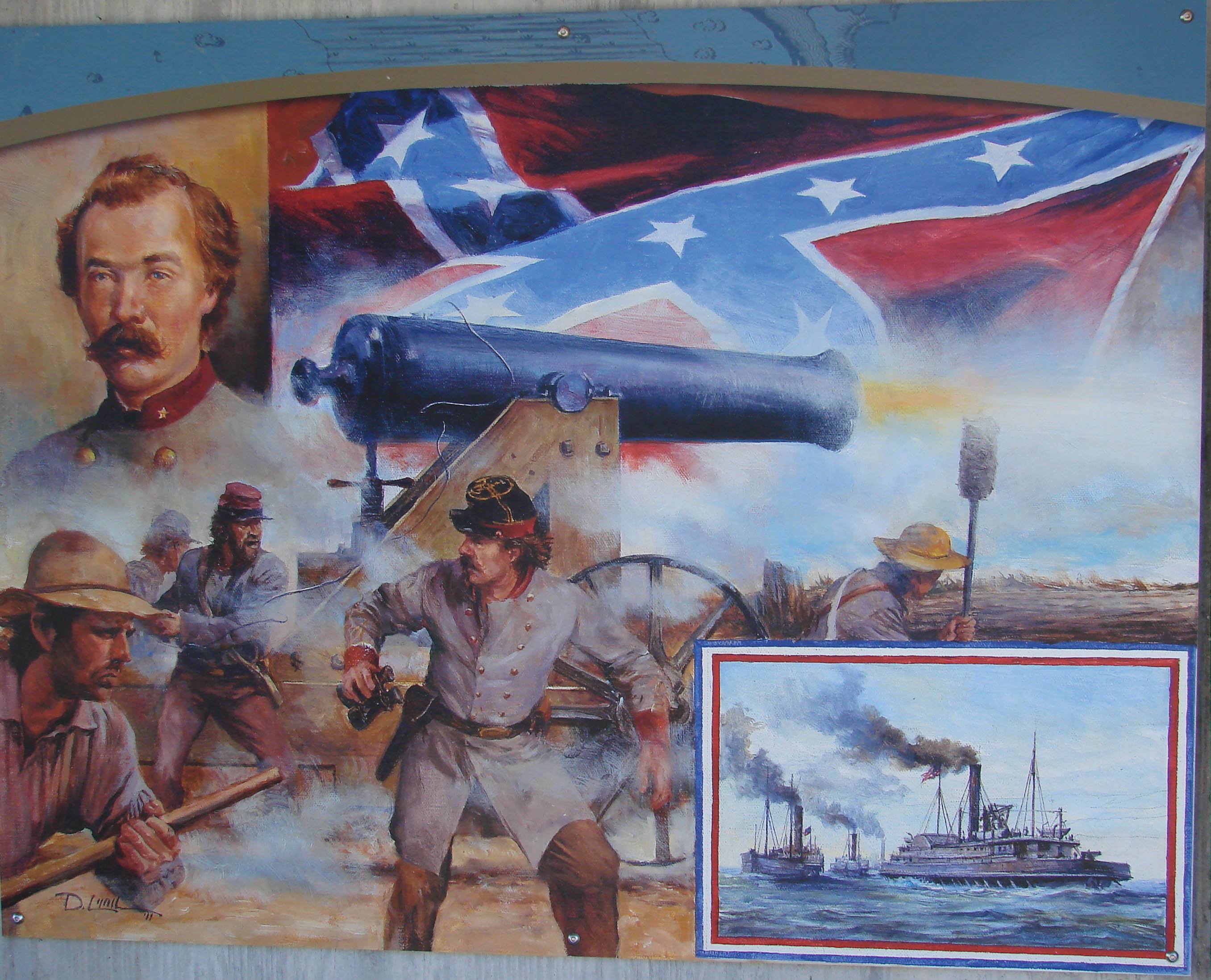
In the late summer of 1863 the Union army set out to plant its flag in Texas. A fleet of gunboats and troop transports carrying roughly 5,000 Federal soldiers steamed toward the mouth of the Sabine River, the narrow waterway that divides Texas from Louisiana. Standing in the way was a small mud fort with six old cannon and fewer than fifty men, most of them Irish dockworkers from Houston and Galveston. What happened next, on September 8, 1863, is remembered as the Second Battle of Sabine Pass, and it is often called the most lopsided Confederate victory of the war. Here is the story of Lieutenant Dick Dowling, the Jefferson Davis Guards and the forty minutes that saved Texas from invasion.
Why the Union Wanted Sabine Pass
By 1863 the Federal government had strong reasons to push into Texas. The Lone Star State was a vital source of cotton, cattle and supplies for the Confederacy, and goods moved freely across the Rio Grande into Mexico. Washington was also uneasy about the French army, which had occupied Mexico City that summer. A Union presence in Texas would cut the trade, show the flag to the French and open a road toward Houston, the headquarters of the Confederate Trans-Mississippi defenses in the region.
The plan called for Major General William B. Franklin to land his troops near Sabine City, march inland and seize the railroad running toward Beaumont and Houston. Four Navy gunboats under Acting Volunteer Lieutenant Frederick Crocker, the Clifton, Sachem, Arizona and Granite City, were to steam up the pass first and silence any guns that might threaten the landing.
Dick Dowling and the Jefferson Davis Guards
The guns they had to silence belonged to Company F of the 1st Texas Heavy Artillery, a unit that called itself the Jefferson Davis Guards. Nearly all of its men were Irish immigrants who had worked the docks and wharves of the Texas coast. Their commander, Richard W. “Dick” Dowling, had come to America as a boy from County Galway and settled in Houston, where he became a popular saloon keeper and businessman.
The Guards were no strangers to a fight. They had served at the recapture of Galveston on New Year’s Day, 1863, and earlier that year they had helped turn back Federal warships off Sabine Pass. Through the summer of 1863 Dowling drilled his men on their guns again and again, until they could hit a target in either channel of the river.
Fort Griffin: Six Old Guns and Painted Range Stakes
The post they defended was Fort Griffin, an earthwork on the Texas side of the pass, reinforced with timber and railroad iron. It mounted six smoothbore cannon, usually described as two 24-pounders and four 32-pounders. None of them were modern, but Dowling made the most of them. His men drove stakes into the shallow river channels at known distances and painted them as aiming points. Any vessel that passed a marker could be hit with a gun already sighted to that range.
The channels themselves helped the defenders. They were only a few feet deep and separated by an oyster reef, so the gunboats would have to come up single file through narrow lanes that Dowling’s gunners knew by heart.
The Order to Fall Back
When the Federal fleet appeared off the bar on September 7, the odds looked hopeless. Accounts differ on the exact wording, but Dowling’s superiors in the area had authority to abandon the fort if a much larger force attacked, and Dowling was told he could spike his guns and withdraw. According to the traditional story, the lieutenant put the question to his men. The Guards had spent months building and improving that fort, and they chose to stay and fight.
Forty Minutes on September 8, 1863
On the morning of September 8 the gunboats shelled Fort Griffin from long range. Dowling ordered his men to keep their heads down and hold their fire. In the afternoon the gunboats moved in, with the troop transports waiting behind them.
When the lead vessels reached the range stakes, the Davis Guards opened fire. A shot struck the Sachem‘s boiler, and the explosion of scalding steam left her helpless in the channel. The Clifton ran aground under the fort’s guns, and a shot cut her steering; after a hard fight she struck her colors. The Arizona could not get past the disabled Sachem and backed away, and the Granite City and the transports turned back toward the Gulf.
The fight lasted somewhere between 35 and 45 minutes, depending on the account. The Guards fired well over a hundred rounds, and Dowling is said to have skipped swabbing the guns between shots to keep up the pace, a real risk with hot barrels. Several sources also note that Dowling worked one of the guns himself.
When the smoke cleared, two Union gunboats had been captured, along with roughly 300 to 350 prisoners by most counts, and dozens of Federal sailors had been killed, wounded or scalded. The garrison suffered no casualties. The invasion fleet sailed back to New Orleans.

How Many Men Held Fort Griffin?
The number most people remember is the one in our old headline, 42, but historians give figures from about 42 to 47. The Texas Historical Commission counts 45 enlisted men plus an engineer and a surgeon, while other sources put the garrison at 46 or 47. Whatever the exact count, fewer than fifty men turned back a joint Army and Navy expedition of several thousand.
Medals, Honors and the Legacy of Dick Dowling
News of Sabine Pass spread across the South and made Dowling and his Irishmen instant heroes. The citizens of Houston had silver medals made for every member of the Guards, and the Confederate Congress passed a formal resolution of thanks in February 1864. The Davis Guards Medal is often described as the only medal for valor issued to Confederate soldiers. Years later Jefferson Davis wrote that he “considered the battle of Sabine pass the most remarkable in military history.”
After the war Dowling returned to Houston and his business interests, but he died in the yellow fever epidemic of 1867, not yet thirty years old. Today the battlefield is preserved as the Sabine Pass Battleground State Historic Site near Port Arthur, where a monument to Dowling and the Davis Guards still faces the river.
Frequently Asked Questions
What happened at the Second Battle of Sabine Pass?
On September 8, 1863, a small Confederate garrison at Fort Griffin disabled and captured two Union gunboats and forced a fleet carrying about 5,000 troops to abandon its invasion of Texas.
How many men did Dick Dowling have at Sabine Pass?
Most sources put the garrison at about 46 men, though counts range from 42 to 47. Nearly all were members of the Jefferson Davis Guards.
Who were the Davis Guards?
The Jefferson Davis Guards were Company F of the 1st Texas Heavy Artillery, a unit made up mostly of Irish immigrants from Houston and Galveston under Lieutenant Richard W. “Dick” Dowling.
Why is Sabine Pass called the most lopsided victory of the Civil War?
Fewer than fifty defenders beat a joint Army and Navy expedition of several thousand men, captured two gunboats and hundreds of prisoners, and did not lose a single man.
What was the Davis Guards Medal?
It was a silver medal presented by the citizens of Houston to each member of the garrison after the battle. It is often called the only Confederate medal for valor.
Where is the Sabine Pass battlefield?
It is on the Texas side of Sabine Pass near Port Arthur, at the mouth of the Sabine River on the Texas and Louisiana border, and is preserved as a state historic site.
Fly the Flags of Texas and the Confederacy
Few stories capture Texas grit better than Sabine Pass. Read more Lone Star history in Terry’s Texas Rangers: History of the 8th Texas Cavalry and Christmas Picket on the Potomac, 1861. Honor the men who defended Texas with our Texas Flag, the 8th Texas Cavalry Regiment Flag, the 20th Texas Volunteers Flag or the First National 13 Stars and Bars Flag.
Thanks for reading. Please share our posts with your friends and family so they too can learn more about Southern Heritage and History.
Brought to you by: Ultimate Flags