

 BUY Rebel Flags For Sale
Few Confederate soldiers left behind a memoir as honest, funny and heartbreaking as Private Sam Watkins of the 1st Tennessee Infantry. He served from the first months of the war to the very last, and in his book Co. Aytch he tells how he finally earned a set of corporal’s stripes. It did not come from years of hard fighting. It came from picking up a flag on the bloody field east of Atlanta on July 22, 1864. Here is that story, along with the history of the battle, the regiment and the man who wrote it all down.

Who Was Sam Watkins?
Samuel Rush Watkins was born in 1839 in Maury County, Tennessee, near the town of Columbia. In 1861 he enlisted in the Maury Grays, which became Company H of the 1st Tennessee Infantry Regiment. Soldiers pronounced the company letter “Aytch,” and that is where his book got its name.
The 1st Tennessee served in the Army of Tennessee, the main Confederate army in the Western Theater. Watkins marched and fought with it at Shiloh, Perryville, Murfreesboro, Chickamauga, Missionary Ridge, Kennesaw Mountain, Atlanta, Franklin and Nashville. Of the roughly 120 men who first joined Company H, Watkins later wrote that only a handful were left by the surrender in 1865. He was one of them.
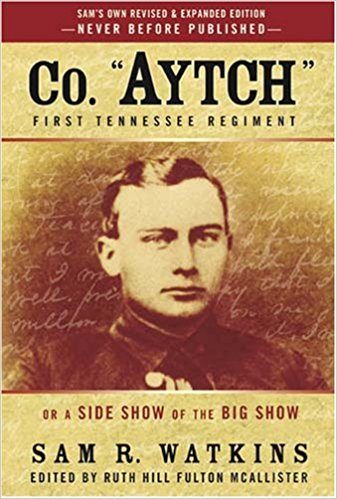
Years after the war he wrote his memoir, first published in the early 1880s as Co. Aytch, Maury Grays, First Tennessee Regiment; or, A Side Show of the Big Show. Historians and readers still treasure it because it tells the war from the ranks, with all the hunger, cold, humor and grief of the common soldier.
The Road to Atlanta in the Summer of 1864
By the summer of 1864, Union General William T. Sherman had pushed the Army of Tennessee south from Dalton, Georgia, toward Atlanta. General Joseph E. Johnston fought a careful retreat, making Sherman pay at places such as Resaca and Kennesaw Mountain, where the 1st Tennessee held the famous “Dead Angle” on June 27.
As Sherman’s armies closed in on Atlanta, President Jefferson Davis replaced Johnston with General John Bell Hood on July 17. Hood was known for his aggressive style, and he struck quickly. After an attack at Peachtree Creek on July 20, he planned a bold flank march for July 22.
The Battle of Atlanta, July 22, 1864
Hood sent General William J. Hardee’s corps on a long night march to hit the left flank of the Union Army of the Tennessee, east of the city. At the same time, General Benjamin F. Cheatham’s corps attacked from the Atlanta defenses. Watkins’s 1st Tennessee came forward as part of that assault.
The fighting was some of the fiercest of the campaign. Union Major General James B. McPherson, commander of the Army of the Tennessee, was killed by Confederate skirmishers that afternoon. Charges and countercharges swept across the ground around Bald Hill, also called Leggett’s Hill. By nightfall the Union lines had held, and Confederate losses that day are estimated at about 5,500 men. Atlanta itself would not fall until September 2, after a long siege.

The Orphan Flag and Two Yellow Stripes
Watkins took part in several charges that day. On the last one, by his own account, he was wounded in the ankle and heel and took cover in a ditch. While he was there, he picked up a flag lying on the battlefield. It had been trampled, as he put it, by “a thousand fellows.”
Once he was patched up, Watkins was rewarded with a promotion to fourth corporal for gallantry. He tells the story with his usual dry humor, recalling a friend named Sloan who greeted him:
“Why, hello, corporal, where did you get those two yellow stripes from on your arm?”
Watkins answered that he had been promoted for picking up “an orphan flag” and that he only grabbed it because he thought it was pretty and wanted a shirt made out of it. Sloan replied that he could have picked up forty if he had known that.
Then Watkins gave his own verdict on the whole business, one of the most quoted passages in his book:
“As long as I was in action, fighting for my country, there was no chance for promotion, but as soon as I fell out of ranks and picked up a forsaken and deserted flag, I was promoted for it.”
He joked that if every flag raised him “one notch higher,” he would have quit fighting, gone to picking up flags and soon been President of the Confederate States of America.
Why Flags Mattered So Much
Watkins was poking fun, but the honor given to flags in the Civil War was very real. A regiment’s colors marked its place in the smoke and noise of battle, so men could see where to rally. Losing them was a deep disgrace, and capturing or saving them was among the highest honors a soldier could earn. Color bearers were often the first men shot, and the flags of many Southern regiments came home torn by bullets and stained with blood.
Watkins understood that better than anyone. His humor was a way of telling the truth: that the brave men who fought all day in the ranks rarely got medals or stripes, while luck and timing could bring recognition to anyone. That honesty is a big part of why his memoir has lasted.
After Atlanta
Watkins recovered and stayed with his regiment through Hood’s disastrous Tennessee Campaign, including the battles of Franklin and Nashville in late 1864. He surrendered with the remnant of the Army of Tennessee in North Carolina in 1865, then returned to Maury County, where he married, farmed and raised a family. He died in 1901 and is buried near Mount Pleasant, Tennessee. His words reached a new generation when filmmaker Ken Burns quoted them throughout his 1990 documentary The Civil War.
If you enjoy Sam’s stories, read more of them on our site: “A Minnie Ball Passes Through My Bible”: Sam Watkins and the 1st Tennessee’s Rear Guard After Missionary Ridge and Carrie Berry’s Diary: The 1864 Shelling of Atlanta Through a Ten-Year-Old Girl’s Eyes.
Frequently Asked Questions
Who was Sam Watkins in the Civil War?
Sam Watkins was a Confederate private in Company H of the 1st Tennessee Infantry who served from 1861 to 1865. He wrote the memoir Co. Aytch, one of the most famous first-hand accounts of the war.
What does “Co. Aytch” mean?
It is the way soldiers said “Company H.” Watkins served in Company H of the 1st Tennessee, also known as the Maury Grays.
How did Sam Watkins become a corporal?
According to his memoir, he was promoted to fourth corporal after he picked up a fallen flag on the battlefield during the Battle of Atlanta on July 22, 1864. He joked that he was never promoted for fighting, only for picking up a flag.
When was the Battle of Atlanta?
The Battle of Atlanta was fought on July 22, 1864, east of the city. The city itself fell to Sherman on September 2, 1864.
Who was killed at the Battle of Atlanta?
Union Major General James B. McPherson, commander of the Army of the Tennessee, was killed by Confederate skirmishers during the battle.
Was Sam Watkins wounded at Atlanta?
Yes. By his own account he was wounded in the ankle and heel during the final charge on July 22, 1864, but he recovered and returned to his regiment.
Honor the 1st Tennessee and the Men of the Army of Tennessee
Remember Sam Watkins and his comrades with a State of Tennessee Flag or the 10th Tennessee Sons of Erin Cotton Flag. You can also browse our full selection of Rebel Flags and Confederate Battle Flags.
Thanks for reading. Please share our posts with your friends and family so they too can learn more about Southern Heritage and History.
Brought to you by: Ultimate Flags