
 BUY Rebel Flags For Sale
When the war came in 1861, the Confederacy’s western frontier bordered the lands of the Five Civilized Tribes: the Cherokee, Creek, Choctaw, Chickasaw and Seminole Nations in Indian Territory, today’s Oklahoma. Each of the five nations signed treaties of alliance with the Confederate government, and thousands of tribal members took up arms. Among them, none earned more renown than the Cherokee and their commander, Stand Watie.

Who Was Stand Watie?
Watie’s Cherokee name is often written as Degadoga or Tak-er-taw-ker, meaning “he stands” or “stands firm.” He combined part of that name with his father’s name, Oo-wat-ie, to call himself Stand Watie in English. Before the war he was a planter, newspaperman and leader in the Cherokee Nation.
Watie raised a regiment of Cherokee Mounted Rifles in 1861 and quickly caught the attention of senior officers. At the Battle of Pea Ridge in northern Arkansas in March 1862, his men captured a Union artillery battery and then fought a skilled rear guard action to cover the retreat of the Confederate army. His courage, tactics and leadership earned him greater responsibility, and his regiment became known as the 1st Cherokee Mounted Rifles, with Colonel Stand Watie commanding.

Masters of the Raid
Cherokee fighters were used to close-range combat, and they were masters of irregular, hit-and-run warfare. They knew how to strike fast, vanish, and keep an enemy from bringing his full strength to bear. Watie’s men cut Union supply lines and disrupted Federal operations across Indian Territory, Arkansas and Missouri. Their raids forced the Union to keep thousands of troops in the region instead of sending them east, where they were badly needed.
By many counts, Watie’s regiment fought in 18 battles and major skirmishes during the war. Two of his most famous exploits came in 1864. In June his men captured the Union steamboat J. R. Williams on the Arkansas River. That September, at the Second Battle of Cabin Creek, Watie and General Richard Gano captured a massive Federal supply train of wagons, mules and supplies, often valued at around $1.5 million, one of the great Confederate victories in the Trans-Mississippi.
Watie’s troops played a key role in protecting North Texas and Indian Territory. On May 6, 1864, he was promoted to brigadier general in command of the First Indian Brigade of the Army of the Trans-Mississippi. He was the only Native American to reach the rank of general in the Confederate army.
The Last Confederate General to Lay Down Arms
Watie fought on long after Appomattox. On June 23, 1865, more than two months after Lee’s surrender, he formally ceased hostilities at Doaksville in the Choctaw Nation. He was the last Confederate general in the field to do so.
That same month he wrote to the people of Texas: “During the whole period of the war my people have stood side by side with your own gallant sons, between your homes and the enemy on the north.” It was true. Federal armies never broke through Indian Territory to invade North Texas.
The Cherokee Braves Flag
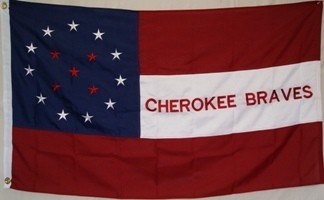
The Cherokee Braves flag is still reproduced today. Sometimes called the “Cherokee Brigade flag,” its design follows the pattern of the Confederate First National Flag. The blue canton holds eleven white stars in a circle surrounding five red stars for the Five Civilized Tribes. The red star in the center represents the Cherokee Nation, and “Cherokee Braves” is lettered in red across the center of the white stripe.
In 1995 the U.S. Postal Service issued a set of 20 Civil War commemorative stamps, and General Stand Watie was one of those honored. His service and the service of the Cherokee who rode with him remain a proud part of Southern history.
Thanks for reading. Please share our posts with your friends and family so they too can learn more about Southern Heritage and History.
Brought to you by: Ultimate Flags