
 BUY Rebel Flags For Sale
Few horsemen of the War Between the States became legends as quickly as Turner Ashby. Dark-haired, heavily bearded and almost fearless in the saddle, he led Stonewall Jackson’s cavalry through the Shenandoah Valley in the spring of 1862 and became known as the “Black Knight of the Confederacy.” His career lasted barely a year, and it ended on a wooded ridge outside Harrisonburg, Virginia, with a shout his men never forgot: “Charge, men! For God’s sake, charge!”

A Virginia Horseman From Fauquier County
Turner Ashby Jr. was born on October 23, 1828, at Rose Bank, his family’s farm in Fauquier County, Virginia. He came from a family with a proud military tradition, and from boyhood he was known as one of the finest riders in that part of Virginia. As a young man he farmed, ran a business in the village of Markham and took part in local tournaments, the riding contests of skill that were popular across the antebellum South.
In his twenties, Ashby gathered his friends into a volunteer mounted company called the Mountain Rangers. At first they helped keep order among railroad laborers on the Manassas Gap Railroad. When John Brown raided Harpers Ferry in October 1859, Ashby led the Rangers to the border, and they stood guard at Charles Town during Brown’s trial and execution.
From Militia Captain to Cavalry Colonel
When Virginia left the Union in April 1861, Ashby and his Mountain Rangers reported for duty at Harpers Ferry, where they served under a stern former VMI professor named Thomas J. Jackson. Ashby was soon scouting and picketing along the upper Potomac River. On July 23, 1861, Brigadier General Joseph E. Johnston appointed him lieutenant colonel of the 7th Virginia Cavalry.
That summer brought him a deep personal loss. In late June 1861, his younger brother, Captain Richard Ashby, was mortally wounded in a skirmish near Kelly’s Island along the Potomac. Turner Ashby threw himself into his duties with even greater intensity. In early 1862 he was promoted to colonel and took full command of the regiment, which soldiers simply called “Ashby’s Cavalry.”
Stonewall Jackson’s Eyes in the Valley
During Jackson’s famous Shenandoah Valley Campaign of 1862, Ashby’s troopers were the screen and the eyes of the army. They scouted Federal movements, guarded the flanks, burned bridges and fought rear-guard actions while Jackson’s “foot cavalry” marched hard and struck the enemy at Kernstown, McDowell, Front Royal and Winchester.
Ashby led more by personal example than by drill. His men adored him, and his daring made him famous in the newspapers of both North and South. Jackson sometimes worried that Ashby’s loosely organized command lacked discipline, but he also knew that no officer in his army had a better feel for the enemy’s movements. On May 23, 1862, Ashby was appointed a brigadier general. Jackson told him that perhaps the country might “now hope for less exposure of your person.” Ashby, as usual, did not take the hint.
“Bag Ashby”: The Capture of Sir Percy Wyndham
In early June 1862, Jackson’s small army withdrew south up the Valley, with Major General John C. Frémont’s Federals close behind. Ashby commanded the rear guard. Leading the Union pursuit was Colonel Sir Percy Wyndham, an English soldier of fortune who had fought under Garibaldi in Italy and now commanded the 1st New Jersey Cavalry. Wyndham had reportedly boasted that he would “bag Ashby.”
On June 6, 1862, Wyndham’s cavalry pushed through Harrisonburg and ran straight into Ashby’s trap near Good’s Farm, on the southern edge of town. Ashby’s horsemen counterattacked and routed the New Jersey troopers. Wyndham himself was taken prisoner along with roughly sixty of his men. It was the Englishman, not Ashby, who ended the day in the bag.
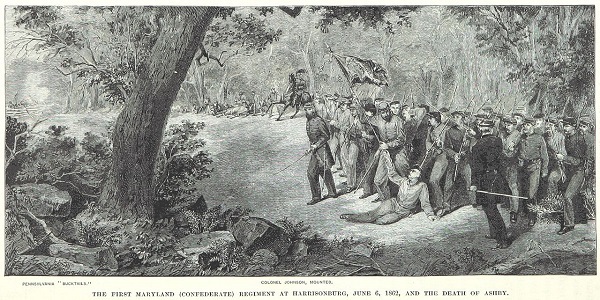
The Last Charge on Chestnut Ridge
Later that afternoon the Federals came on again, this time with infantry: the Pennsylvania “Bucktails” under Lieutenant Colonel Thomas L. Kane. Ashby met them on wooded Chestnut Ridge with infantry of his own, the 58th Virginia and Colonel Bradley T. Johnson’s 1st Maryland. The fight in the woods was sharp and close.
In the thick of it, Ashby’s horse was shot out from under him. Ashby sprang to his feet, raised his sword and shouted, “Charge, men! For God’s sake, charge!” He had taken only a few steps forward when a bullet struck him in the chest, and he fell dead. He was 33 years old and had worn a general’s star for just two weeks.
His men carried the fight. The Marylanders and Virginians drove the Bucktails from the woods, and Colonel Kane was wounded and captured. The Confederate rear guard had held, and within days Jackson won his crowning victories of the campaign at Cross Keys and Port Republic.
“The Confederacy Had No Truer or Braver Soldier”
The news of Ashby’s death struck the Valley army hard. Stonewall Jackson, who seldom spoke at length about any man, wrote a tribute that has been quoted ever since:
“As a partisan officer I never knew his superior; his daring was proverbial; his powers of endurance almost incredible; his tone of character heroic, and his sagacity almost intuitive in divining the purposes and movements of the enemy.”
Ashby was first buried at the University of Virginia Cemetery in Charlottesville. In October 1866 his remains were moved to the Stonewall Confederate Cemetery in Winchester, Virginia, where he rests beside his brother Richard. On June 6, 1898, the Turner Ashby Chapter of the United Daughters of the Confederacy dedicated a monument at the spot near Harrisonburg where he fell, and many Shenandoah Valley communities have long marked June 6 as a day of remembrance.

Frequently Asked Questions
Who was Turner Ashby?
Turner Ashby (1828–1862) was a Virginia cavalry commander who led Stonewall Jackson’s cavalry during the 1862 Shenandoah Valley Campaign. He was nicknamed the “Black Knight of the Confederacy.”
How did Turner Ashby die?
He was shot in the chest on June 6, 1862, near Harrisonburg, Virginia, while leading a charge on foot after his horse was killed beneath him.
What were Turner Ashby’s last words?
Witnesses recalled that his final command was “Charge, men! For God’s sake, charge!”
Where is Turner Ashby buried?
He is buried in Stonewall Confederate Cemetery in Winchester, Virginia, beside his brother Richard. He was moved there from Charlottesville in October 1866.
Was Turner Ashby a general?
Yes. He was appointed brigadier general on May 23, 1862, about two weeks before his death, though the Confederate Senate never formally confirmed the appointment.
Who captured Sir Percy Wyndham?
Ashby’s cavalry captured Colonel Sir Percy Wyndham of the 1st New Jersey Cavalry near Harrisonburg on June 6, 1862, the same day Ashby was killed.
What regiment did Turner Ashby command?
He commanded the 7th Virginia Cavalry, often called “Ashby’s Cavalry,” before being promoted to lead a cavalry brigade.
Honor the Black Knight of the Valley
Remember Turner Ashby and the horsemen of the Shenandoah with the Confederate Cavalry Battle Flag (Square With White Border) in thick premium cotton, or fly the State of Virginia Flag for the Old Dominion he served. For more Valley history, read “The Women Are the Devils”: The Defiant Ladies of Civil War Winchester, Virginia and “There Stands Jackson, Like a Stone Wall”.
Thanks for reading. Please share our posts with your friends and family so they too can learn more about Southern Heritage and History.
Brought to you by: Ultimate Flags