
 BUY Rebel Flags For Sale
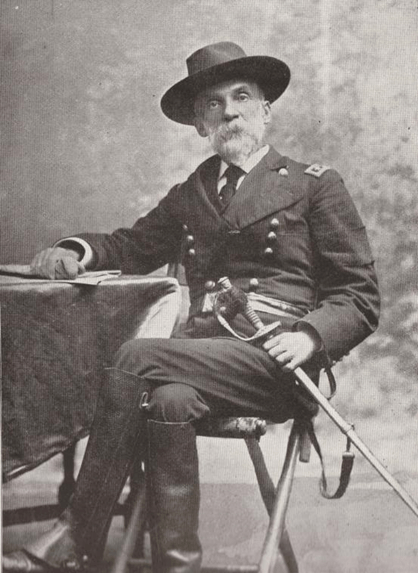
Mention Confederate cavalry and most people think first of J.E.B. Stuart or Nathan Bedford Forrest. Yet the man who commanded the cavalry of the Army of Tennessee for most of the war was a slight, quiet Georgian named Joseph Wheeler. One of his troopers summed him up after the war in a single line: he “warn’t afraid of nuthin’ or nobody.” His career carried him from the frontier to the Western Theater, into Congress, and finally to Cuba at the head of the division that included Theodore Roosevelt’s Rough Riders.

From Augusta to West Point
Joseph Wheeler was born on September 10, 1836, near Augusta, Georgia. His family had New England roots, and he spent much of his boyhood with relatives in Connecticut. He always considered himself a Georgian and a Southerner. He entered the U.S. Military Academy at West Point in July 1854, barely meeting the height requirement, and graduated on July 1, 1859, 19th in a class of 22.
After cavalry school he was posted to the Regiment of Mounted Rifles in New Mexico Territory. It was there, during a skirmish with Native American raiders, that the young lieutenant earned the name that followed him for the rest of his life: “Fighting Joe.”
Going with the South
When Georgia seceded in early 1861, Wheeler resigned his U.S. commission and offered his services to the South. He was first commissioned a lieutenant of artillery and in September 1861 became colonel of the 19th Alabama Infantry. He led the regiment at Shiloh in April 1862. His talent for handling mounted troops was soon noticed, and in the fall of 1862 he was given command of the cavalry of the Army of Mississippi, later the Army of Tennessee.
Promotion came fast. He was made brigadier general on October 30, 1862, and major general on January 20, 1863, when he was only 26 years old. During the Stones River campaign he rode completely around the Federal army, burning wagons and taking prisoners, and he was wounded by a bursting shell at La Vergne, Tennessee, in November 1862.
The “Horse Marines” at Harpeth Shoals
In January 1863, Wheeler struck at the Federal supply line on the Cumberland River below Nashville. On January 13, at Harpeth Shoals, his troopers ambushed river traffic, captured the Union gunboat Sidell and several transports, and burned the boats. Cavalry capturing a gunboat was unusual enough that admirers jokingly called his men “horse marines.” Wheeler’s troopers were also known for felling trees across roads to slow Federal columns during retreats.
Raids, Retreats and Hard Service
In October 1863, after Chickamauga, Wheeler led a major raid into the Sequatchie Valley of Tennessee, destroying a huge Federal wagon train bound for besieged Chattanooga. Through the Atlanta Campaign of 1864 his cavalry screened Joseph E. Johnston’s army and then John Bell Hood’s.
His greatest success came at the end of July 1864, when General William T. Sherman sent two large cavalry columns under Generals Edward McCook and George Stoneman to cut the railroads south of Atlanta and free Union prisoners at Macon and Andersonville. Wheeler’s outnumbered cavalry broke up the raid. McCook’s column was routed near Newnan, and on July 31, 1864, at Sunshine Church near Macon, Wheeler’s subordinate Brigadier General Alfred Iverson Jr. trapped Stoneman’s force. Stoneman surrendered with several hundred men, becoming the highest-ranking Union officer captured during the war.
Wheeler later harassed Sherman’s March to the Sea and fought through the Carolinas. His service record is remarkable by any measure. He is credited with being wounded three times, having 16 horses shot from under him, and seeing 36 staff officers fall at his side.

A General Without Vanity
In early 1865, Lieutenant General Wade Hampton was placed over all the cavalry facing Sherman, putting Wheeler under another cavalry officer for the first time. According to one account, Wheeler simply replied, “Certainly, General, I will receive your orders with pleasure.” He fought under Hampton at Bentonville in March 1865.
His men remembered small kindnesses too. One trooper told how, during an inspection, a soldier would not unbutton his coat because he had no shirt underneath. Wheeler quietly understood, and after the inspection he sent the man his own spare shirt. Robert E. Lee is often quoted as naming Wheeler and J.E.B. Stuart the two finest cavalry officers the Confederacy produced.
Capture and Prison
After Johnston’s surrender, Wheeler tried to help cover President Jefferson Davis’s flight. On May 9, 1865, he and a few staff officers were captured by Federal cavalry at Conyers Station, east of Atlanta. He was sent north on the steamer William P. Clyde with Davis, his family and other prisoners. According to one account, Wheeler spent hours on deck carrying the Davises’ baby daughter, Winnie, while her parents endured the strain of captivity. Wheeler was held at Fort Monroe and then at Fort Delaware, and was released in June 1865.
Congressman, General and National Hero
After the war Wheeler settled in Alabama and practiced law. He was elected to Congress from Alabama and served from the 1880s until 1900, working to heal the wounds between North and South. When war with Spain came in 1898, President William McKinley made the 61-year-old ex-Confederate a major general of volunteers and gave him command of the cavalry division sent to Cuba. That division included the 1st U.S. Volunteer Cavalry, the Rough Riders, with Theodore Roosevelt as lieutenant colonel, along with the Regular cavalry and the 10th Cavalry’s Buffalo Soldiers.
Wheeler led the attack at Las Guasimas on June 24, 1898, the first land battle of the war. A popular story says that in the excitement he shouted that they had “the damn Yankees on the run again.” Though sick with fever, he rose to take part in the fighting at San Juan Heights on July 1. He then served in the Philippines in 1899 and 1900, was commissioned a brigadier general in the Regular Army, and retired on September 10, 1900. Joseph Wheeler died in New York City on January 25, 1906, and was buried at Arlington National Cemetery, one of very few Confederate generals laid to rest there.
Frequently Asked Questions
Why was Joseph Wheeler called Fighting Joe?
He earned the nickname as a young U.S. Army lieutenant in New Mexico Territory after a skirmish with Native American raiders, before the Civil War began.
How many horses were shot from under Joseph Wheeler?
Wheeler is credited with having 16 horses shot from under him during the Civil War. He was also wounded three times.
Who captured General Stoneman?
Brigadier General Alfred Iverson Jr., serving under Wheeler, captured Major General George Stoneman at Sunshine Church, Georgia, on July 31, 1864.
Did Joseph Wheeler command the Rough Riders?
Yes. In 1898 he commanded the cavalry division in Cuba, which included Theodore Roosevelt’s Rough Riders, and led it at Las Guasimas.
Where is Joseph Wheeler buried?
Wheeler is buried at Arlington National Cemetery. He died in New York City on January 25, 1906.
How old was Joseph Wheeler when he became a major general?
He was promoted to major general in the Confederate army on January 20, 1863, at age 26.
Ride With Wheeler’s Cavalry
Wheeler’s command included the famous 8th Texas Cavalry. Read their story in Terry’s Texas Rangers: History of the 8th Texas Cavalry, and see a young trooper’s daring ride in “Hurrah for the Brave Rebel Boy!”. Honor Wheeler’s first command with the 19th Alabama Infantry Cotton Flag, fly the Confederate Cavalry Battle Flag, or remember his home state with the Georgia 2nd Infantry Flag.
Thanks for reading. Please share our posts with your friends and family so they too can learn more about Southern Heritage and History.
Brought to you by: Ultimate Flags