
 BUY Rebel Flags For Sale
Few soldiers in American history survived what General John Brown Gordon survived on September 17, 1862. Holding the center of Robert E. Lee’s line at Antietam, he was hit five times in a single day and kept fighting until a ball through the face knocked him senseless. He lived, recovered, and went on to become one of Lee’s most trusted commanders and the general who led the Army of Northern Virginia’s final march at Appomattox.
When Gordon died in 1904, President Theodore Roosevelt summed him up in one sentence: “A more gallant, generous, and fearless gentleman and soldier has not been seen by our country.” Here is the story behind that tribute.

From Georgia Lawyer to Confederate Colonel
John Brown Gordon was born on February 6, 1832, in Upson County, Georgia. He studied at the University of Georgia, practiced law and later worked in coal mining in northwest Georgia. He had no formal military training when the war began in 1861.
That did not stop him. Gordon raised a company of mountain men known as the “Raccoon Roughs,” and the company became part of the 6th Alabama Infantry. He was elected major and soon rose to colonel. He fought through the Peninsula Campaign and the Seven Days Battles in 1862 and was wounded in the eyes at Malvern Hill. His men noticed that he seemed fearless under fire, and his reputation grew quickly.
The Sunken Road at Antietam
On September 17, 1862, Lee’s army faced George B. McClellan’s much larger Army of the Potomac along Antietam Creek near Sharpsburg, Maryland. It would become the bloodiest single day in American history, with roughly 23,000 casualties on both sides.
Gordon’s 6th Alabama was posted in a farm lane worn deep by years of wagon traffic, at the center of the Confederate line. The lane would soon be known as the Sunken Road, and later as “Bloody Lane.” Before the fight, Gordon told Lee that his men would hold, a promise he recalled in his memoirs: “These men are going to stay here, General, till the sun goes down or victory is won.”

Five Wounds in One Day
Union brigades attacked the Sunken Road wave after wave through the late morning. Gordon walked his line to steady his riflemen and soon paid the price.
- First wound: a ball passed through the calf of his right leg.
- Second wound: another ball struck the same leg higher up. He later wrote that he was still “able to walk along the line and give encouragement to my resolute riflemen.”
- Third wound: a ball tore through his left arm. His men urged him to go to the rear, but he refused.
- Fourth wound: a ball struck his shoulder. He recalled that he could still stand and walk, though loss of blood had left him little strength.
- Fifth wound: a ball struck him in the face, passing through his left cheek and jaw. He fell unconscious, face-down into his cap.
Gordon later joked that he might have drowned in his own blood if a “thoughtful Yankee” had not already shot a hole through the cap, letting the blood drain out. His men carried him from the field, and soon afterward the Sunken Road line gave way.
“I Am Going to Get Well”
When Gordon came to, he saw his surgeon, Dr. Thaddeus Weatherly, looking at him with obvious worry. Gordon asked what he thought of the case. The doctor tried to sound hopeful, but Gordon was not fooled. As he told the story in his memoirs:
“He made a manly effort to say that he was hopeful. I knew better, and said: ‘You are not honest with me. You think I am going to die; but I am going to get well.'”
His wife, Frances “Fanny” Haralson Gordon, who followed him through much of the war, rushed to his side. For months she nursed him, feeding him through a jaw that could barely move and treating his infected arm. It took about seven months before Gordon could return to duty.
Back in the Saddle: Gettysburg to Petersburg
Gordon returned in the spring of 1863 as a brigadier general commanding a Georgia brigade. On July 1, 1863, at Gettysburg, his Georgians routed Union troops on what is now called Barlow’s Knoll. A few days earlier his men had marched to the Susquehanna River at Wrightsville, Pennsylvania, a story told in Burning of the Wrightsville Bridge, 1863.
In May 1864 at the Wilderness and Spotsylvania, his counterattacks helped save Lee’s army, and he was promoted to major general. He fought in Jubal Early’s Shenandoah Valley Campaign that summer and fall, then rejoined Lee in the trenches at Petersburg, where he eventually commanded the Second Corps of the Army of Northern Virginia.
On March 25, 1865, Gordon planned and led the surprise attack on Fort Stedman, Lee’s last major attempt to break the siege. The Confederates captured the fort before dawn, but Union counterattacks drove them back within a few hours. Gordon was wounded in the leg once again.
The Last Charge and the Salute at Appomattox
After Richmond fell in early April 1865, Lee’s army retreated west, hungry and exhausted. On the morning of April 9, near Appomattox Court House, Gordon’s men made the army’s final attack and drove back Union cavalry, but they found masses of Union infantry beyond. Lee knew the end had come and met Ulysses S. Grant that afternoon to surrender.
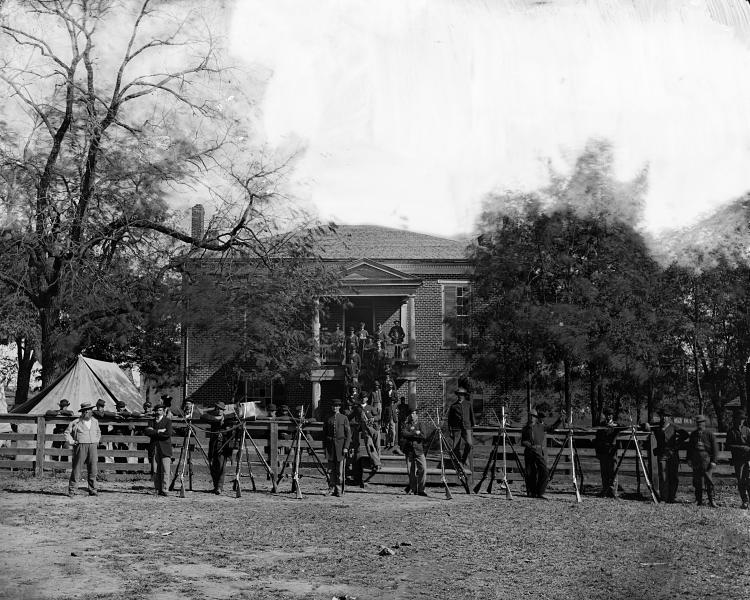
The formal laying down of arms took place on April 12, 1865. Gordon rode at the head of the Confederate infantry, his leg still sore from the wound received 18 days earlier at Fort Stedman. Union General Joshua L. Chamberlain, the hero of Little Round Top, commanded the troops receiving the surrender. As the Confederates approached, Chamberlain ordered his men to shift to “carry arms,” a marching salute of honor. Gordon saw it, wheeled his horse, touched his sword point to his boot and ordered his own men to return the salute. Chamberlain called it “honor answering honor.” Historians still debate the exact details, but the moment became one of the most famous symbols of respect between former enemies.
Senator, Governor and Commander of the Veterans
After the war Gordon became one of the South’s most prominent public men. He served Georgia as a U.S. senator (1873–1880 and 1891–1897) and as governor (1886–1890). His war memoir, Reminiscences of the Civil War, appeared in 1903. He was also the first commander-in-chief of the United Confederate Veterans, holding that post until his death.
Gordon died on January 9, 1904, near Miami, Florida, at age 71, and was buried in Atlanta’s Oakland Cemetery. Former Confederates and Union veterans alike mourned him. His story of courage at the Sunken Road is also told in The Flag They Followed: General John B. Gordon and the 3rd Arkansas.
Frequently Asked Questions
How many times was John B. Gordon wounded at Antietam?
Five times. He was hit twice in the right leg, once in the left arm, once in the shoulder, and finally in the face, which knocked him unconscious.
What was the Sunken Road at Antietam?
It was a worn farm lane at the center of the Confederate line at Antietam on September 17, 1862. The heavy losses there earned it the name “Bloody Lane.”
Did John B. Gordon survive the Civil War?
Yes. Despite being wounded many times, Gordon survived the war, led the Confederate infantry at the Appomattox surrender, and lived until 1904.
What did Theodore Roosevelt say about John B. Gordon?
Roosevelt said, “A more gallant, generous, and fearless gentleman and soldier has not been seen by our country.”
Who surrendered to Joshua Chamberlain at Appomattox?
General John B. Gordon led the Confederate infantry at the formal surrender ceremony on April 12, 1865, where Chamberlain’s troops gave a marching salute and Gordon’s men returned it.
Where is General John B. Gordon buried?
Gordon is buried in Oakland Cemetery in Atlanta, Georgia.
What was Gordon’s role after the war?
He served as a U.S. senator and governor of Georgia and was the first commander-in-chief of the United Confederate Veterans.
Honor General Gordon with a Flag
Remember Gordon and his Georgians with our 2nd Georgia Infantry Cotton Flag, or honor the 6th Alabama and the Raccoon Roughs with the Alabama State Cotton Flag. For the army he served, see the General Lee Headquarters Flag, Made in USA, or browse all of our Rebel Flags.
Thanks for reading. Please share our posts with your friends and family so they too can learn more about Southern Heritage and History.
Brought to you by: Ultimate Flags