

 BUY Rebel Flags For Sale
Generals get the statues and the biographies, but the Confederate armies were made of privates. They marched the miles, dug the trenches and stood in the battle line. One of them, Sam Watkins of the 1st Tennessee Infantry, decided after the war that somebody ought to tell their side of the story. His memoir gave us one of the most defiant lines any Southern soldier ever wrote, aimed straight at General William T. Sherman in the spring of 1864: “You will be a picked chicken before you do that.”
This is the story behind that boast, the man who wrote it, and the campaign that inspired it.
Who Was Sam Watkins?
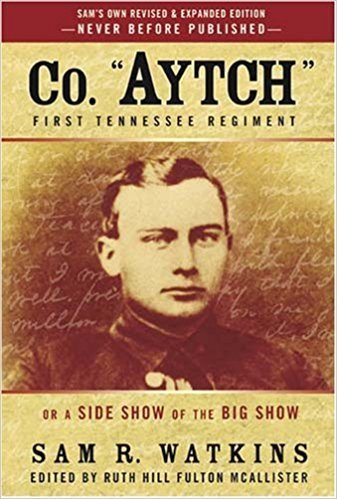
Samuel Rush Watkins was born on June 26, 1839, in Maury County, Tennessee, and studied at Jackson College in Columbia. When Tennessee left the Union in 1861, the 21-year-old joined the Maury Grays, which became Company H of the 1st Tennessee Infantry. He would spell the company’s letter the way it sounded: “Aytch.”
Watkins served from the first year of the war to the last. He marched with the regiment through the mountains of western Virginia under Robert E. Lee and Stonewall Jackson in 1861, then fought in the Western Theater at Shiloh, Perryville, Murfreesboro, Chickamauga, Missionary Ridge, the Atlanta Campaign, Franklin and Nashville. About 120 men served in Company H. When the Army of Tennessee surrendered in North Carolina in April 1865, Watkins was one of only seven of them still in the ranks. According to several accounts, only about 65 men of the whole regiment were left to be paroled.
He went home, married Virginia Mayes, farmed and kept store, and died in Maury County on July 20, 1901. He is buried at Zion Church cemetery near Columbia.
A Memoir Written by a “High Private”
In 1881, with what he called a house full of young “rebels” around his elbows, Watkins began writing down his memories for the Columbia Herald. The pieces were collected in 1882 as “Co. Aytch,” Maury Grays, First Tennessee Regiment; or, A Side Show of the Big Show. A second edition was printed by the Chattanooga Times in 1900.
Watkins was clear about his purpose. The generals and politicians had written their own histories. He wanted to tell about “the fellows who did the shooting and killing, the fortifying and ditching.” He called himself a “high private in the rear ranks of the rebel army” and admitted that a private rarely knew what the generals were planning. His job was to load, shoot, stand picket and march.
That point of view is what makes the book special. Watkins writes about hunger, lice, red tape, homesick boys, comrades he loved and lost, and a long list of practical jokes. He can be funny on one page and heartbreaking on the next. Historians still rank Co. Aytch among the finest memoirs by a common soldier, and Ken Burns quoted it often in his 1990 documentary The Civil War.
Old Joe Johnston Brings the Army Back to Life
The “picked chicken” line came out of one of the most hopeful moments Watkins describes. After the defeat at Missionary Ridge in November 1863, the Army of Tennessee went into winter quarters around Dalton, Georgia. Morale was low and desertion was high.
Then General Joseph E. Johnston took command. Watkins remembered that Johnston issued an amnesty for men absent without leave, increased rations, issued clothing and shoes, and allowed furloughs by rotation. Order returned and the men’s pride came back. Watkins wrote that Johnston “restored the soldier’s pride” and that the men would gladly have died for him. You can read about Watkins’s own struggle to get a pass in Sam Watkins and the Furlough Red Tape at Dalton.
Sherman’s Flank Movements in the Spring of 1864
In early May 1864, Sherman moved south from Chattanooga with roughly 100,000 men against Johnston’s army of about 60,000. Johnston’s men were dug in along Rocky Face Ridge west of Dalton, a position almost impossible to take from the front.
Sherman did not attack it head-on. While two of his armies pressed the ridge at Mill Creek Gap and Dug Gap, General James B. McPherson’s Army of the Tennessee marched south through undefended Snake Creek Gap toward Resaca, the railroad town behind Johnston’s lines. McPherson reached the outskirts of Resaca on May 9 but found Confederates entrenched and pulled back. When Sherman shifted most of his force that way, Johnston evacuated Dalton on the night of May 12 and fell back to Resaca, where the two armies fought on May 14 and 15.
That pattern repeated for weeks. Sherman swung around a flank. Johnston fell back to a new line of earthworks, usually thrown up overnight, and waited for the attack. The two armies were in contact almost every day from Dalton to the Chattahoochee River.

“You Will Be a Picked Chicken Before You Do That”
In the chapter he called “Falling Back,” Watkins captured how the men felt during those first weeks. They were not discouraged by the retreats. They trusted Johnston, and they believed every new line was a chance to hurt Sherman’s army. “The private’s tread is light,” he wrote, “his soul is happy.”
Then Watkins spoke directly to the Yankees, as if shouting across the lines:
“Well, you have come here to fight us; why don’t you come on? We are ready; always ready. Everything is working like clockwork… You say old Joe has got the brains and you have got the men; you are going to flank us out of the Southern Confederacy. That’s your plan, is it? Well, look out; we are going to pick off and decimate your men every day. You will be a picked chicken before you do that.”
A “picked chicken” is a bird stripped of its feathers one at a time. Watkins meant that Sherman’s army would be plucked bare by daily skirmishing and sharpshooting before it ever drove the Confederates out. It is a farm boy’s image, full of swagger and humor, and it says a lot about the confidence Johnston’s men felt in May 1864.
How the Campaign Turned Out
The boast was not empty. On June 27, 1864, at Kennesaw Mountain, Sherman finally attacked head-on. The 1st and 27th Tennessee held a salient called the “Dead Angle,” and Watkins wrote that he fired 120 times that day. The assault failed with heavy Union losses.
But Sherman kept maneuvering, and by July his armies were across the Chattahoochee near Atlanta. On July 17, President Jefferson Davis replaced Johnston with General John Bell Hood, a decision Watkins and many of his comrades bitterly regretted. Hood attacked, and Atlanta fell on September 2, 1864. The private soldiers who had been so confident in May went on to Franklin and Nashville, where the Army of Tennessee was nearly destroyed.
Watkins kept going anyway. He was promoted to corporal after picking up a fallen flag at the Battle of Atlanta, a story told in Sam Watkins Becomes a Corporal. His regiment’s grit during the retreat from Missionary Ridge is covered in “A Minnie Ball Passes Through My Bible.”
Why We Remember the Private Soldier
The Confederate infantryman was usually a farmer or a farmer’s son. He was paid little, fed poorly and outnumbered almost everywhere he fought. Yet men like Sam Watkins stayed in the ranks for four years. Their descendants remember them not for politics but for courage, endurance and loyalty to their comrades and their home states. Watkins dedicated his book to the dead and living men of the Maury Grays and the 1st Tennessee, and his pluck still comes through on every page.

Frequently Asked Questions
What does “you will be a picked chicken” mean?
It means being plucked bare one feather at a time. Sam Watkins used it to say Sherman’s army would be worn down by daily fighting before it could flank Joe Johnston’s Confederates out of Georgia.
Who was Sam Watkins?
Sam Watkins (1839–1901) was a soldier in Company H of the 1st Tennessee Infantry who served the entire war. He wrote the famous 1882 memoir Co. Aytch.
What does “Co. Aytch” mean?
“Aytch” is Watkins’s spelling of the letter H. The title refers to Company H, the Maury Grays, of the 1st Tennessee Regiment.
How many men of Company H survived the war?
Of the roughly 120 men who served in Company H, Watkins was one of only seven still with the company when the Army of Tennessee surrendered in April 1865.
What battles did Sam Watkins fight in?
He fought at Shiloh, Perryville, Murfreesboro, Chickamauga, Missionary Ridge, Resaca, Kennesaw Mountain, Atlanta, Franklin and Nashville, among others. He began the war serving in western Virginia in 1861.
Why did Joseph E. Johnston keep retreating in 1864?
Sherman had a much larger army and kept moving around Johnston’s flanks to threaten his railroad supply line. Johnston fell back to new defensive lines to keep his army intact and make Sherman pay for every advance.
Is Co. Aytch still in print?
Yes. The book is in the public domain and is available in many modern editions, free online texts and audiobooks.
Fly a Flag for the Private Soldier
Honor Sam Watkins and the Maury Grays with our Tennessee State Cotton Flag, or remember the Army of Tennessee’s corps with the Hardee Flag and the Polk Battle Flag. You can also browse all of our Rebel Flags.
Thanks for reading. Please share our posts with your friends and family so they too can learn more about Southern Heritage and History.
Brought to you by: Ultimate Flags