
 BUY Rebel Flags For Sale
In the last weeks of 1862, the Union high command believed Vicksburg, Mississippi, was within its grasp. The “Gibraltar of the Confederacy” sat on high bluffs above the Mississippi River and kept the Confederacy connected to Texas, Arkansas and Louisiana in the Trans-Mississippi. Major General Ulysses S. Grant planned to take it with a two-pronged campaign, and his army depended on a vast supply depot at the little railroad town of Holly Springs. Then, before dawn on December 20, 1862, Major General Earl Van Dorn and some 3,500 Confederate horsemen came thundering into town. By nightfall Grant’s supplies were in flames, and his overland march on Vicksburg was finished. This is the story of the Holly Springs Raid, one of the most successful cavalry strikes of the war.

Grant’s Two-Pronged Plan for Vicksburg
Grant’s plan was straightforward. He would march about 40,000 men south from Tennessee along the Mississippi Central Railroad toward Oxford and Grenada, drawing the Confederate army of Lieutenant General John C. Pemberton away from Vicksburg. At the same time Major General William T. Sherman would carry roughly 32,000 troops down the Mississippi River from Memphis and strike the city from the north, near Chickasaw Bayou.
An army that size needed enormous quantities of food, ammunition, clothing and medicine. Grant made Holly Springs, just south of the Tennessee line, his forward supply base. Warehouses, the railroad depot and even public buildings were packed with stores. The base was guarded by a garrison under Colonel Robert C. Murphy of the 8th Wisconsin Infantry. It was a tempting target, and the Confederates knew it.
Earl Van Dorn: A Cavalryman Born to Raid
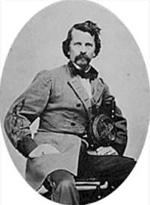
Earl Van Dorn was a Mississippian through and through. He was born on September 17, 1820, near Port Gibson in Claiborne County, and he was a great-nephew of President Andrew Jackson. He graduated from West Point, was wounded in the Mexican War, and was badly wounded again leading U.S. cavalry against the Comanche at the Battle of Wichita Village in October 1858. Few officers in America had more experience in the saddle.
When Mississippi left the Union, Van Dorn followed his home state and resigned his commission. He rose to major general and commanded armies at Pea Ridge and Corinth in 1862, but his greatest gift was as a leader of horsemen: fast, bold and inspiring to the men who rode with him. After Corinth he was placed in charge of Pemberton’s cavalry, and he was eager to prove what mounted troops could do.
The Ride Behind Grant’s Army
The idea for the raid is often credited to Lieutenant Colonel John S. Griffith of the 6th Texas Cavalry, who suggested striking Grant’s supply line. Pemberton approved and gave Van Dorn three brigades of cavalry, about 3,500 men. On December 16 the column rode out of Grenada in cold, wet weather. Rather than head straight north into Grant’s army near Oxford, Van Dorn swung east through Houston, Mississippi, then north to Pontotoc on December 18, past New Albany and on to Ripley, far behind the Union lines.
Federal scouts caught glimpses of the column, but the warnings did not reach the garrison in time to matter. On the evening of December 19 Van Dorn rested his troopers some miles from Holly Springs and divided his force to approach the town by more than one road.
Dawn at Holly Springs, December 20, 1862
Shortly before dawn the Confederates charged into Holly Springs from several directions with the Rebel yell ringing through the streets. Surprise was nearly complete. Many Federal soldiers were still asleep, and Colonel Murphy was captured with most of his command. Accounts of the number of prisoners vary from about 1,500 to more than 2,000. Only a small part of the garrison, including some Union cavalry that cut its way out, escaped.
Van Dorn did not want to slow his column with thousands of captives, so he paroled the prisoners on the spot. His men then spent the rest of the day destroying everything they could not carry: commissary stores, ammunition, medical supplies, clothing, rail cars and the depot itself. Telegraph wires were cut and track was torn up. Van Dorn reported the loss to the enemy at about $1.5 million, while Grant put it closer to $400,000. Whatever the exact figure, the stores Grant’s army needed for its advance were gone.
Van Dorn also showed a gentleman’s courtesy. Grant’s wife, Julia, had been staying in Holly Springs, and Van Dorn gave orders that she was to be protected, not knowing she had left to join her husband at Oxford just before the raid.

Forrest, Chickasaw Bayou and Grant’s Withdrawal
Holly Springs was only half of the blow. In the same weeks, Brigadier General Nathan Bedford Forrest was raiding through West Tennessee, tearing up the railroads and telegraph lines that connected Grant to his supply bases in Kentucky and Tennessee. With his forward depot destroyed and his railroad cut, Grant could not feed his army deep in Mississippi. He called off the overland advance and fell back toward Tennessee.
Because Forrest had cut the telegraph, word of Grant’s retreat did not reach Sherman. Sherman pressed ahead alone, and on December 29, 1862, his assault at Chickasaw Bayou north of Vicksburg was repulsed with heavy losses by Pemberton’s defenders. Sherman withdrew in early January 1863. Between Van Dorn, Forrest and the defenders of Chickasaw Bayou, the first Union campaign against Vicksburg had failed.
The Ride Home and Van Dorn’s Legacy
Van Dorn did not linger. His troopers struck at other Union posts along the railroad, then turned south and reached Grenada again on December 28, having ridden about 500 miles in roughly two weeks. The raid restored Van Dorn’s reputation and is often counted among the most effective cavalry operations of the war. Vicksburg would hold out for another six months.
According to one account, an officer who served under Van Dorn said that riding with him made him feel “as if I could charge hell and capture the devil.” Sadly, the general did not live to see the end of the Vicksburg Campaign. He was killed at his headquarters in Spring Hill, Tennessee, on May 7, 1863, at the age of 42. His men remembered him as one of the most dashing cavalry leaders the South ever produced, and the distinctive Van Dorn battle flag, a red field with a crescent and thirteen stars, still honors the Army of the West he led.
Frequently Asked Questions
What was the Holly Springs Raid?
It was a Confederate cavalry raid on December 20, 1862, in which Major General Earl Van Dorn surprised and destroyed Grant’s supply base at Holly Springs, Mississippi.
Why was the Holly Springs Raid important?
Together with Forrest’s raids in West Tennessee, it cost Grant his supplies and communications and forced him to abandon his first overland campaign against Vicksburg.
How many men did Van Dorn have at Holly Springs?
Van Dorn led about 3,500 cavalrymen in three brigades, riding out of Grenada, Mississippi, on December 16, 1862.
How much in supplies was destroyed at Holly Springs?
Van Dorn estimated about $1.5 million in Union supplies, while Grant put the loss nearer $400,000.
What happened to the Union prisoners at Holly Springs?
Van Dorn paroled them immediately rather than slow his column. Estimates of their number range from about 1,500 to more than 2,000.
How did General Earl Van Dorn die?
Van Dorn was shot and killed at his headquarters in Spring Hill, Tennessee, on May 7, 1863.
Fly the Flags of Van Dorn’s Army
For more on the Confederate cavalry in the Western Theater, read Nathan Bedford Forrest and Streight’s Raid. Honor Van Dorn and the men who rode with him with the Van Dorn Cotton Flag, the Van Dorn Flag 3 x 5 Ft, the Confederate Cavalry Battle Flag or the Army of the Trans-Mississippi Flag.
Thanks for reading. Please share our posts with your friends and family so they too can learn more about Southern Heritage and History.
Brought to you by: Ultimate Flags