
The American Revolution produced plenty of tough frontier fighters, and one of the toughest was a woman. On the Georgia backcountry, where neighbors fought neighbors and no cabin was safe, Nancy Hart became a legend for the day she turned the tables on a band of Tory raiders who barged into her home. Her story has been told for two centuries, and a grim discovery in 1912 suggests there may be more truth in it than legend. Here is what we know about Georgia’s “War Woman.”

Who Was Nancy Hart?
Nancy Morgan Hart was most likely born around 1735 in the Yadkin River valley of North Carolina, though some researchers place her birth later or believe she was born in Pennsylvania. She was a cousin of General Daniel Morgan, the rifleman who would later win the Battle of Cowpens. She married Benjamin Hart, and in the early 1770s the family moved south to the Broad River valley in Georgia, in what was then Wilkes County and is now Elbert County. Nancy and Benjamin raised six sons and two daughters.
Early accounts describe her as tall, rawboned and red-haired, with a face marked by smallpox. One old writer said she had no share of beauty, and she would likely have agreed. What she had instead was grit. Nancy could not read or write, but she was a skilled herbalist, an expert hunter and a crack shot. Many who knew the family said it was Nancy, not Benjamin, who ran the household. Local Native Americans reportedly called her “Wahatche,” which may have meant “war woman.”
Civil War on the Georgia Frontier
To understand Nancy Hart, you have to understand the war she lived through. In the Southern backcountry the Revolution was not just a fight between redcoats and Continentals. It was a brutal civil war between Patriots, called Whigs, and Loyalists, called Tories. After the British captured Savannah in December 1778 and pushed inland toward Augusta, Tory bands roamed the Georgia frontier, raiding farms and hunting Patriot leaders.
The Patriots struck back. On February 14, 1779, militia under Andrew Pickens, John Dooly and Elijah Clarke routed a large Loyalist force at the Battle of Kettle Creek, also in Wilkes County. Some accounts claim Nancy was there. Whether or not she was, her family lived in the middle of this fight.
The Day the Tories Came to Dinner
The most famous story about Nancy Hart is usually set in 1779. Most versions say six Tories came to her cabin; a few say five. They were hunting a Whig leader and demanded to know if she had seen him. He had in fact passed through, but Nancy denied seeing anyone. One of the men shot her prized turkey and ordered her to cook it for them.
Nancy played the gracious hostess. The Tories stacked their muskets in a corner and sat down to eat and drink the wine she served. Meanwhile, she sent her daughter, often named as Sukey, to the spring for water, with secret instructions to blow a conch shell kept nearby to warn the neighbors that Tories were at the house.
As she moved around the table, Nancy quietly slipped the stacked muskets, one by one, through a gap between the logs of the cabin wall to her daughter outside. When the Tories finally noticed, she had a musket leveled at them and warned that she would shoot the first man who moved. One man lunged toward her anyway, and she shot him. According to most accounts she shot a second man as well, then held the rest at gunpoint until Benjamin and the neighbors arrived.
Benjamin wanted to shoot the prisoners. Nancy insisted that shooting was too good for them, and the surviving Tories were hanged from a nearby tree.
Legend or History?
Like many frontier tales, the Nancy Hart story was passed down by word of mouth before anyone wrote it down. Historians point out that there is little contemporary documentation. A version of the story appeared in a Georgia newspaper in 1825, while Nancy was still alive, and a niece of her son John recorded family stories in an 1872 letter. Other tales, such as Nancy throwing boiling lye in the eyes of a spy or dressing as a man to slip into Tory camps, are best treated as folklore.
Then, in 1912, workers grading the Elberton and Eastern Railroad near the old Hart cabin site unearthed a row of five or six skeletons, buried about three feet down. Some reportedly had broken necks, and they were judged to have been in the ground for at least a century. For many Georgians, that settled the question.
Nancy Hart After the Revolution
After the war Nancy joined the Methodist church. The Harts moved to Brunswick on the Georgia coast, where Benjamin died. Nancy later lived with her son John near Athens, and around 1803 she moved with his family to Henderson County, Kentucky. She died there in 1830 and was buried in the Hart family cemetery outside Henderson.
How Georgia Remembers Nancy Hart
Georgia never forgot her. Hart County and its county seat of Hartwell are named for her, as are Lake Hartwell, Hartwell Dam, Hart State Park and the Nancy Hart Highway (Georgia Route 77). A reconstructed log cabin stands at the Nancy Hart Historic Park in Elbert County. During the Civil War, the women of LaGrange, Georgia, formed a militia company to defend their town and called themselves the Nancy Harts. In 1997 she was inducted into Georgia Women of Achievement.
Frequently Asked Questions
Who was Nancy Hart?
Nancy Hart was a Georgia frontier woman and Patriot during the American Revolution, famous for capturing a band of Tory raiders in her cabin around 1779.
Is the Nancy Hart story true?
The story was passed down orally and has little contemporary documentation, so details vary. The discovery of five or six skeletons near her cabin site in 1912 suggests it has a basis in fact.
What is Nancy Hart’s nickname?
She was known as the “War Woman.” Local Native Americans reportedly called her “Wahatche,” which may have meant war woman.
Where did Nancy Hart live?
She lived near the Broad River in what is now Elbert County, Georgia. Later in life she moved to Henderson County, Kentucky, where she died in 1830.
What is named after Nancy Hart?
Hart County, Georgia, the city of Hartwell, Lake Hartwell, Hart State Park and Georgia’s Nancy Hart Highway are all named in her honor.
Was Nancy Hart related to Daniel Morgan?
Yes. Nancy Morgan Hart was a cousin of General Daniel Morgan, the Patriot commander who won the Battle of Cowpens in 1781.
Honor the Patriots of 1776
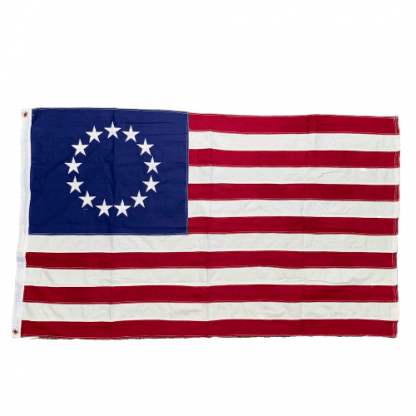
Nancy Hart is one of many brave women of the Revolution. Read about others in Heroine of the Battle of Cowpens: Catherine Moore Barry and Teenage Heroine: Emily Geiger. Then fly the spirit of 1776 with our Betsy Ross 13 Star Flag, made in USA, the Culpeper Minutemen Liberty or Death Flag or the Sons of Liberty Flag.
Thanks for reading! We hope you enjoyed our post. Please share with all your fellow patriots. Brought to you by: Ultimate Flags