
Whether you call it Old Glory, the Stars and Stripes or the Star-Spangled Banner, the American flag is our most cherished national symbol. Many Americans fly it proudly from their porches, but fewer know that Congress has written down how the flag should be displayed and respected. These guidelines, known as the U.S. Flag Code, were first drawn up at the National Flag Conferences of 1923 and 1924, passed by Congress in 1942 and are found today in Title 4 of the United States Code. Here are nine Flag Code rules that many well-meaning patriots don’t follow, and how to get them right.
One note before we begin: the Flag Code is a set of guidelines for respectful display. It does not set penalties for private citizens, and the Supreme Court has ruled that the First Amendment protects expression involving the flag. Following the Code is a matter of respect, not fear of a fine.
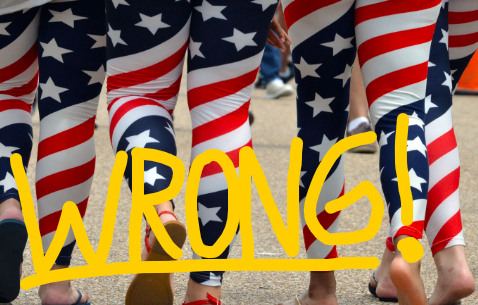
1. The Flag Should Not Be Worn as Clothing
Those red, white and blue flip-flops may be fun on the Fourth of July, but the Flag Code says the flag “should never be used as wearing apparel, bedding, or drapery,” and no part of the flag should be used as a costume or athletic uniform. A flag patch is a different matter. The Code specifically allows a flag patch on the uniforms of military personnel, firefighters, police officers and members of patriotic organizations.
Clothing with a patriotic red, white and blue design that is not an actual flag is a gray area, and most people treat it as a matter of good taste. The safest way to show your colors is to fly a real flag.
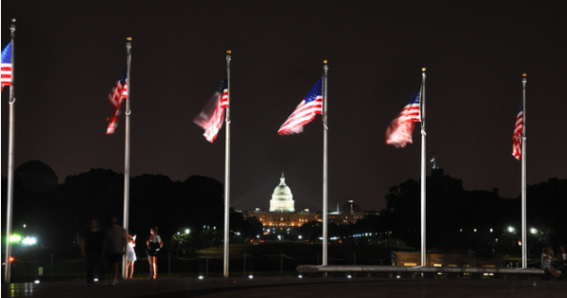
2. Fly It From Sunrise to Sunset, or Light It at Night
Francis Scott Key needed “the dawn’s early light” to see the flag still flying over Fort McHenry in September 1814, and the Flag Code still reflects that idea. The custom is to display the flag only from sunrise to sunset. You may fly it 24 hours a day when a patriotic effect is desired, but only if it is properly illuminated during the hours of darkness. A small spotlight or solar flagpole light aimed at the flag does the job.
The Code also says the flag should not be flown in inclement weather unless it is an all-weather flag. Most modern nylon and polyester flags are made for outdoor use.
3. Hang It the Right Way, and Never Upside Down
When the flag hangs flat against a wall or in a window, horizontally or vertically, the union (the blue field of stars) should be at the top and to the flag’s own right, which is the observer’s left. In a window, it should look the same to people outside on the street.
The flag should never be displayed with the union down except as a signal of dire distress in instances of extreme danger to life or property. Flying it upside down to make a point is not what the Code intends.
4. A Flag That Touches the Ground Doesn’t Have to Be Destroyed
The Code says the flag should never touch anything beneath it, such as the ground, the floor or water, so take care when raising and lowering it. But a common myth says a flag that touches the ground must be burned. That is not in the Code. Simply pick it up, clean it if necessary and keep flying it.
What the Code does say is that when a flag is so worn, faded or torn that it is no longer a fitting emblem for display, it should be destroyed in a dignified way, preferably by burning. Many American Legion posts, VFW posts and Scout troops hold flag retirement ceremonies and will accept worn flags.
5. The Stars and Stripes Flies Highest, Except With Other Nations
When the U.S. flag is flown with state, city or organizational flags, it should be at the center and the highest point of the group, or to the right of the other flags. No other flag should be placed above it on the same staff, with narrow exceptions such as the church pennant during naval services at sea.
Flags of other nations are different. In time of peace, international custom forbids displaying one nation’s flag above another’s, so the flags of two or more nations should be flown from separate staffs of the same height and should be about the same size.
6. Hand Over Heart and Hats Off for the Pledge
The Pledge of Allegiance was written by Francis Bellamy in 1892 for schoolchildren celebrating the 400th anniversary of Columbus’s voyage, and the words “under God” were added in 1954. The Flag Code says it should be recited standing at attention, facing the flag, with the right hand over the heart. Men not in uniform should remove any non-religious headdress with the right hand and hold it at the left shoulder, with the hand over the heart. People in uniform should face the flag, remain silent and give the military salute.
Since 2008, the Code has also allowed veterans and members of the armed forces who are not in uniform to give the military salute when the flag is raised, lowered or passes by.
7. Know When to Fly at Half-Staff
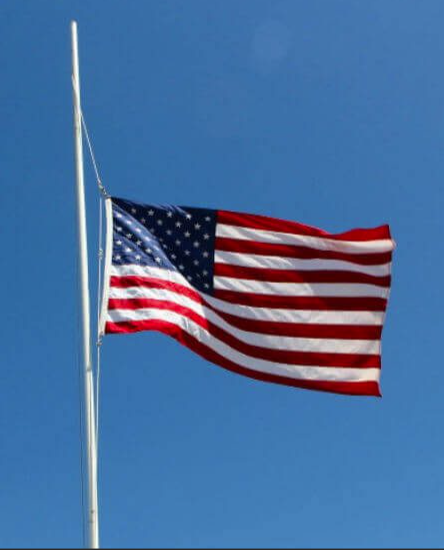
Flying the flag at half-staff (the term on land; “half-mast” is the nautical term) is a sign of national mourning. When flying at half-staff, the flag should first be raised briskly to the peak for an instant and then lowered to the half-staff position, and raised to the peak again before it is lowered for the day.
- Memorial Day: half-staff until noon only, then raised to the top of the staff.
- Peace Officers Memorial Day (May 15): half-staff, unless that day is also Armed Forces Day.
- Patriot Day (September 11) and National Pearl Harbor Remembrance Day (December 7): half-staff under federal law.
- Deaths of national leaders: 30 days for a President or former President, and 10 days for a Vice President, the Chief Justice or the Speaker of the House.
- By proclamation: the President, and state governors for state officials and members of the armed forces from their state, may order the flag lowered on other occasions.
8. Nothing Should Be Written or Drawn on the Flag
The Code says the flag should never have placed on it, or attached to it, any mark, insignia, letter, word, figure, design, picture or drawing. It also should not be printed on paper napkins, boxes or other items meant to be used for a moment and thrown away, and it should not be used for advertising.
If you want red, white and blue decorations for a parade or a porch railing, the Code suggests bunting with blue on top, then white, then red, instead of draping or tying up the flag itself.
9. The Flag Is a Flag, Not a Tablecloth
The flag should never be used to cover a ceiling, as a curtain, or as a receptacle for receiving, holding, carrying or delivering anything. It should never be festooned, drawn back or tied up in folds, but always allowed to fall free. The only time it should cover anything is a casket, with the union at the head and over the left shoulder; it should not be lowered into the grave.
A flag presented at a military funeral or flown over the U.S. Capitol is usually folded into the traditional triangle. Many families keep these flags folded in a wooden triangular display case, a respectful way to honor a loved one’s service.
Frequently Asked Questions
Is it illegal to fly the American flag at night?
No. The Flag Code says you may fly the flag 24 hours a day if it is properly illuminated during the hours of darkness, and the Code carries no penalties for private citizens.
Is it disrespectful to wear the American flag?
The Flag Code says the flag should not be used as wearing apparel or a costume, though flag patches are allowed on the uniforms of military, police, firefighters and patriotic organizations.
Do you have to burn a flag if it touches the ground?
No. The flag should not touch the ground, but if it does, simply pick it up and clean it if needed. Only worn-out flags should be retired, preferably by burning in a dignified ceremony.
When should the American flag be flown at half-staff?
On Memorial Day until noon, on Peace Officers Memorial Day, Patriot Day and Pearl Harbor Remembrance Day, after the deaths of certain national leaders, and whenever the President or a governor orders it.
What is the correct way to hang an American flag vertically?
Hang it so the union of stars is at the top and on the observer’s left, whether it is on a wall or in a window facing the street.
Can the American flag be flown with other countries’ flags?
Yes. In peacetime, each nation’s flag should fly on its own staff at the same height, and the flags should be about the same size.
What is the U.S. Flag Code?
The Flag Code is a set of federal guidelines in Title 4 of the U.S. Code describing how to display and respect the American flag, adopted by Congress in 1942.
Fly Your Flag With Pride
Following the Flag Code is one of the simplest ways to honor the men and women who have served under the Stars and Stripes. For more tips, see our guide on How to Display the American Flag and the Days to Fly It, and read about The History of Veterans Day. When your flag starts to show its age, replace it with a new one from our 50 Star USA Flags collection, such as the 50 Star USA Flag 3 x 5 Ft Outdoor or the USA 250 American Flag.
Thanks for reading! We hope you enjoyed our post. Please share with all your fellow patriots. Brought to you by: Ultimate Flags