

 BUY Rebel Flags For Sale
Long before the word “sniper” became common, the marksmen of the War Between the States were already doing the job. Riflemen on both sides learned to judge distance, hide in trees and rifle pits, and pick off officers and artillery crews from hundreds of yards away. Northern newspapers made heroes of Hiram Berdan’s green-coated Federals, but the Confederacy fielded sharpshooters every bit as skilled, men who often fought with scarce, costly imported rifles and made every shot count. This is the story of how sharpshooting North and South laid the foundation for modern military sniping.

A War Fought With Old Tactics and New Rifles
When the war began in 1861, most generals still thought in the terms of Napoleon’s day: long lines of infantry trading volleys at close range, with little real aiming. Yet the weapons had changed. The rifle-musket, with its spinning Minie ball, could hit a man-sized target at several hundred yards. On the Union side the standard arms were the Springfield Model 1855 and Model 1861. Southern soldiers carried a mix of arms, including copies of the Springfield made at Richmond and Fayetteville and, above all, the British Pattern 1853 Enfield in .577 caliber, which Confederate agents bought by the hundreds of thousands from private makers in Britain and Europe.
A good rifle was only half the equation. As the British had learned in the Crimea, a long-range weapon did little good in the hands of a man who had never been taught to estimate distance or adjust his sights. The armies that trained true marksmen gained a deadly edge.
Berdan’s Sharpshooters: The Union’s Green Coats
The best-known marksmen of the war were raised by Hiram Berdan, a New York inventor and one of the finest rifle shots in the country before the war. In 1861 he organized the 1st and 2nd U.S. Sharpshooters, drawing companies of volunteers from several Northern states.
Getting in was not easy. A recruit had to fire ten consecutive shots at 200 yards, and the average distance of his hits from the center could be no more than five inches. Those who passed were trained in range estimation, observation and concealment, skills that look a great deal like modern sniper school.
Berdan’s men wore green coats and trousers instead of Union blue, an early form of camouflage. At first they were issued Colt revolving rifles, which the men disliked. Berdan wanted the Sharps New Model 1859, a .52-caliber breechloader with double-set triggers that could be loaded lying down. The Army’s chief of ordnance objected to the cost, but after President Lincoln took an interest the Sharps rifles were issued in May 1862. Some volunteers also brought heavy, privately owned target rifles fitted with long telescopic sights.
The green coats served in nearly every major battle in the East, from Yorktown and the Seven Days to Gettysburg and Petersburg, until the two regiments were consolidated and mustered out at the end of 1864. One of their most famous characters, Truman “California Joe” Head, made a name for himself during the siege of Yorktown in the spring of 1862 by picking off the crew of a Confederate gun.
Southern Sharpshooters: Skill Without Plenty
It has often been claimed that the South could not match the North’s marksmen. That idea does not hold up. Southern boys grew up hunting, and many could shoot well before they ever put on a uniform. What held the Confederacy back early in the war was a shortage of good rifles and of organized training, not a shortage of talent.
As the war went on, commanders in the Army of Northern Virginia began picking their best shots and forming them into special units. Robert Rodes’s division was among the first to do so, and by the winter of 1863 to 1864 sharpshooter battalions had been organized across Lee’s army. Each brigade selected its steadiest marksmen, trained them hard in judging distance, and sent them out ahead of the main line as skirmishers, scouts and pickets. Historian Fred L. Ray called them the “shock troops of the Confederacy.”
Major William S. Dunlop, who commanded the sharpshooters of McGowan’s South Carolina Brigade, later described their work in his 1899 book Lee’s Sharpshooters; or, The Forefront of Battle. His men tested their rifles at known distances and drilled constantly at estimating range, and according to his account the Enfield proved effective well beyond the ranges at which ordinary infantry fought. These battalions fought in rifle pits in front of the army, covered retreats, and led attacks, and by 1864 they were some of the most experienced soldiers in Lee’s ranks.
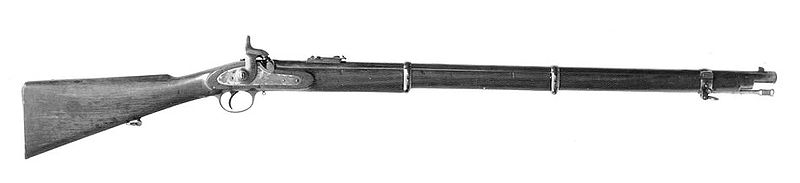
The Whitworth Rifle: The Confederacy’s Long-Range Weapon
The most famous Southern sharpshooting weapon was the English Whitworth rifle, designed by Sir Joseph Whitworth. Instead of ordinary grooves, its barrel had a twisted hexagonal bore that fired a matching six-sided .451-caliber bullet. In British trials in the 1850s it far outshot the Enfield at long range. It was also expensive and hard to keep clean, so Britain never adopted it as a standard arm.
The Confederacy ran the blockade to buy what it could. Estimates of how many Whitworths reached Southern hands vary widely, from about one hundred to several hundred, and some were fitted with telescopic sights. They were given to the very best shots in a brigade or division, often alongside the similar English Kerr rifle. These “Whitworth sharpshooters” were frequently assigned to silence Federal artillery crews, and in the Western Theater the Whitworth men of Patrick Cleburne’s division earned a fearsome reputation. During fighting near Dalton, Georgia, in February 1864, a small body of Confederate sharpshooters, many of them armed with Whitworths, helped turn back a Federal advance.
The Death of General John Sedgwick
The most famous sharpshooter’s shot of the war came on May 9, 1864, at the Battle of Spotsylvania Court House. Union Major General John Sedgwick, commander of the Federal Sixth Corps, was walking his lines when he saw men ducking from Confederate bullets. He chided them, saying the enemy “couldn’t hit an elephant at this distance.” Moments later a bullet struck him below the left eye, and he died almost instantly.
The shot is usually estimated at somewhere between 800 and 1,000 yards. Who fired it has never been settled. Ben Powell of the 12th South Carolina is often credited, though some historians believe his target was a different mounted general. Other veterans named Thomas Burgess of the 15th South Carolina. What is certain is that a Confederate marksman killed one of the highest-ranking Union officers to fall in the war.
The Legacy of Civil War Sharpshooting
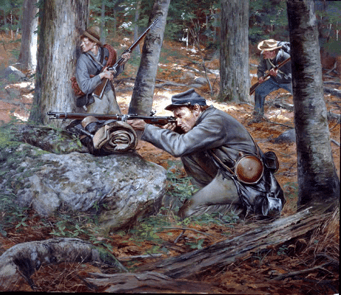
Sharpshooters on both sides changed the way soldiers lived and fought. Officers learned to remove their insignia and keep their heads down, and men in the trenches at Petersburg and Atlanta knew that showing themselves for even a moment could be fatal. The tactics these marksmen pioneered, including careful range estimation, concealment, working in pairs, and targeting leaders and gun crews, became the basis of modern sniper doctrine. The Southern sharpshooter battalions, in particular, showed how a small number of well-trained riflemen could shape a battle far out of proportion to their numbers.
Frequently Asked Questions
Did the Civil War have snipers?
Yes, although they were called sharpshooters at the time. Both armies used specially selected marksmen to shoot officers, artillery crews and enemy skirmishers at long range.
Who were Berdan’s Sharpshooters?
They were the 1st and 2nd U.S. Sharpshooters, two Union regiments raised by Hiram Berdan in 1861. They were known for their strict marksmanship test, green uniforms and Sharps breech-loading rifles.
What rifle did Confederate sharpshooters use?
Most used the British Pattern 1853 Enfield rifle-musket. The very best shots were given the rare and costly English Whitworth rifle, and some carried the Kerr rifle.
How far could a Whitworth rifle shoot?
In British trials in the 1850s the Whitworth hit targets at far greater distances than the Enfield, and Civil War marksmen used it for shots of 800 yards and more. Its accuracy came from its hexagonal bore and bullet.
Who shot General Sedgwick?
No one knows for certain. Sedgwick was killed by a Confederate sharpshooter at Spotsylvania on May 9, 1864, and both Ben Powell of the 12th South Carolina and Thomas Burgess of the 15th South Carolina have been credited.
What were Confederate sharpshooter battalions?
They were units of hand-picked marksmen formed within the brigades of Lee’s army and other Southern armies. They served as skirmishers, scouts and pickets in front of the main battle line.
Honor the Marksmen of the Confederacy
The sharpshooters who fought in front of the battle lines were some of the bravest and most skilled soldiers of the war. Read more of their story in Civil War Sharpshooters and Fort Sumter to Appomattox Courthouse: The Story of a Confederate Sharpshooter. You can honor the men of Lee’s army with our Confederate Infantry Battle Flag, the South Carolina Battle Flag, or the General Lee Headquarters Flag.
Thanks for reading. Please share our posts with your friends and family so they too can learn more about Southern Heritage and History.
Brought to you by: Ultimate Flags