
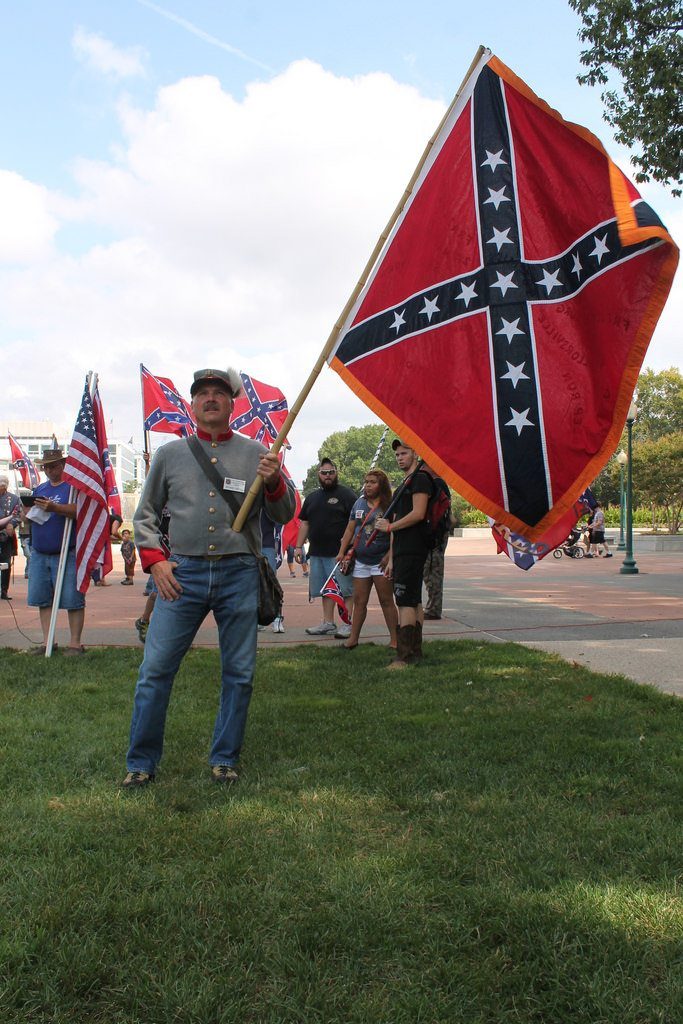
 BUY Rebel Flags For Sale
Two paintings now on display at the Gettysburg National Military Park offer a vivid depiction of two unique perspectives of the Civil War. “The Armed Slave” depicts a slave reading a book with a cigar in hand and a bayonet-equipped musket close by, ready to spring to action in John Brown’s failed slave uprising of 1859. “The Old Veteran” depicts an aged man with a cane amidst a handsome memorial admiring a portrait of Ulysses S. Grant, his former supreme commander. Both were painted by Civil War veteran and artist William Spang of Pennsylvania after his service.
A Soldier Who Painted What He Lived Through
Spang was not a studio artist looking back on a war he had read about. He was a veteran who had seen it firsthand, and that gives both canvases a weight that later paintings often lack. Hung side by side, they show the war at its two ends: the tension that led up to it, and the long memory that followed it.
“The Armed Slave” and the Road to War
The first painting reaches back to October 1859, when John Brown and a small band of followers seized the federal armory at Harpers Ferry, Virginia. Brown hoped enslaved people would rise up and join him, and he planned to arm them with the rifles stored there. The uprising never came. Within about a day and a half, U.S. Marines under Colonel Robert E. Lee stormed the engine house where Brown had barricaded himself. Brown was tried for treason against Virginia and hanged that December.
To the North, Brown became a martyr. To the South, the raid proved that outsiders were willing to stir up violence on Southern soil. Many historians count Harpers Ferry as one of the sparks that made war almost certain within two years. Spang’s painting captures that charged moment: a man who is reading and calm, with a weapon close at hand.
“The Old Veteran” and the Years of Memory
The second painting moves forward decades. An aging soldier with a cane stands before a memorial and a portrait of Ulysses S. Grant, who rose to command all Union armies and later served as president. In the years after the war, veterans on both sides built monuments, held reunions and returned to the fields where they had fought. Gettysburg itself became one of the most visited of those places, and its monuments still draw families from the North and the South.
Seeing the Paintings
Both works were placed on display by the Gettysburg National Military Park museum staff. If you are planning a visit to the battlefield, check with the park’s Museum and Visitor Center for current exhibits.
Remember the men who fought at Gettysburg with flags from our Confederate flag collection.
Source: Side by Side: Two Civil War Paintings (Gettysburg National Military Park blog)
Thanks for reading. Please share our posts with your friends and family so they too can learn more about Southern Heritage and History.
Brought to you by: Ultimate Flags